Well, hello, 2019. I have been a terrible writer. I was in the US for the end of December and all of January, and even though I took with me a backlog of museum visits to work on while I was there, it obviously never happened because a good 97% of my focus at home is devoted to getting tacos. Thank you for your understanding.
So now I’m home, and also sick, which is a great condition for acclimating to the change in time zone, but whatever, my point is I have time. So–
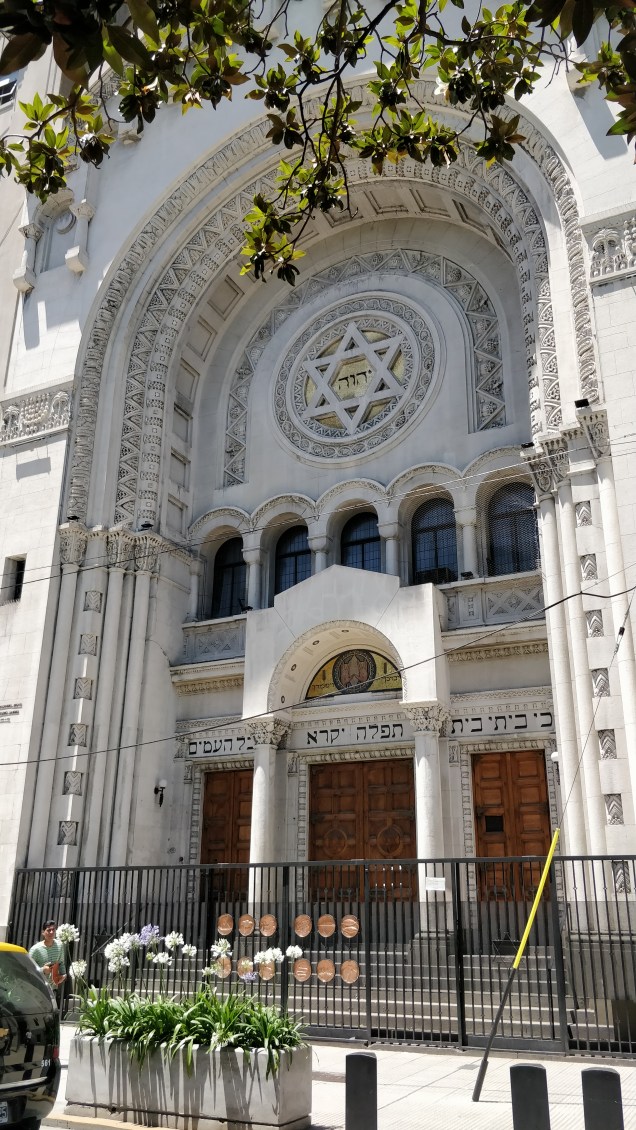
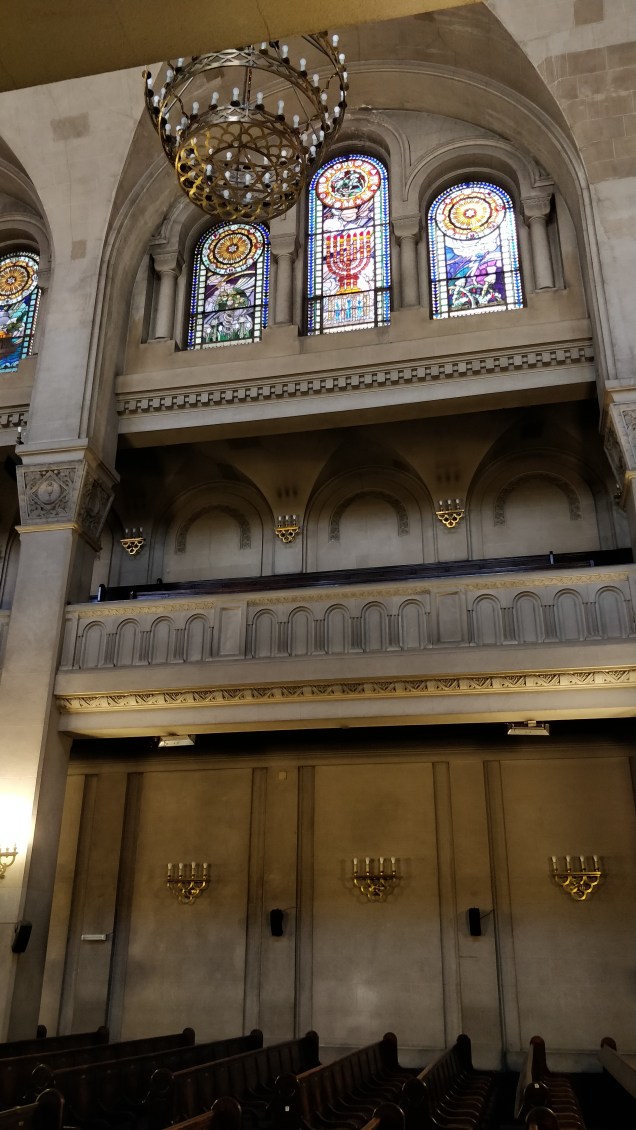
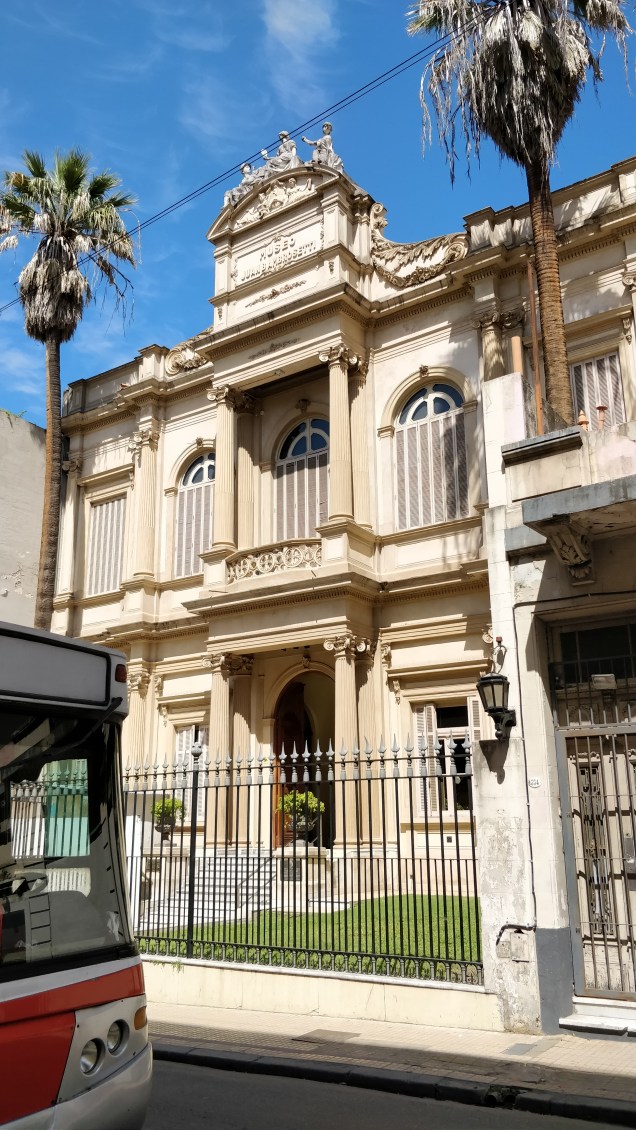
This is the Museo Judío de Buenos Aires, and if you’re thinking that’s a bit unassuming and you might miss it, don’t worry, because this is the temple next door:
You are not going to miss it.
The museum is connected to the Templo Libertad, the central synagogue of Buenos Aires. It faces the same stretch of squares as the Teatro Colón and the Supreme Court building. I’ll touch on the history of Jewish Argentines lightly as I go here, but Argentina has the largest Jewish population in Latin America, and their history is, of course, extensive.
Visitors to the museum will encounter first a heavy, locked door, and they must be buzzed into the antechamber. Visitors are at this point required to show identification to the doorman, who sits behind a shield. After that, the doorman is able to buzz visitors through the next heavy, locked door. You will find extra security precautions at many Jewish schools and synagogues in the city; 1992 and 1994 saw two major terrorist attacks against the Jewish community (the Israeli Embassy and the Jewish Community Center [AMIA], respectively). They are accustomed to foreign visitors, and passports are welcome forms of identification.
Inside, you will find a warm and welcoming staff. The signage is in Spanish, although an audioguide is available in multiple languages for download on smartphones, so bring some headphones. It does not appear that the guide is linked on the museum’s website, so it requires Internet access within the building or a local data plan. I hope they consider linking it in the main website so it can be downloaded prior to visiting. I also hope they expand the content someday, as it is on the lean side, but nevertheless a pleasant way to tour the museum.
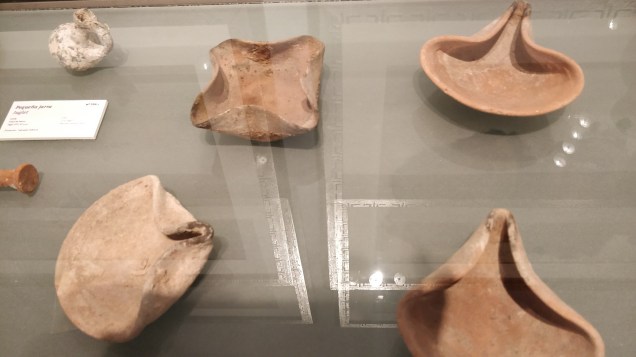
The museum’s collection is entirely donated, and it includes ancient artifacts:
Bronze Age oil lamps made of clay
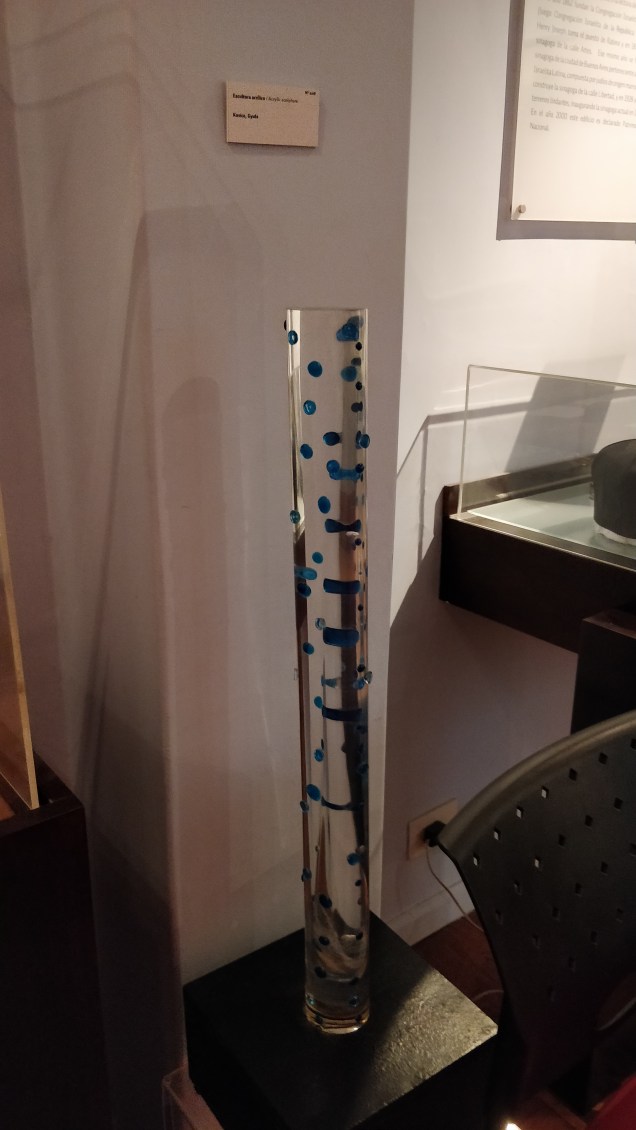
As well as a few contemporary art pieces here and there:
…which is a nice touch, a reminder of the museum’s place within a community that is both ancient and living.
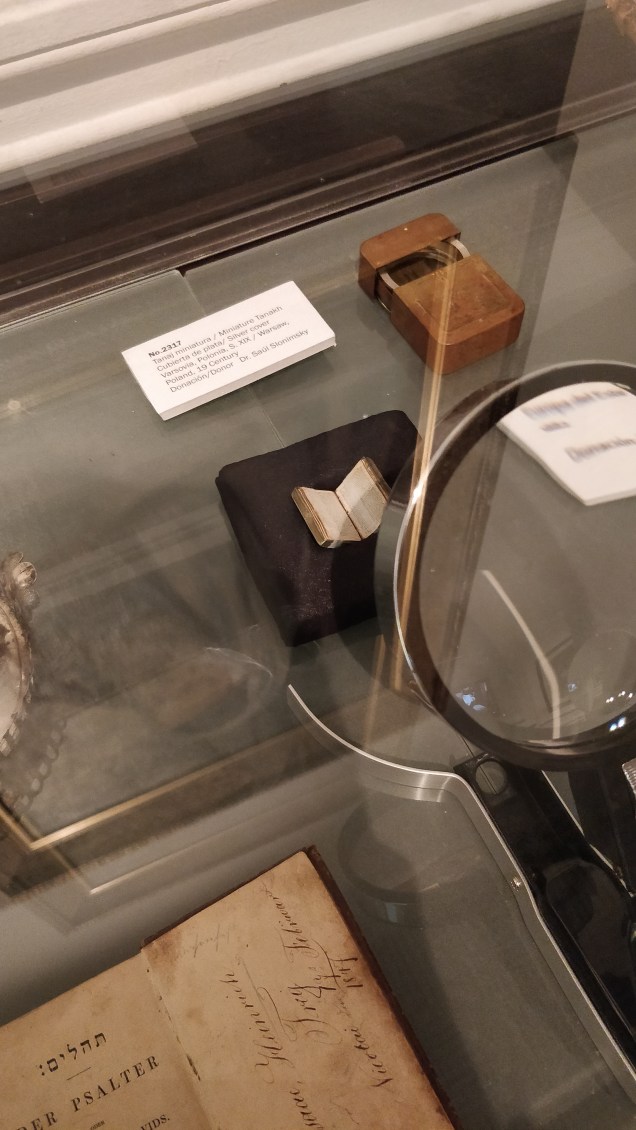
Most of the items are from the 19th and 20th centuries. This is a 19th century Polish Tanahk (Hebrew Bible) in miniature that could be hidden on one’s person as necessary.
There are other religious texts and cases:
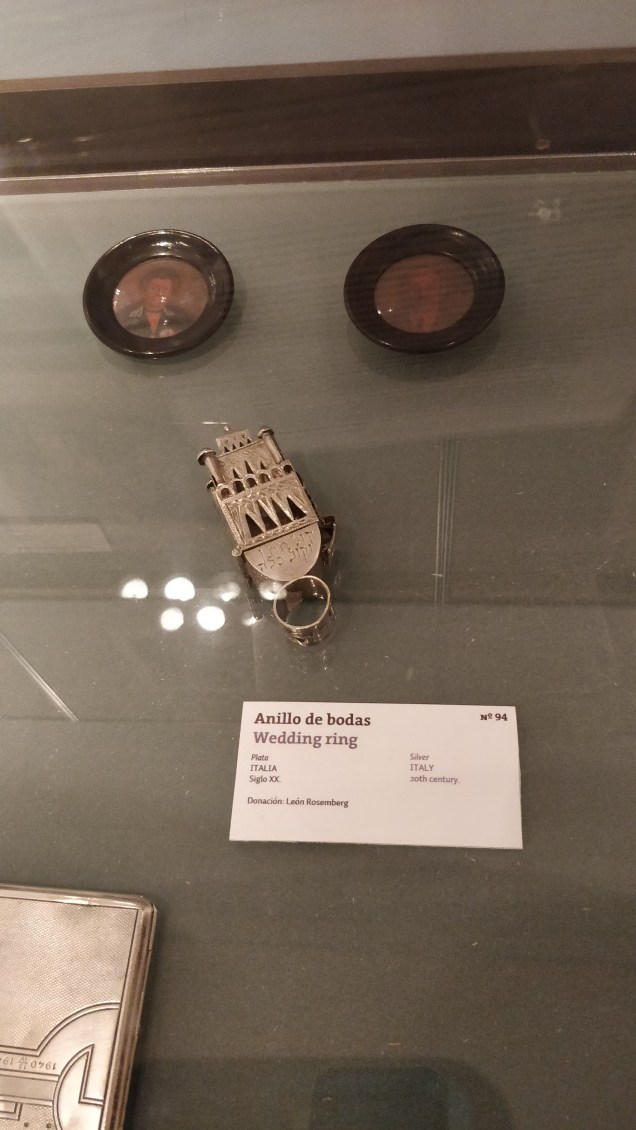
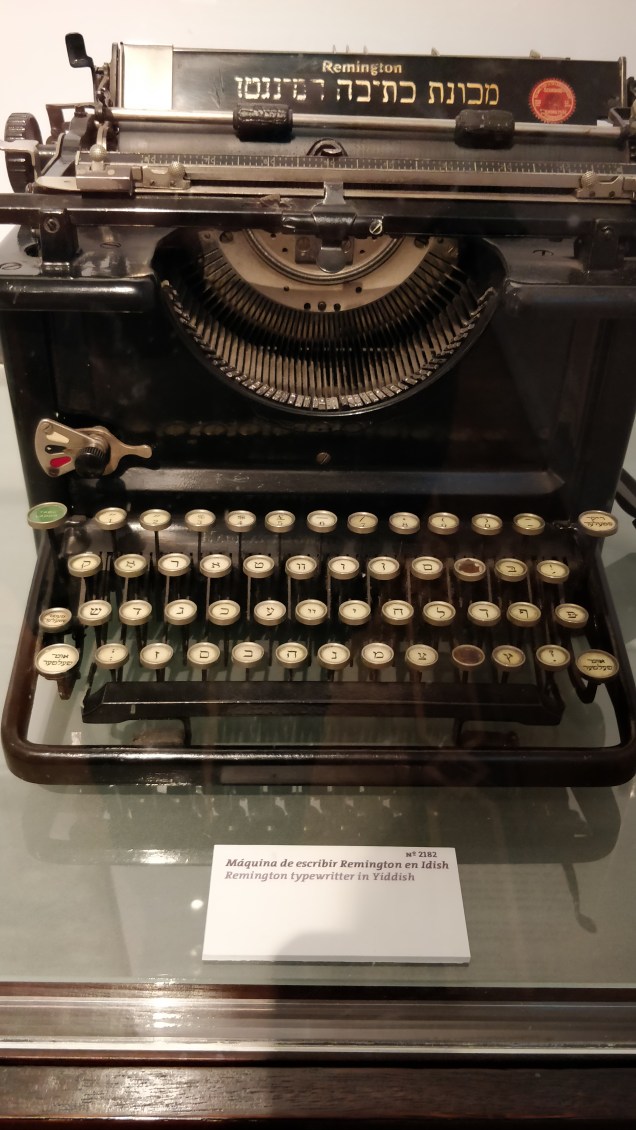
…as well as items related to Jewish life from all over the world:
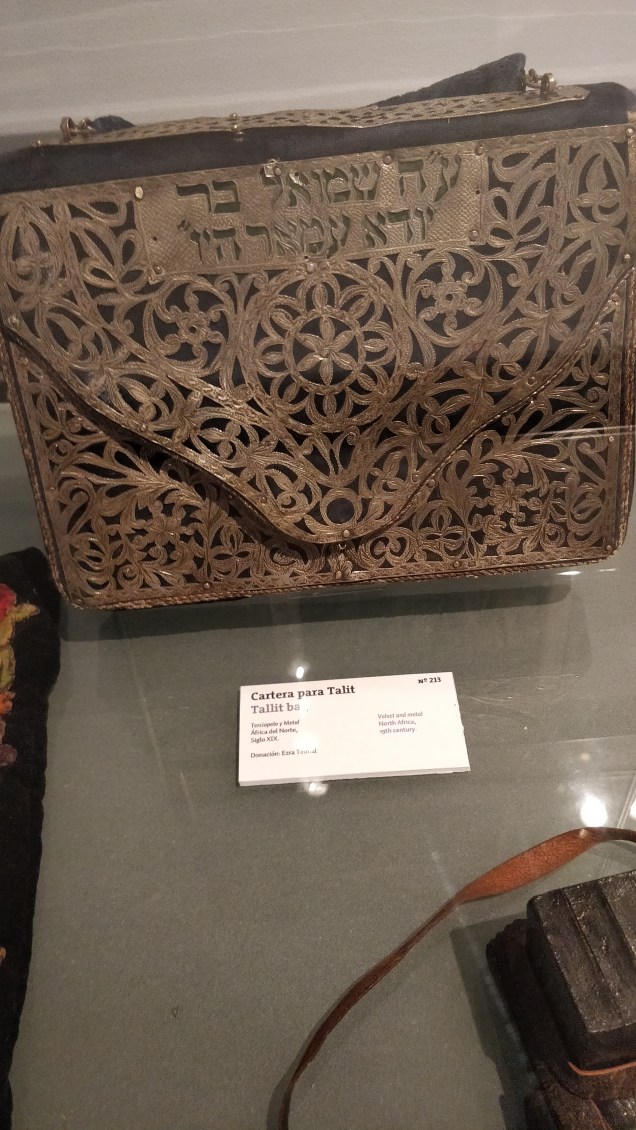
“Tallit Bag”–the glare is obscuring the label there.
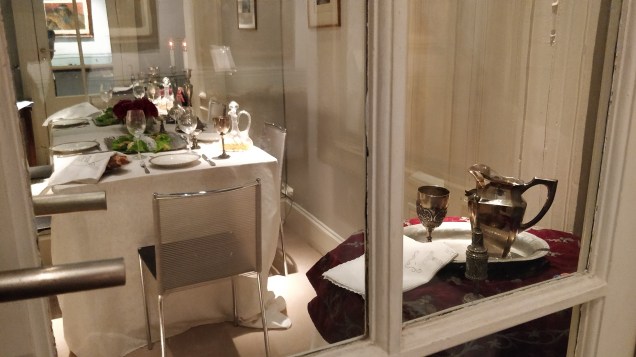
An example of a table set for Passover
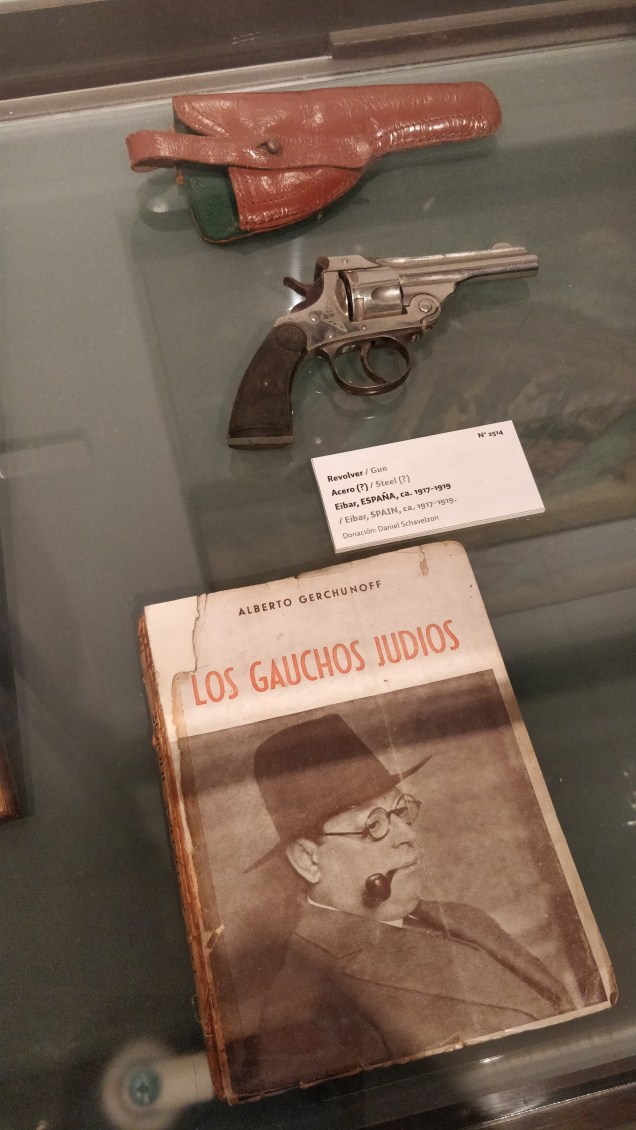
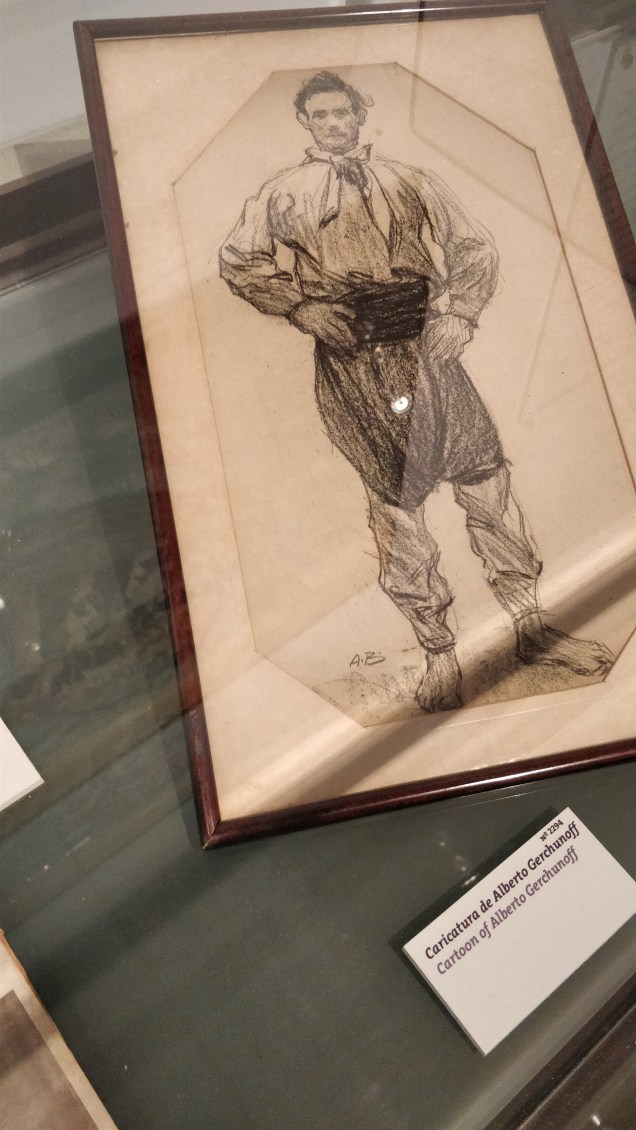
In the late 1800s-early 1900s, there was a large number of Jewish immigrants from Russia and Eastern Europe, escaping violence and attracted by Argentina’s liberal immigration policy. Thousands settled into agricultural life, and Jewish gauchos became a thing.
Alberto Gerchunoff emigrated to an Argentine Jewish agriculture colony as a small child from what is now Ukraine, and later became a writer, although gaucho seemed to be a better look on him.
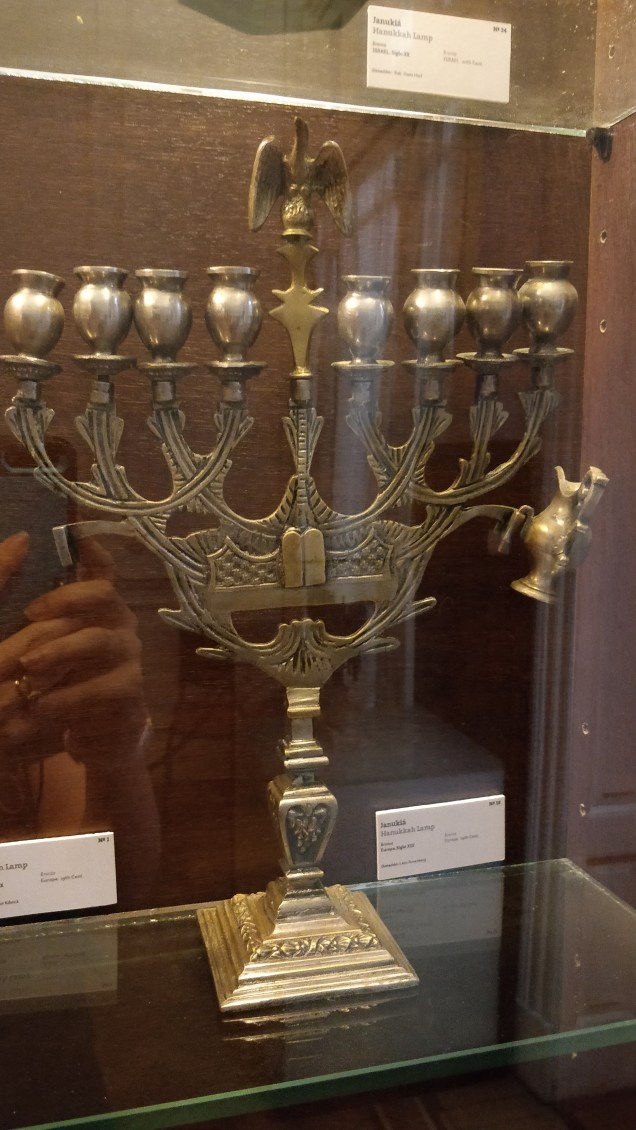
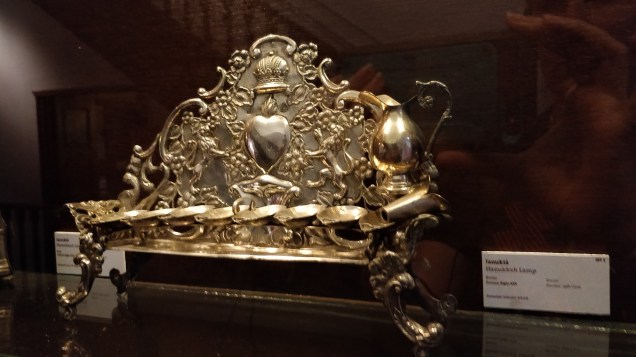
My favorite part was the Menorah collection!
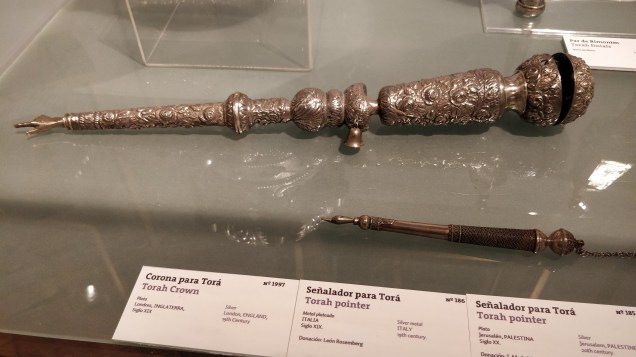
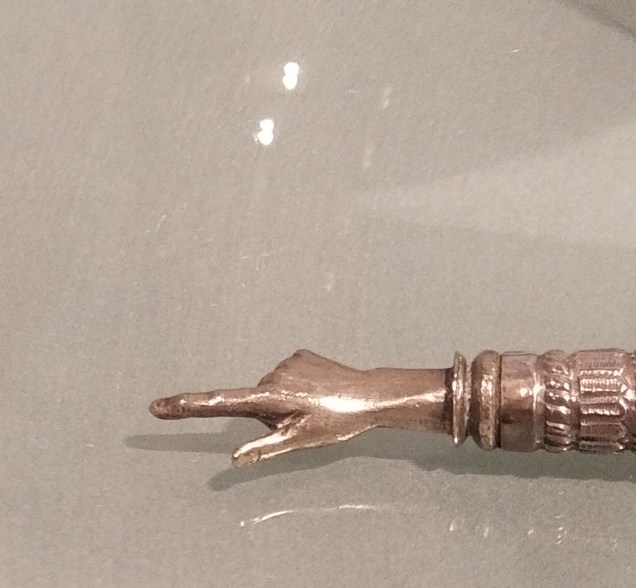
Also the Torah pointer, which is just a really practical design.
YOU ARE HERE
Visitors can also see the temple itself, which is very impressive, and hosts an active congregation.
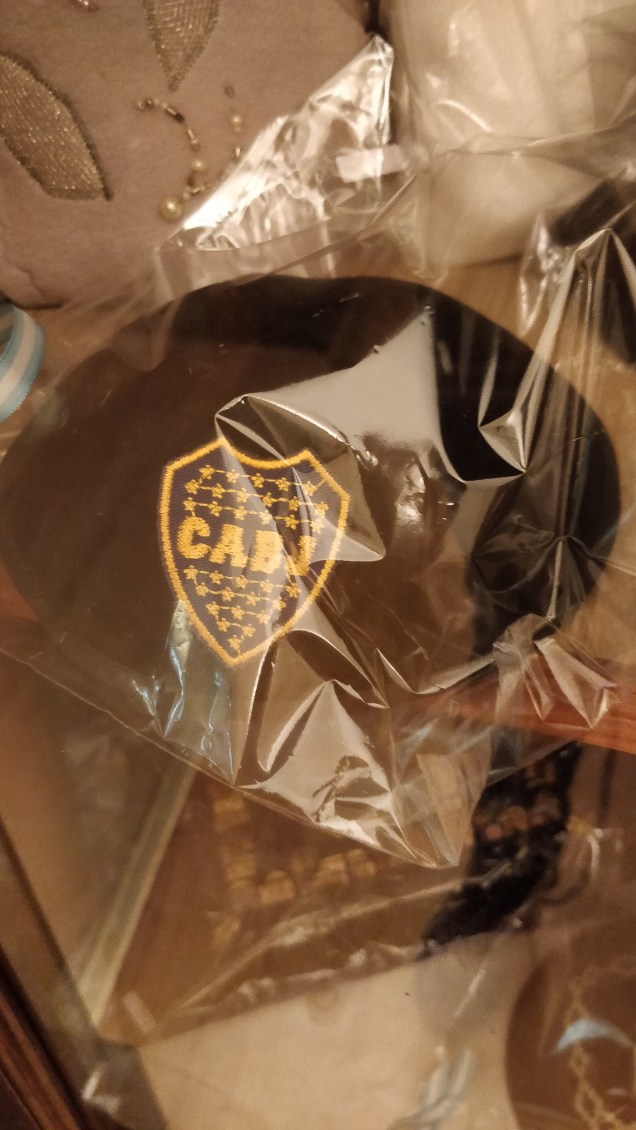
The museum has a small gift shop.
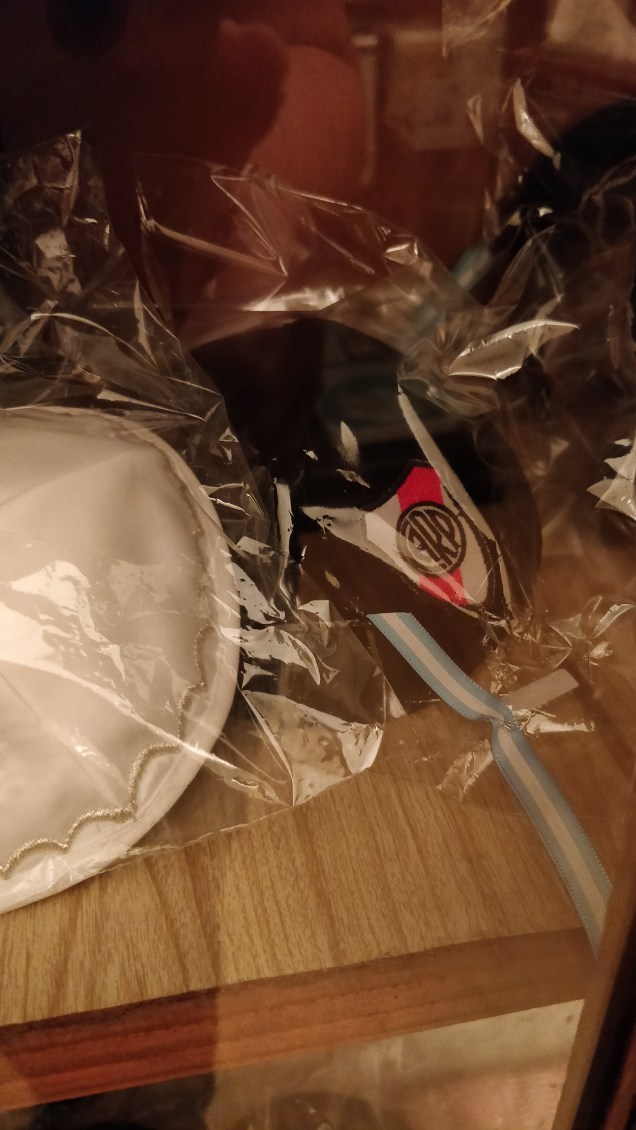
For game day.Don’t worry; God doesn’t play favorites.
A unique history museum and worthwhile visit, the Museo Judío de Buenos Aires is open Monday through Friday from 10am to 6pm. The entry fee is a relatively steep US $10 for foreigners (but currently 80 pesos for Argentine residents and 50 pesos for Argentine retirees). It’s easy to get to via the B and D subway lines and a multitude of buses, and just down the street from Teatro Colón, so it’s right in the thick of things.
I am hardly a scholar of art history, but I can tell you that modern and contemporary art is hard. It often doesn’t adhere to a traditional notion of artistic skill, it often doesn’t portray recognizable subjects, it often offends traditional sensibilities. This art doesn’t lead you to its point; it asks that you meet it there. Modern art requires the consumer to work.
And that’s not a super easy thing to accept.
….okay.
And it isn’t hard to see why many people are suspicious of modern art; they look at simple, geometric paintings or found-object sculpture and get the sense that they’re being conned. I have some opinions about certain artists myself, certainly. Who would want to look at or experience something, ascribe to it a meaning, and then find out it didn’t mean anything? That would suck.
So modern art requires some faith on the part of the consumer. It requires some work to understand the artist’s intent. And it requires considering what art is and what it should do.
….okay.
But that isn’t all there is to it. The consumer experience matters. When you look at something, your feelings are your feelings, and it’s useful to examine them. You don’t have to like what you see, you don’t even have to see what the artist sees. The artist doesn’t get to dictate your reaction or interpretation. How it makes you as an individual feel is important. Modern art places importance on innovation and that emotional evocation.
From the Delia Cancela exhibition; I will photograph anything with a cat on it.
Regarding innovation, I will tell you of the two times I met Jackson Pollock’s work in educational settings. The first time I was a young child on a school trip to an art museum. The woman leading the tour showed us a large Pollock canvas, and told us maybe we thought we could do that, but that it was deceptively simple–it was the way that he dripped the paint, his method, that made it unique and valuable. She was an Adult Authority Figure in her Field, so I tried to see the skill in his splatters, despite my reservations. When I was in college, my art history professor gave an explanation that seemed much clearer to me. “Maybe you think you could do that,” he said. “But you didn’t.” Pollock had innovated, and created something that no one else can now create.
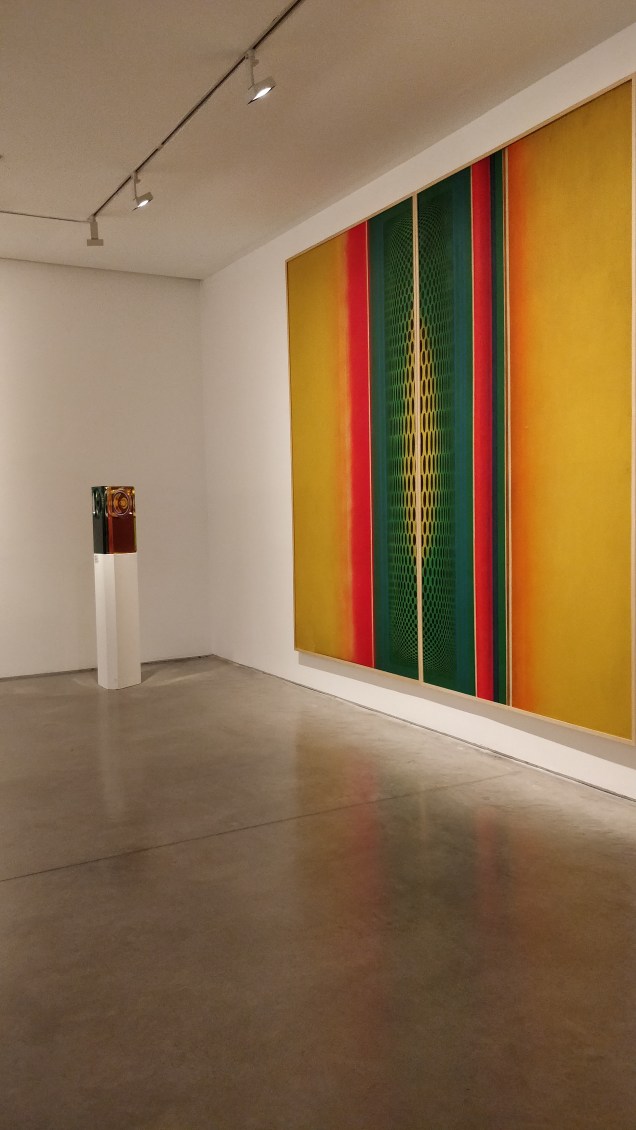
So maybe you see something in a piece like this, motion and depth and shape:
Maybe you’re already rolling your eyes.
I think it’s perfectly fair to look at something that is abstract and decide what you see in it and if you like it. But I do encourage you to at least take that look.
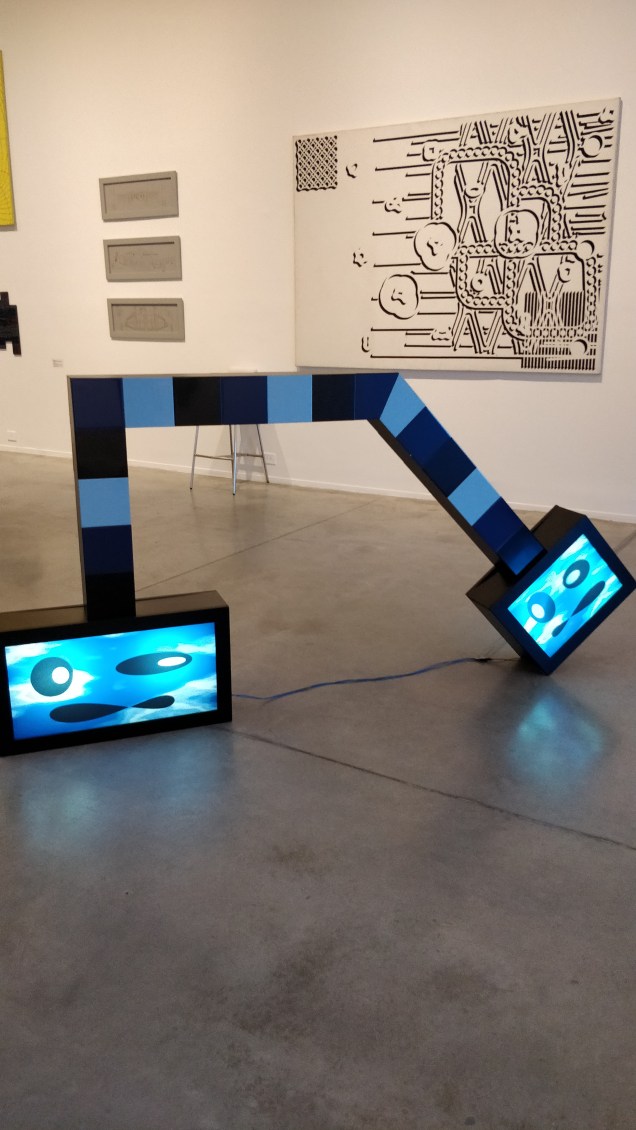
Now, modern art of course involves more than just painting and sculpture. There are often multimedia components and even tactile ones. The exhibition Pulso by Nicolás Mastracchio∼ incorporates photography, found objects, video, and your bare feet.
And optionally your butt, if you sit in front of the screen, but do not bare that.
After removing your shoes, you walk around in very close proximity to the photos and what are described as “fragile mobiles,” such as that dry leaf you see there. You may sit for several minutes for the video portion.
Mastracchio∼ was influenced by meditation and Zen principles, and “exploring the spontaneous and ephemeral configurations of a small cosmos of objects, which is ordered in a few minutes and then photographed, together with the installation of mobiles in movement.”
I might not have come to that conclusion on my own, but I do see it. The room was smaller and the carpet was soft and dampened the sound, making the exhibition room feel more intimate and quiet than the cavernous galleries. Walking among things like photos and the small mobile objects gave me a sharp sense of my physical being within the space. And, although it isn’t mentioned in the exhibition material, I was also disturbed by the non-natural objects floating in the air and the water in the video. It felt like pollution that I could not remove, and that’s a feeling worth examining, too.
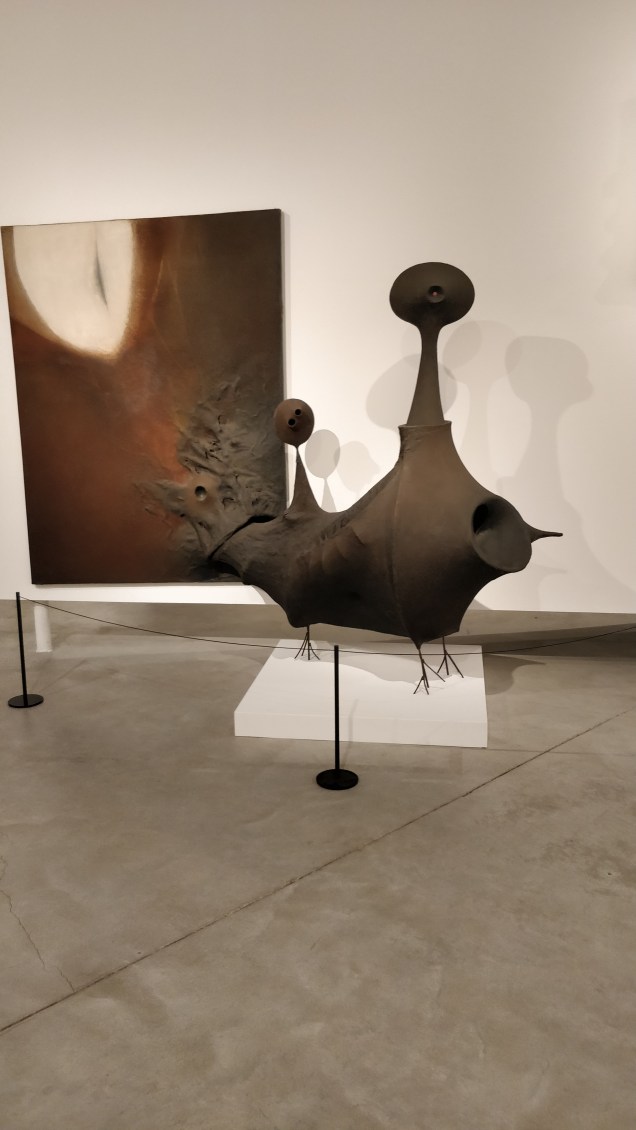
There are lots of Argentine modern artists represented in the Moderno’s collection. This is Integralismo Bio-cosmos N°1, by Emilio Renart, and all I can tell you is I am super glad it does not move.
Bet it could really scamper on those wee legs.
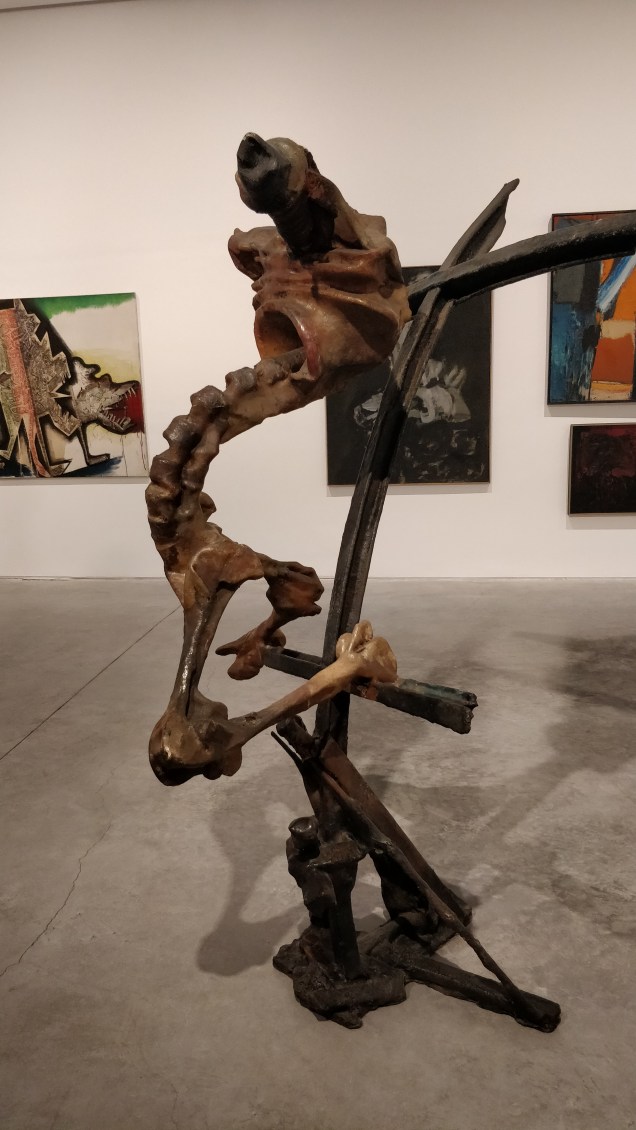
Also in the sculpture realm is this Crucifixión by Norberto Gómez, which is certainly not the most comforting thing I’ve ever seen.
That…that looks painful.
But I wanted to talk about this one for a second. It is clearly a crucifixion; you can see that from any angle, without reading the title plaque. Think, or look here if you like, about traditional crucifixion scenes. At least in my opinion, there is usually a serenity to Jesus, even if his pain is evident. There’s a sense of structure in the composition. They are, in a way, comforting. To my eye, Gómez has reduced the crucifixion to its barest agony. With a minimal human aspect, it twists and contorts without relief.
And then there’s this guy.
I don’t know, man. Maybe take a vacation.
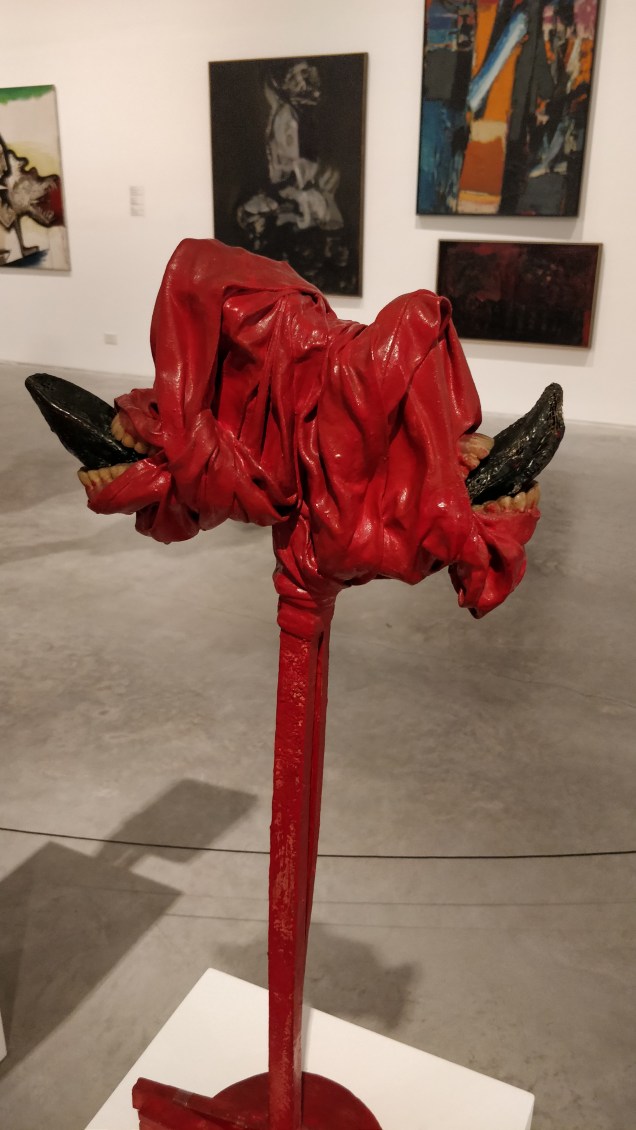
This is Lengua. You might recall Alberto Heredia from the Museo Nacional de Bellas Artes. Not everything he did involved terrifying disembodied mouths, but “terrifying” does seem to be a recurring feature, as seen here with the most alarming San Martin I’ve ever laid eyes on.
And I say this as a Zdzisław Beksiński fan, Heredia’s stuff creeps me right the hell out.
Last in the 3D arts that I’m going to note is Claudia Fontes’s Ofelia, which to me recalls Philippe Curtius’s waxwork Sleeping Beauty modeled on Madame du Berry (Curtius is now best known for teaching Madame Tussaud her craft; the Sleeping Beauty is in the London Tussaud location, and there are better images of it out there than the official video). I won’t go too deep into my thoughts on Ofelia, except to say that while the Sleeping Beauty waxworks (there were several) were created by and for the male gaze, Fontes has removed the female figure entirely, leaving only the gown (a garment that, incidentally, sunk Ophelia to her death). It does still breathe lightly, however.
Now, you could, for example, tell me that it’s just a dress with a little motor and a total sham, a cynical ploy to profit off being called “art.” Let’s say for a moment that you’re right. So what? Humans ascribe meaning in non-literal ways all the time; it’s a feature, not a bug. And people find personal meaning in things that were set up to make a profit, like Nicolas Sparks novels, CrossFit, or (let’s face it) any number of religious organizations, all the time. You, personally, might feel like it’s all bullshit–but the meaning they, personally, find in it is real. The main difference here is that the Moderno is free on Tuesdays.
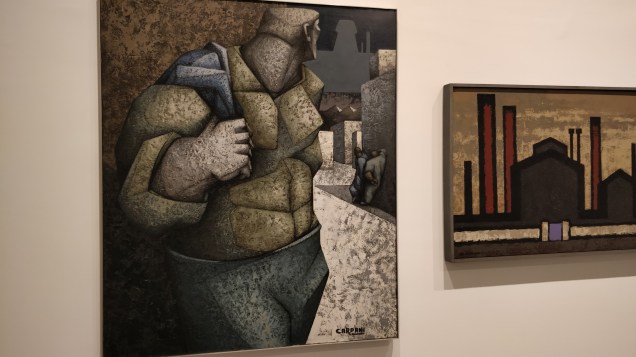
I have less to say about these paintings, mainly because I didn’t photograph many abstract paintings, so I think these are easier to connect with.
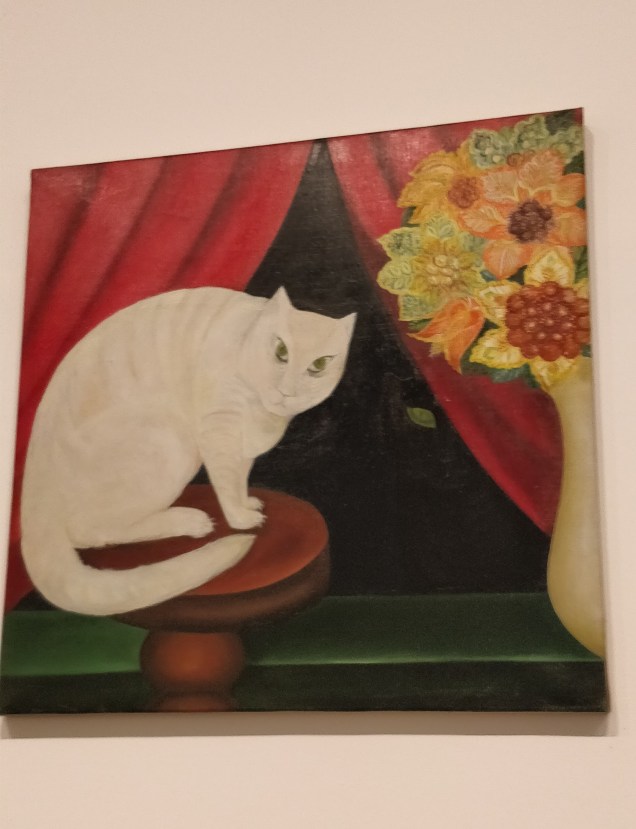
Desocupados [The Unemployed] by Ricardo Carpani, and Fábrica [Factory] by Juan Manuel Sánchez. You will find the concerns of the working class frequently in Argentine modern art.This is a truly terrible photo of Gato y flores by Carlota Reyna.
I took this photo because the title is Cat and Flowers, which I thought was odd because there’s clearly two cats in the painting.
Nicolás García Uriburu, Interior de autobús
I liked this one because as a frequent bus rider, it feels very familiar, even though it’s more than 50 years old. All of the driver’s personal touches, from the Virgin of Luján to the scrolly letters, the crowds all the way up the full aisle–all still very true to life. I also liked it because there’s a cat.
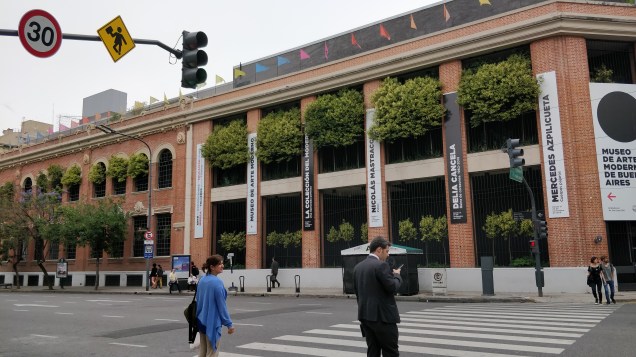
So that’s a small sample of the Museo de Arte Moderno de Buenos Aires, well worth a visit. Much, if not all, of the labeling and signage is in English. It’s located in San Telmo and easy to get to by subway and bus. The building was recently overhauled, and there’s a cafe and a small bookstore, where you can afford to indulge in a coffee considering the museum’s entry price is 30 pesos (less than US $1, currently). The museum is closed on Mondays and free on Tuesdays; check the website for current ticket prices and hours.
December is here, and despite my strenuous objections, spring is warming up the city. These will be the last weeks to enjoy the parks and gardens without feeling super hot and gross the whole time. It’s time to visit the plant museum.
But for real what’s a garden if not a plant museum
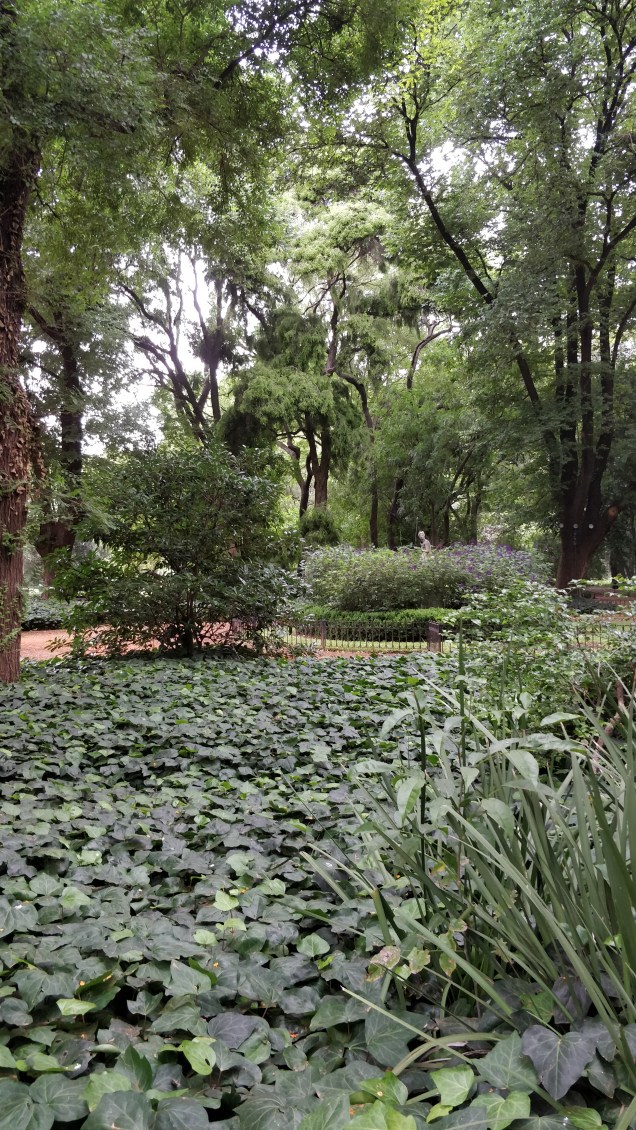
The Buenos Aires Botanical Garden is, objectively speaking, the best place in the entire city. It’s one good soundproofing and a few shady hammocks from achieving empirical perfection. These are just the facts.
Luscious, green facts.
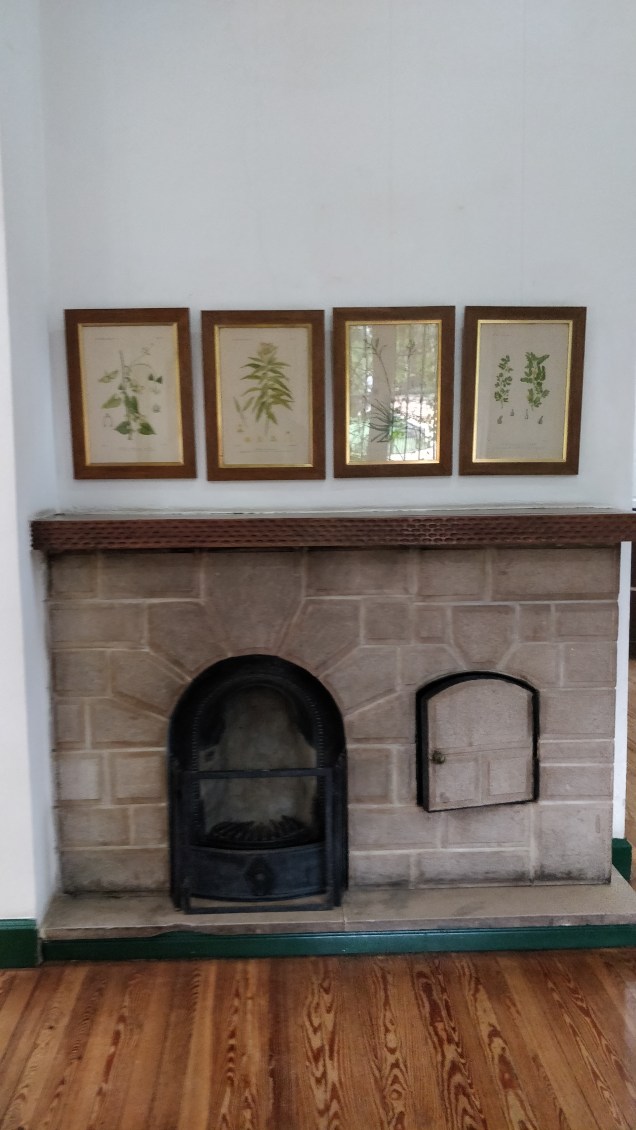
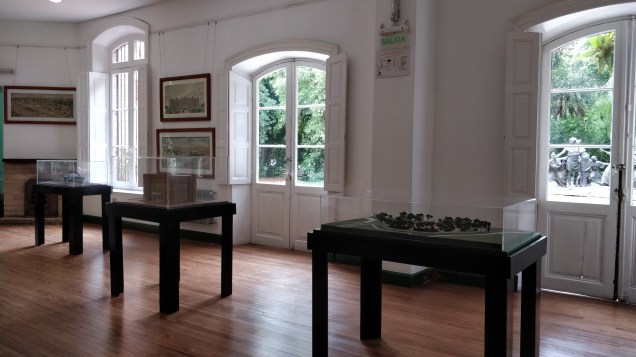
And there is a small sort of museum on the grounds: the main building, where garden designer Carlos Thays lived while he was director of parks and walks, so there’s a nice perk you don’t see in city governments much today.
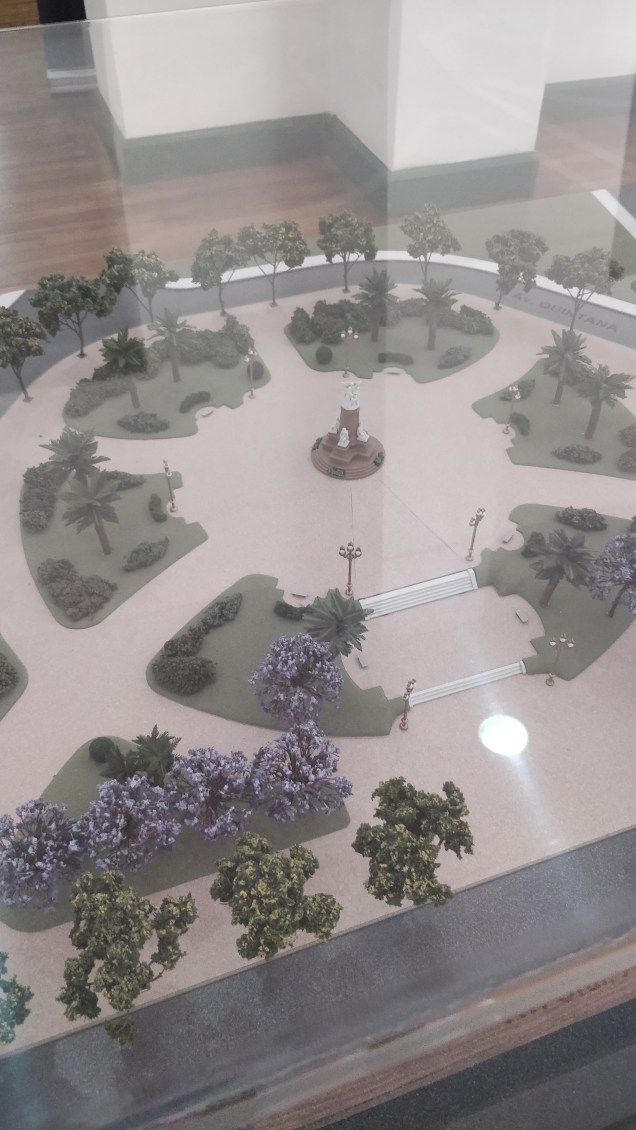
Inside, you’ll find some models of the gardens and structures and antique prints and maps. The whole thing is very picturesque.
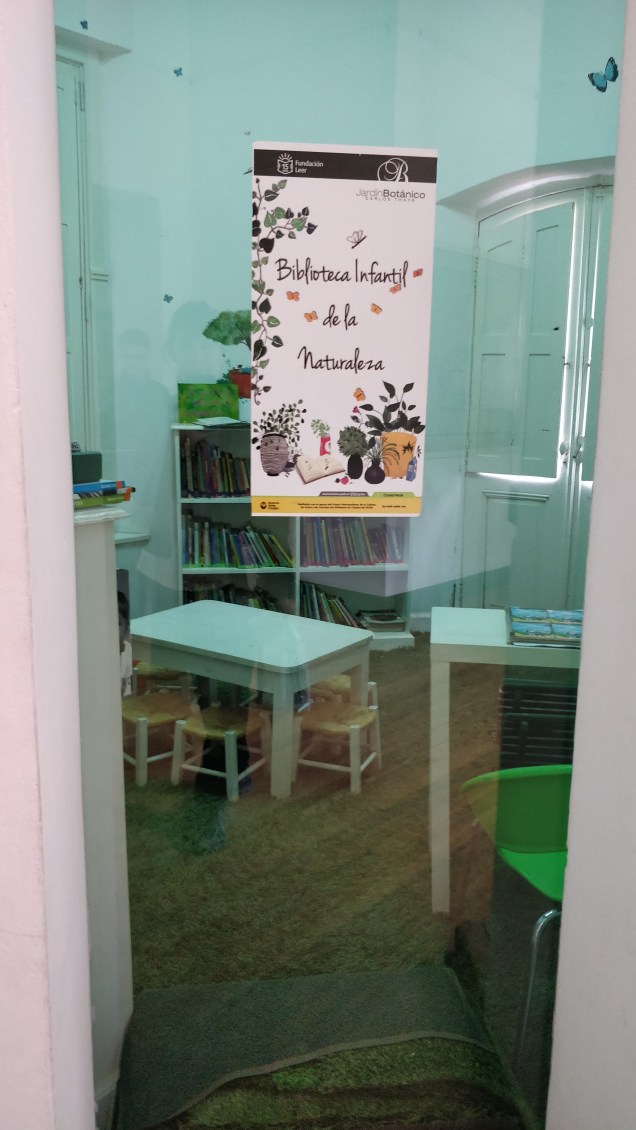
The museum/administration building is the center of the activities for the Garden, and there’s also a wee children’s library, which is adorbs.
The Children’s Library of Nature
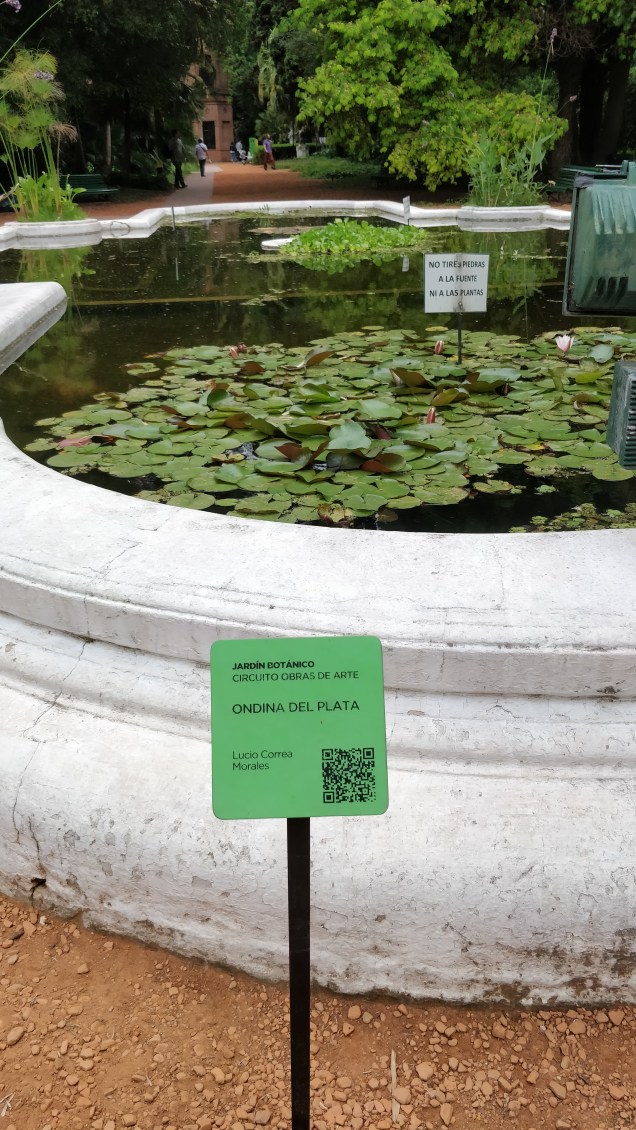
The Garden itself has QR code labels for some of its collection, which is very handy for an outdoor museum (just go with it okay), as you see here on the artwork circuit.
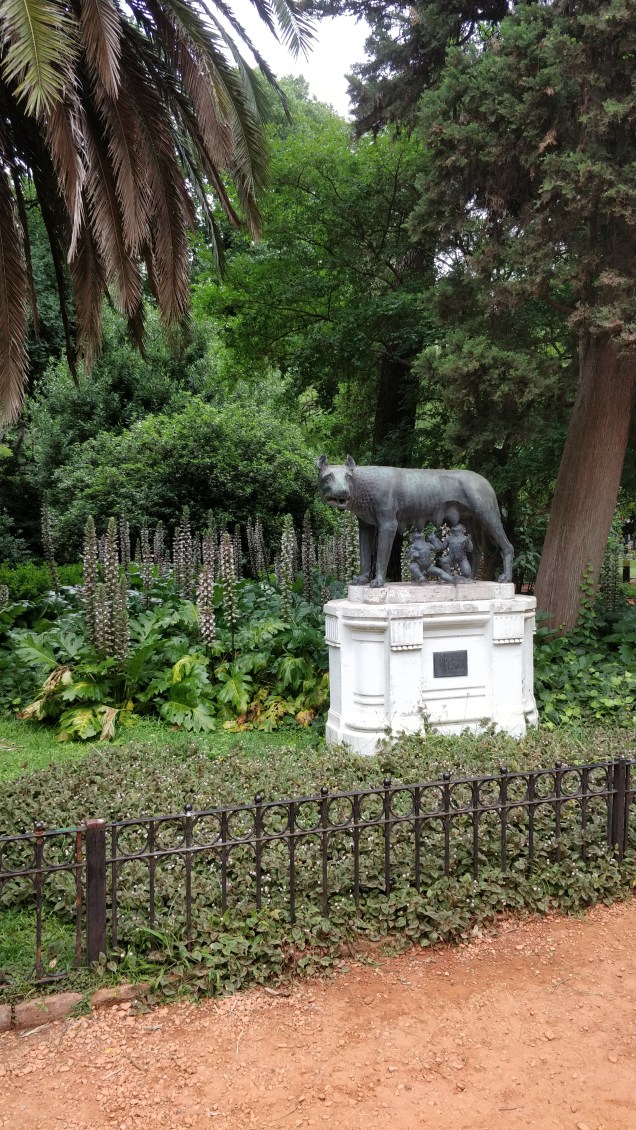
I don’t remember if this one had a QR code, but c’mon it’s a gimme.
And like many large public gardens, you can find contemporary art installations, too, such as “Instalación Mesológica” by Didier Rousseau-Navarre, which is meant to “question our relationship with the earth in the Anthropocene Age.” The seeds are made from the wood of their species.
The Botanical Garden hosts many workshops and activities and is a goddamn delight. It’s in Palermo, near the Rural, the Japanese Garden, the former zoo, the Museo Evita, and lots of other stuff. It’s a nice place in the city to find some birds; I saw a really pretty green hummingbird. It’s free and open every day except Mondays, and closing times depend on the season; check the website. It’s accessible via the Plaza Italia stop of the D line of the subway and a whole mess of buses.
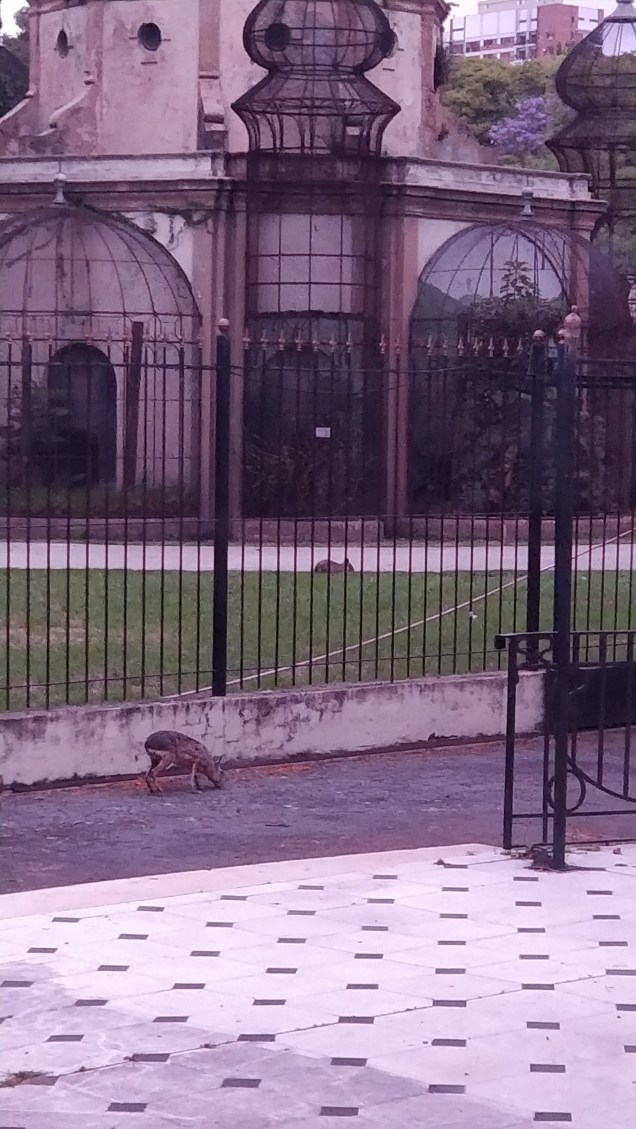
I am still recovering from a “flu-like” virus, which wasn’t too bothersome as I mainly slept for three days, but I managed to make a quick visit to the Centro de Arte y Naturaleza (part of the Museums of the National University of Tres de Febrero, which also includes the Museo de la Inmigración). It’s in a really lovely building on the perimeter of the old Buenos Aires Zoo, which was chiefly built around the turn of the 20th century and as such is a fascinating example of old zoo architecture but was closed down for being a cruelly terrible zoo.
In 2016.
Despite being technically within the limited-capacity (now called) Buenos Aires Eco-Park, a transformation that has not been going well, incidentally, the Centro is accessible from the outside, although you can peek out the back windows and see the maras wandering around the grounds:
The maras are large Patagonian rodents that were always allowed to range freely within the zoo.
The Centro itself faces the large and busy Av. Sarmiento:
You cannot move in.
It’s quite small and doesn’t take much time to visit–but it is free, has a helpful staff, changes exhibits entirely every few months, and is right within a nexus of other attractions, making it an easy addition to any plans that include La Rural or the Botanical Gardens, or any other of the numerous museums and gardens within walking distance.
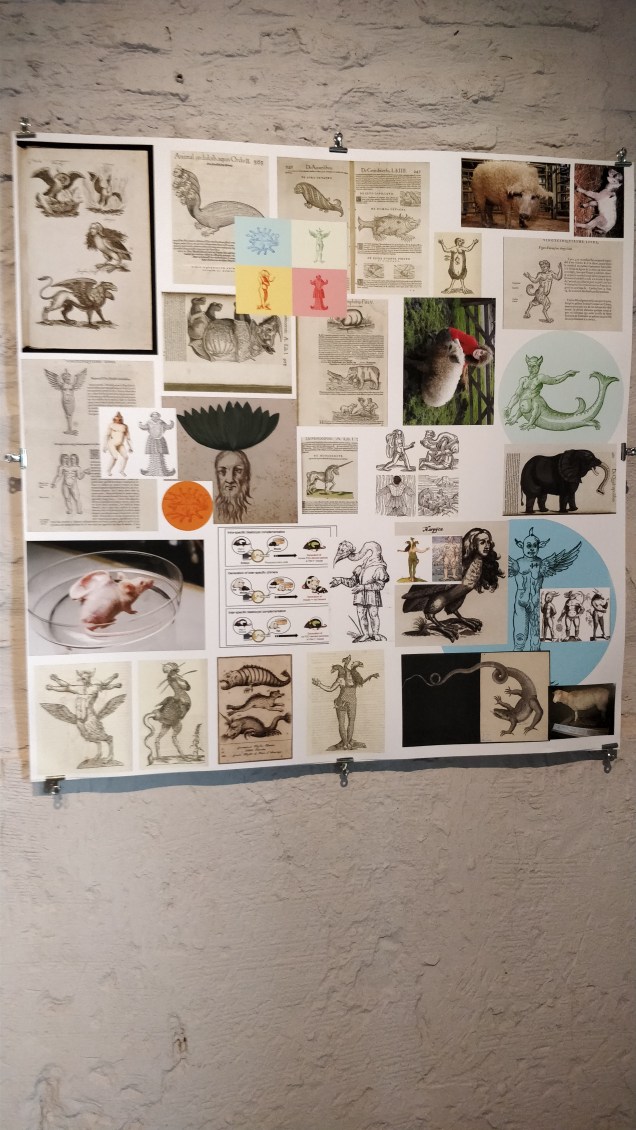
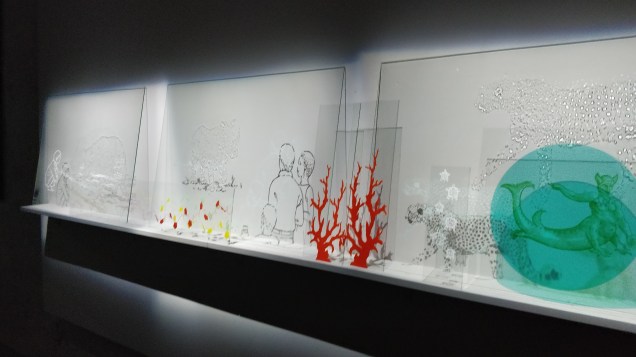
Two artists are currently featured. The first floor holds Zoología Fantástica, by Argentine biologist and artist Pablo La Padula. From the description on the MUNTREF website: “…it invites us to re-read the historical-cultural markers that reside in scientific devices and their interpretations, as well as in the decisions that are made for scientific dissemination, and the forms that these constructions assume in the social imagination. The materials that are used, the assembly, the lighting and the organization system, come together to place the spectator in the place of the scientist.”
The upstairs houses a show by Peruvian artist Claudia Coca called “Do Not Tell Me I Do Not Know How to Catch the Wind.” It examines the city’s life forms and their interaction, and includes embroidered verses.
“Who is the one that, like the tiger, rides the wind with a ghostly body?”
If you’re already in the area, and if you spend much time in Buenos Aires at all you eventually will be, pop into the Centro and see what they have showing. It’s free and open Wednesday to Sunday from 2pm to 7pm. I really hope they put whale kid on a postcard.
It isn’t the biggest waste of life ever perpetrated, but it was a waste of life all the same.
It’s not easy for people who were born and raised in imperial powers to understand, either. There’s a lot of background to the conflict, which is important for understanding how the islands are generally viewed by Argentines, and I am in no way well-versed in the history of it, so I’m going to try to briefly illustrate what was going on before the war broke out in 1982.
1– The sovereignty of the Malvinas (they are known officially outside of Argentina as the Falklands, but this is where I live and also what the museum is called, so I’m going to stick with Malvinas) had been in dispute for 200 years, although they have been held continuously by the British since 1833.
2– The belief that the Malvinas are rightfully the possession of Argentina has been culturally entrenched for a long time.
3– British rule over the Malvinas is seen as imperialistic, and the imperial ambitions of European nations and the US has long wreaked profound tragedy across South America, and indeed the political interference of those nations was actively still doing that in the support of the various military juntas that overthrew Latin American governments at the time.
4– Argentina’s military dictatura had murdered thousands of people and was facing a severe economic crisis and growing opposition; the war was a somewhat cynical ploy to bolster home support by appealing to that dumbest of manipulable emotions, nationalism. The war, the loss–it’s all tainted by its association with an illegitimate and murderous regime.
5– Unlike the US, which is more or less constantly sending soldiers to die in conflicts, Argentina hadn’t been involved in any foreign conflicts to speak of since the Paraguayan War in 1870. Most of the Argentine war dead in the Malvinas were conscripts.
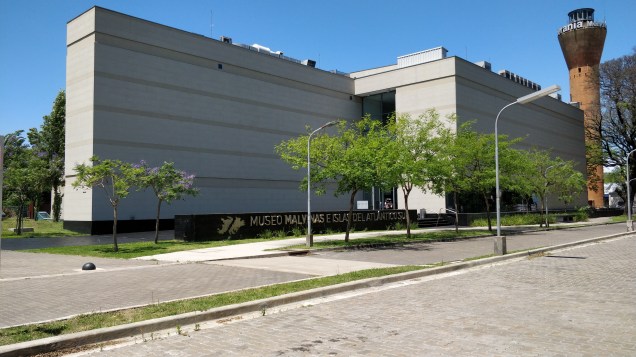
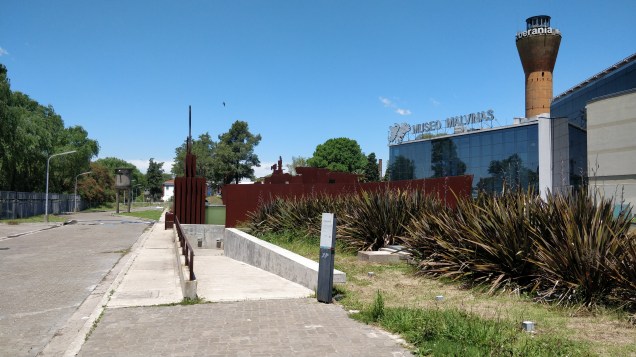
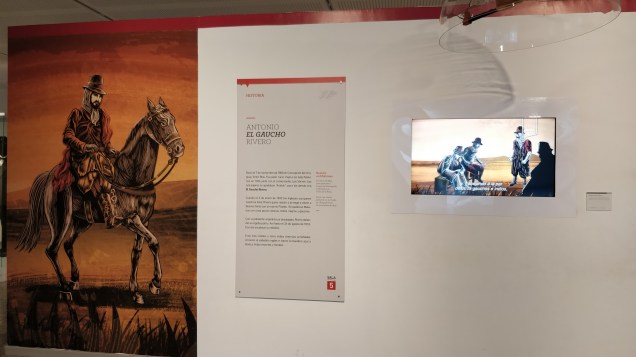
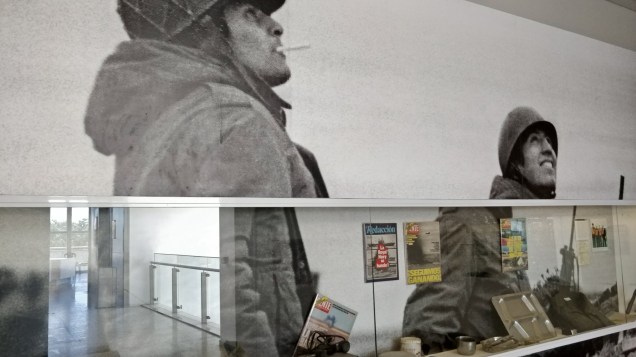
So–the Museo Malvinas is located on the edge of the ex-Escuela Superior de Mecánica de la Armada, once the largest clandestine detention center and execution site during the dictatura, now a memorial complex. The museum itself is quite new and really lovely.
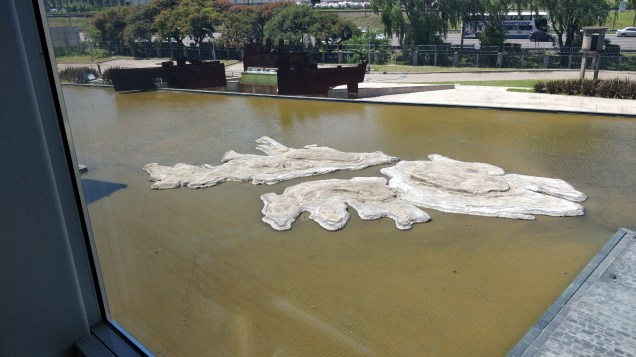
Outside the building is a large pool with a map of the Malvinas in the middle:
As seen from inside the building
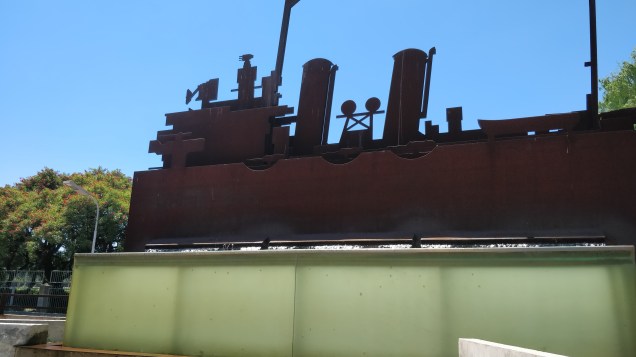
and a memorial to the ARA General Belgrano, which was sunk by British torpedoes with 321 of its crew and two civilians.
It’s not a particularly comforting space. You walk down, until the silhouettes of the ship are above you. The sound of the fountain forcefully brings to mind the idea of water rushing into the ship. It is an evocative, emotional memorial.
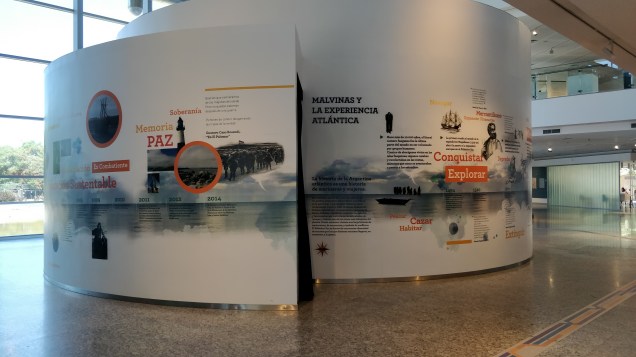
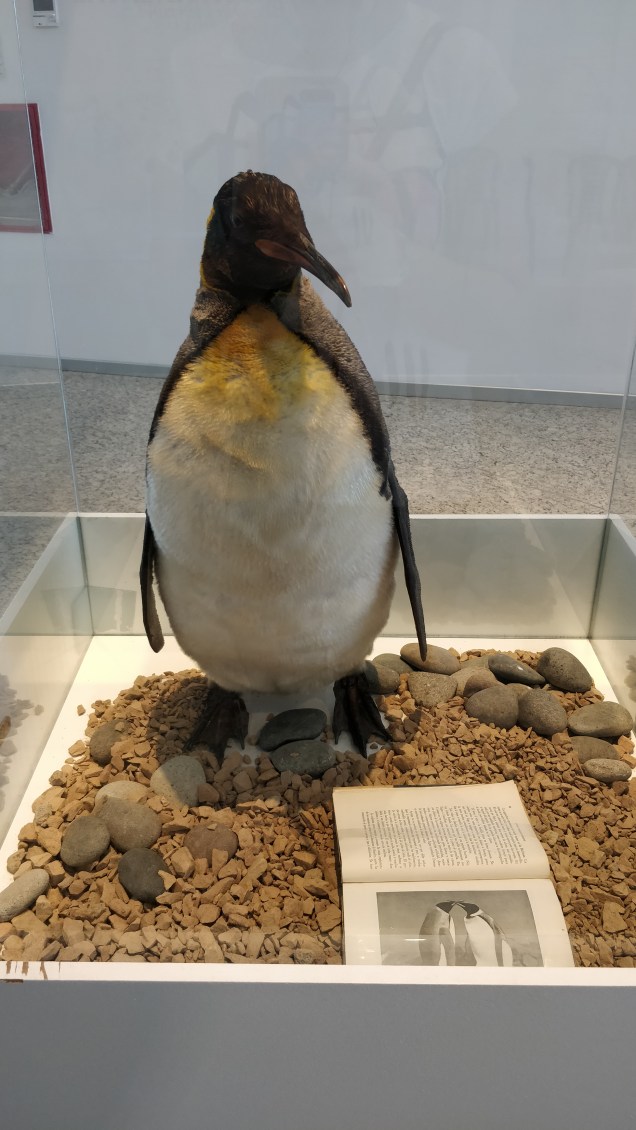
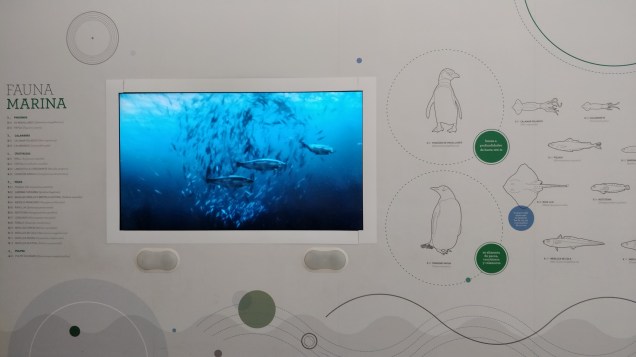
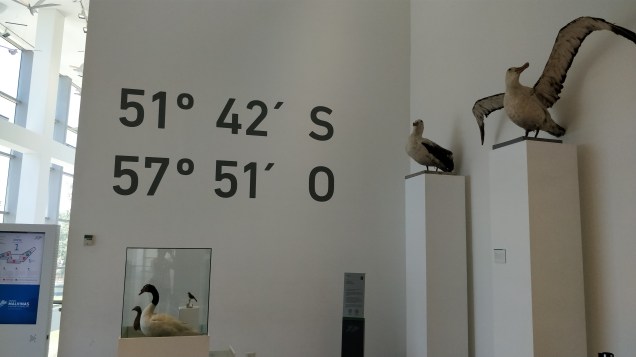
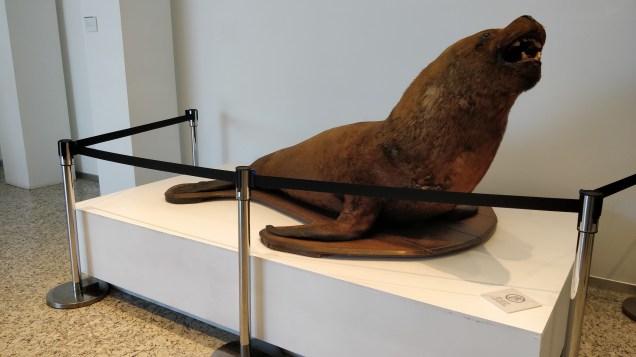
Inside, the museum covers the history and flora and fauna of the islands.
That is the focus of the very polished film that runs inside this little theater, despite its introduction here.
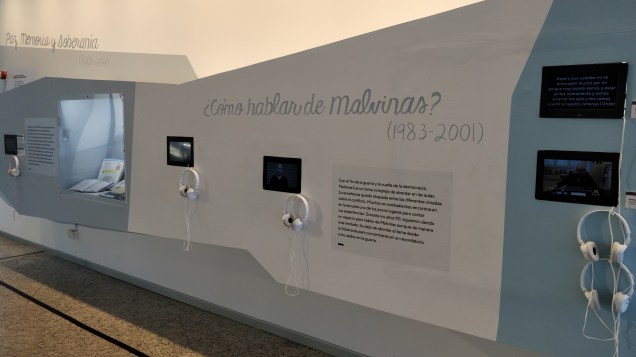
There is a lot of multimedia in the museum.
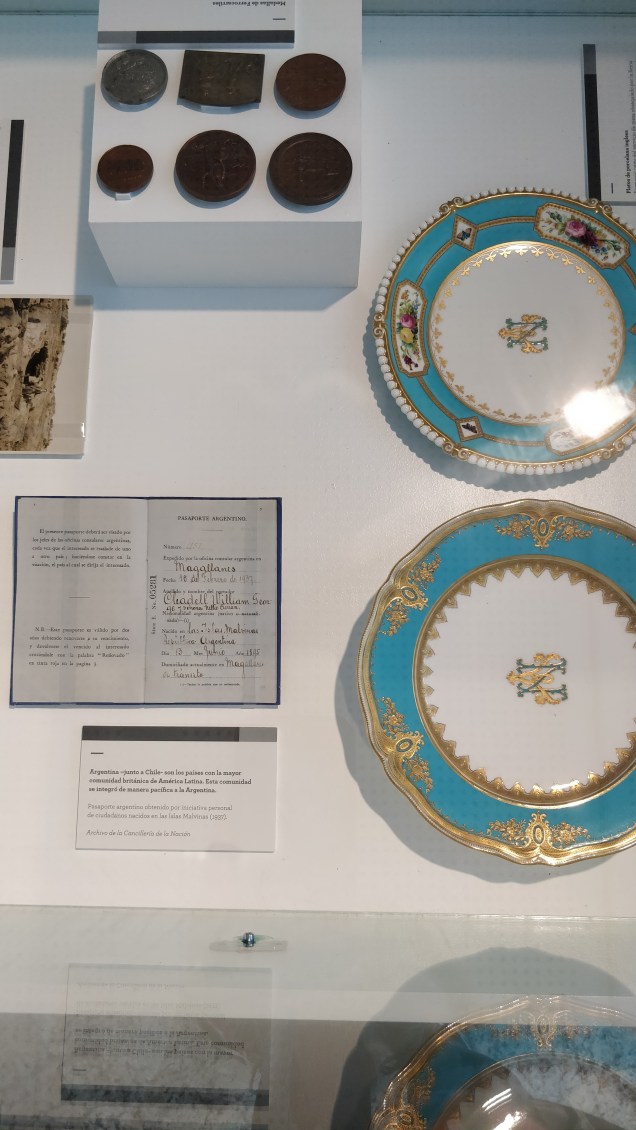
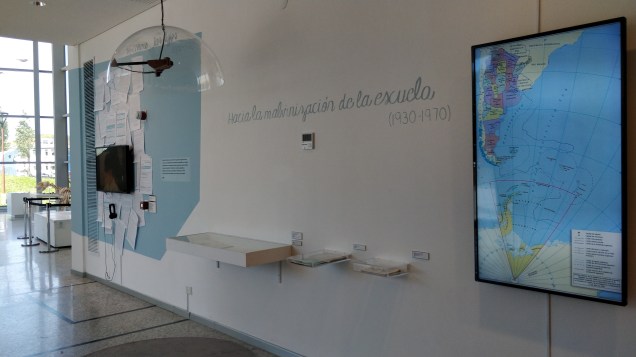
There are also areas that cover the older history of the islands as well as Argentine-British relations.
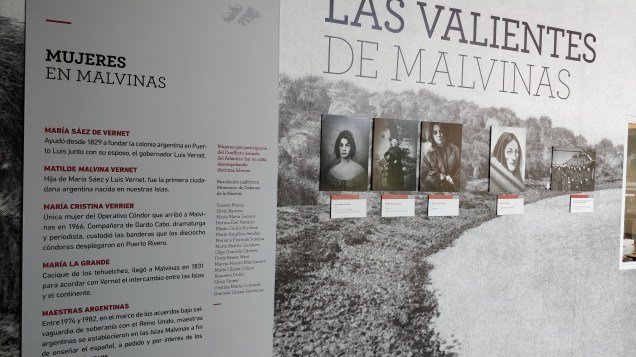
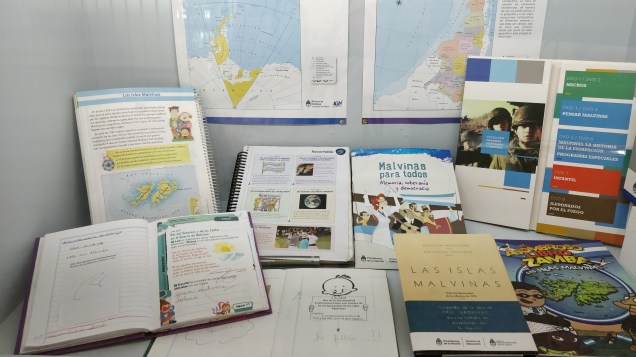
A sizable portion of the museum is dedicated to how the Malvinas have been and are currently addressed in Argentina’s culture, and the idea and importance of sovereignty.
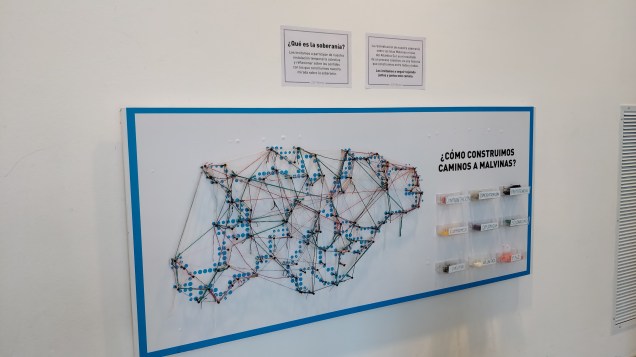
Much of the museum works to make the concepts accessible to the children who visit; this interactive map says “How do we build paths to the Malvinas?” and the strings are color-coded to the choices that can be made as a nation: diplomacy, dialog, peace, conflict, compromise, etc.
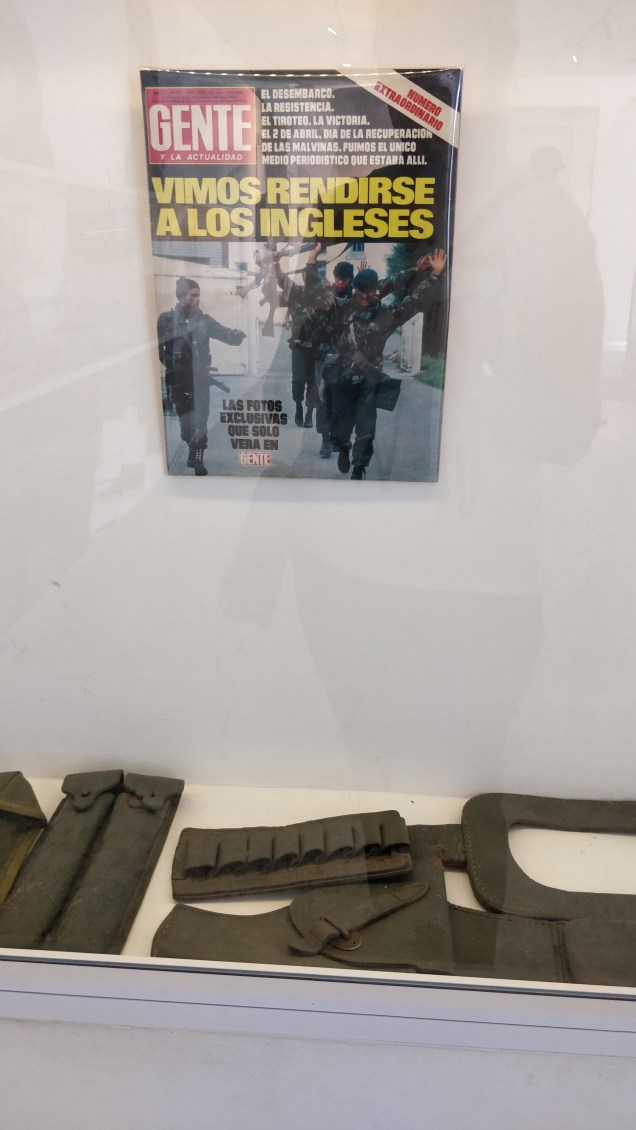
Plenty of space is also given to the war and the dictatura (the leaders had assumed that the UK would not really bother with a military response and that the US, which Argentina had been aiding in funding the Nicaraguan Contras, would stay discreetly out of it, neither of which would be true) that made the dumb ass decision to go through with the invasion.
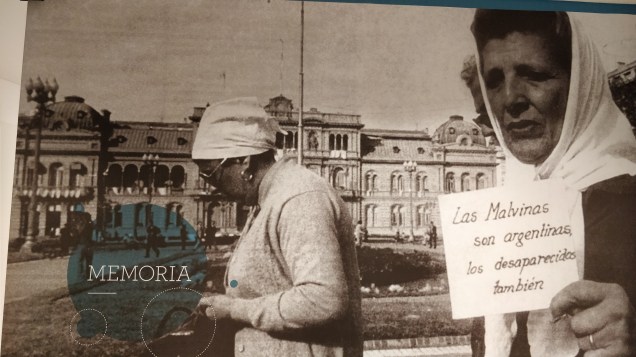
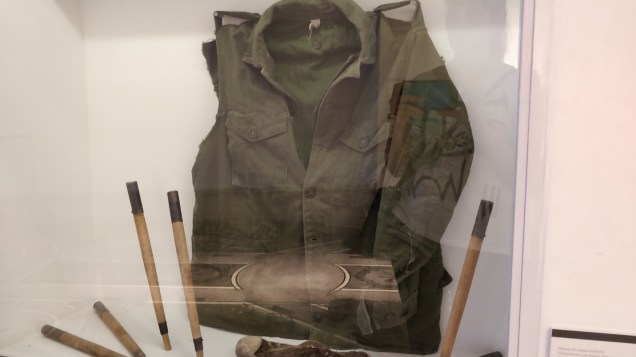
A Mother of the Plaza de Mayo implores viewers to remember the Disappeared are also Argentines.A soldier lost his sleeve and the arm that was in it.
A lot of dumb ass propaganda going around, too.
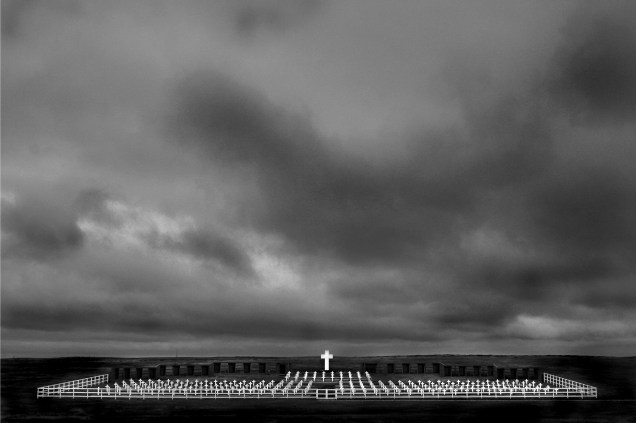
The war dead are, naturally, also memorialized. You can watch the tablets and note how many were young draftees.
So, for better or worse, the Malvinas remain a British holding (the Falklanders, incidentally, are overwhelmingly of British descent and wish to stay within the UK). The brief war ended with 904 dead and 2432 wounded. The loss finally brought down the dictatura, which had bought nothing with all the blood it spent for Argentina except meaningless grief and psychic scars.
The Malvinas are currently on the 50 peso note.
The Museo Malvinas e Islas del Atlántico Sur is free and open seven days a week and holidays. It’s accessible by train and several bus lines, as it is situated at the back of the ESMA on Avenida del Libertador, a huge avenue. None of the signage is in English, so if your language is weak, you’ll need to bring a translator. There’s a nice small cafe within the building.
As such, it has a very fine collection, and since this is a blog post, I will not be providing a thorough overview. For one thing, the museum has a very nice website partially available in English (and a guide app only in Spanish). So I’m just going to do a light overview! There’s just so much art!
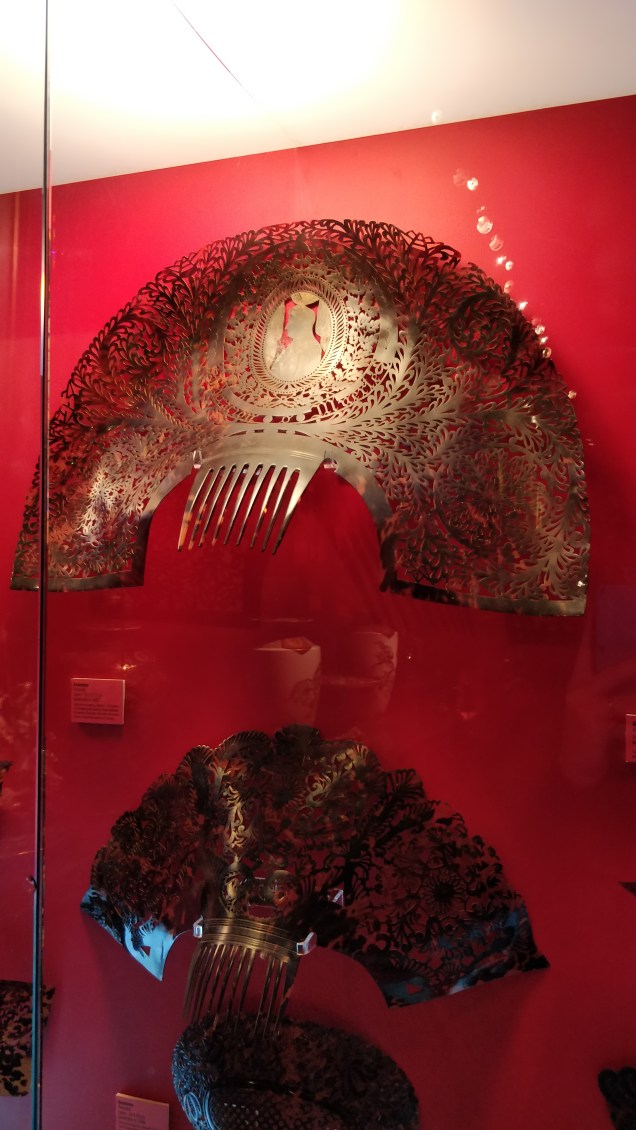
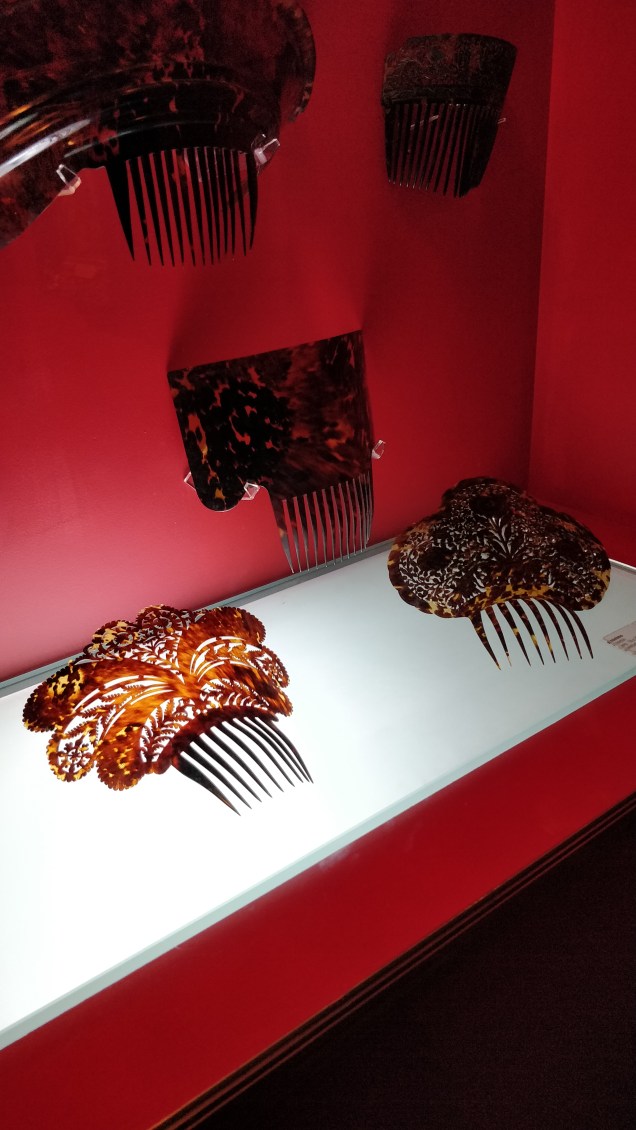
Obviously, as a national fine arts museum, Bellas Artes has a strong collection of Argentine and Latin American art. The international collection trends noticeably to European art. Let’s have a peek, starting with these things, because I am a big fan of hair decoration:
Who has this much hairHow do these not cause headaches
These are peinetónes, very large versions of the Spanish peineta that were distinct to the fashion of the Rio de la Plata region in the 1830s, until shitty men took to criticizing the elaborate and expensive combs in the most sexist way possible (“terrible women neglect their families and whore themselves out in pursuit of this extravagance!”), and their use declined. You can find several contemporary illustrations mocking the peinetón. Certainly, there are reasonable criticisms to be made of fashions that are uncomfortable, inconvenient, and costly, but “look at these shallow immoral bimbos” is just the worst.
On to the older European stuff!
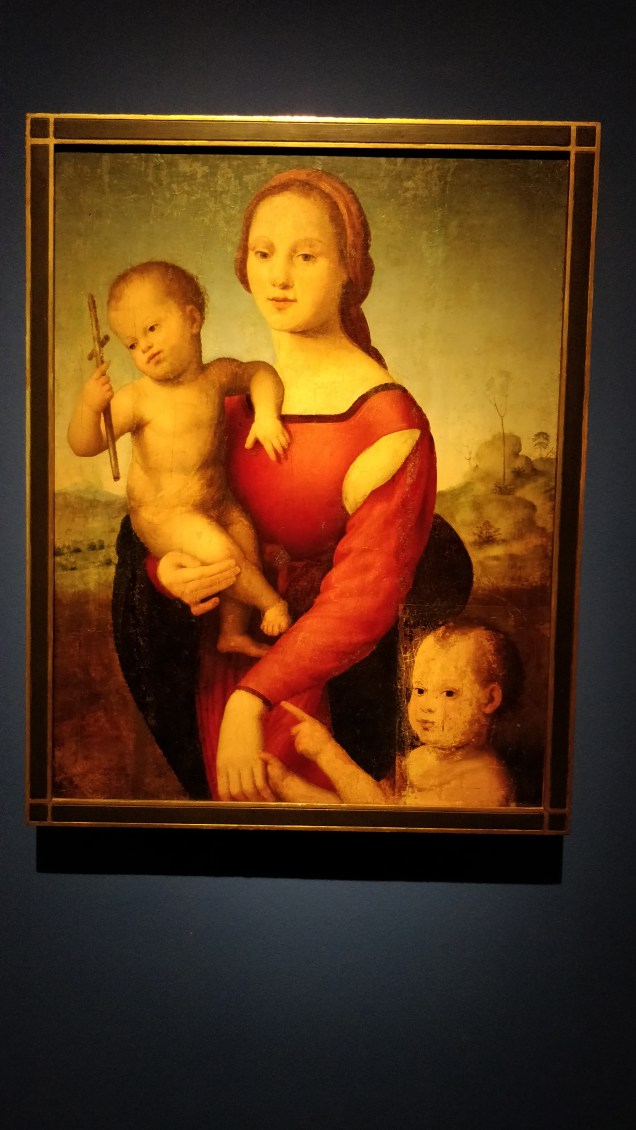
St John here giving you a big hint as to who the principal subject here is, or else trying to draw attention to the incredibly inappropriate baby toy.
Early 1500s Virgin and Child with St John from Florence.
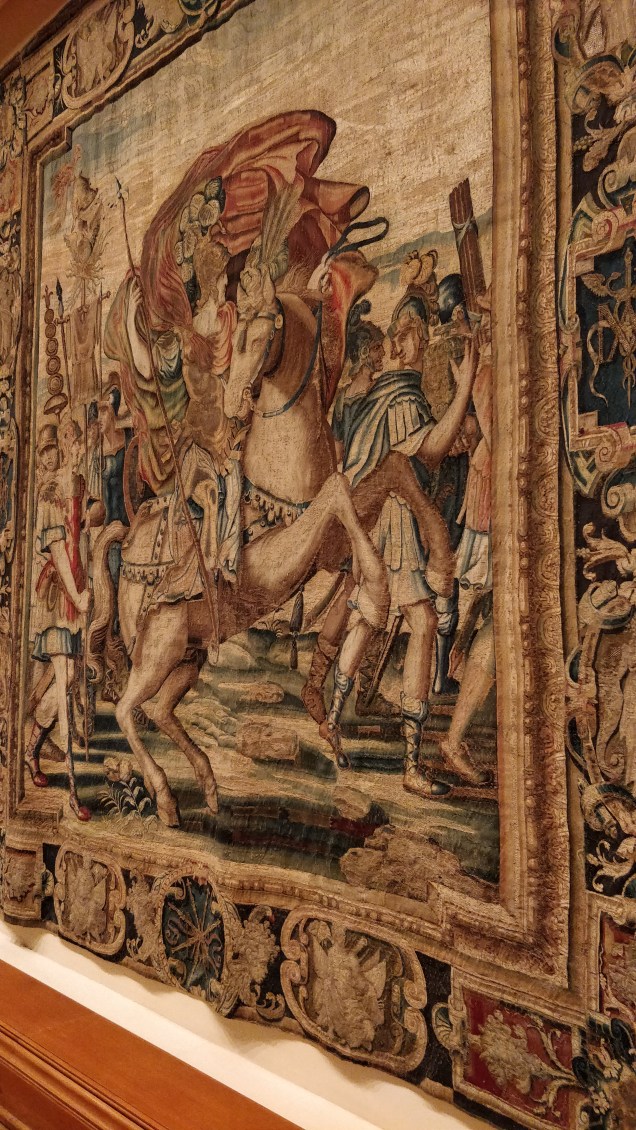
If I ever have a castle, Imma get so many tapestries
This is a Belgian-made tapestry from the early 1600s. As someone who can barely sit still long enough to embroider a simple outline figure on a handkerchief, I am always deeply impressed by tapestries.
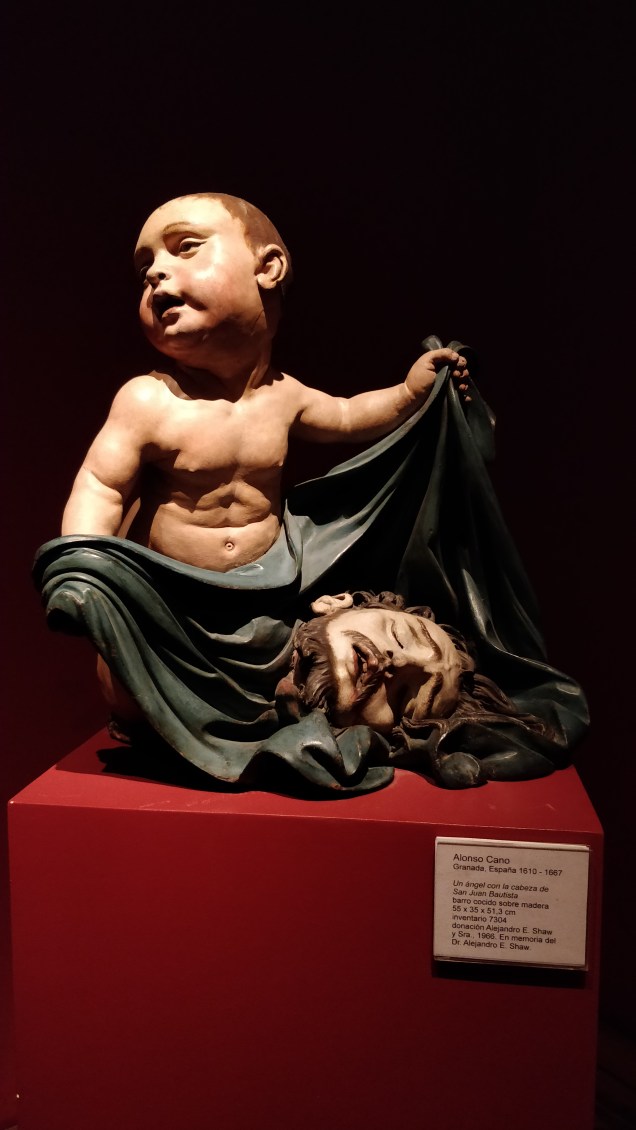
If you leave severed heads laying around, the baby is totally going to get into them.
This is a 17th century wood sculpture, “An angel with the head of St John the Baptist.” This stuff is all pretty typical of the time and region.
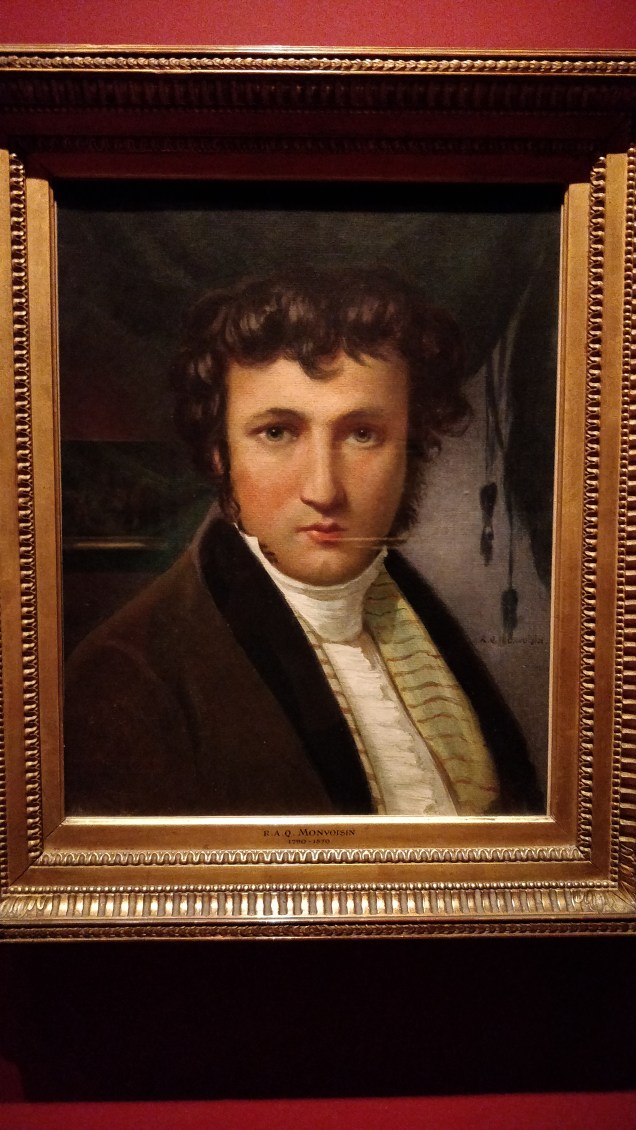
Moving forward, time-wise, the collection includes examples from a lot of the big dudes, El Greco, Rubens, Rembrant, Degas, van Gogh, Monet, Kandinsky, Pollock, Rothko, and so on.
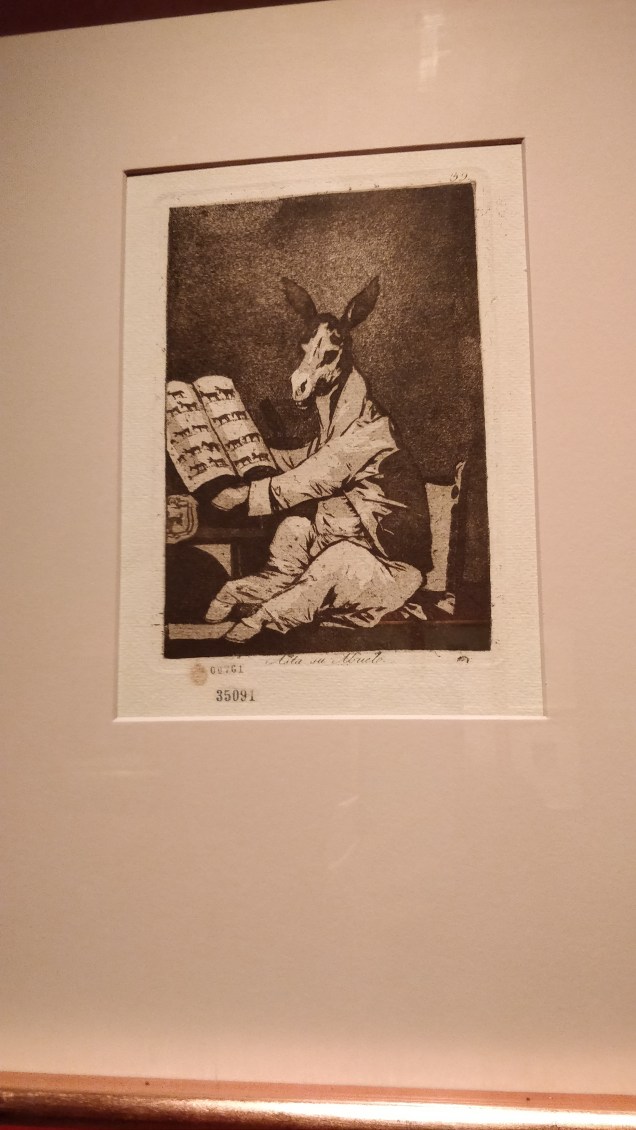
Raymond Monvoision, “self portrait,” early 1800s France.Goya, doing Goya things.
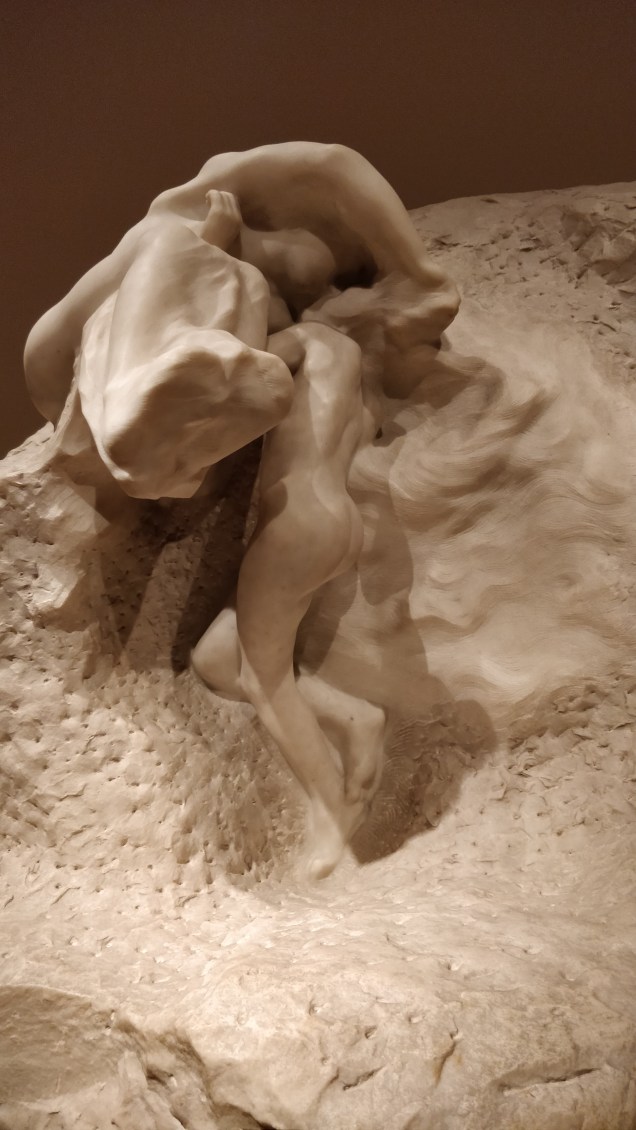
There’s a lot of Rodin, owing to the museum’s first director’s admiration of him.
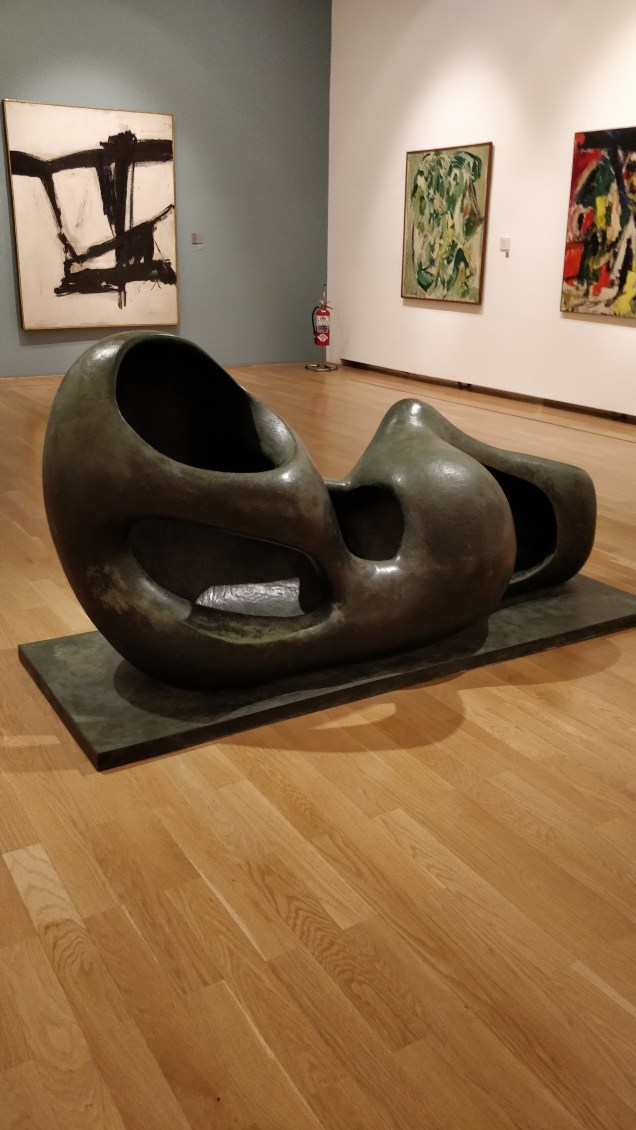
“The Earth and the Moon,” 1898, because how many times do you really want to look at “The Kiss”Henry Moore, “Reclining Figure, External Forms“
But let’s turn our attention to the Argentine artists, my very favorite feature of Bellas Artes.
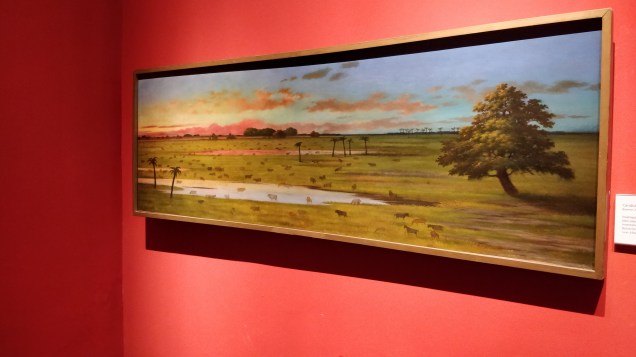
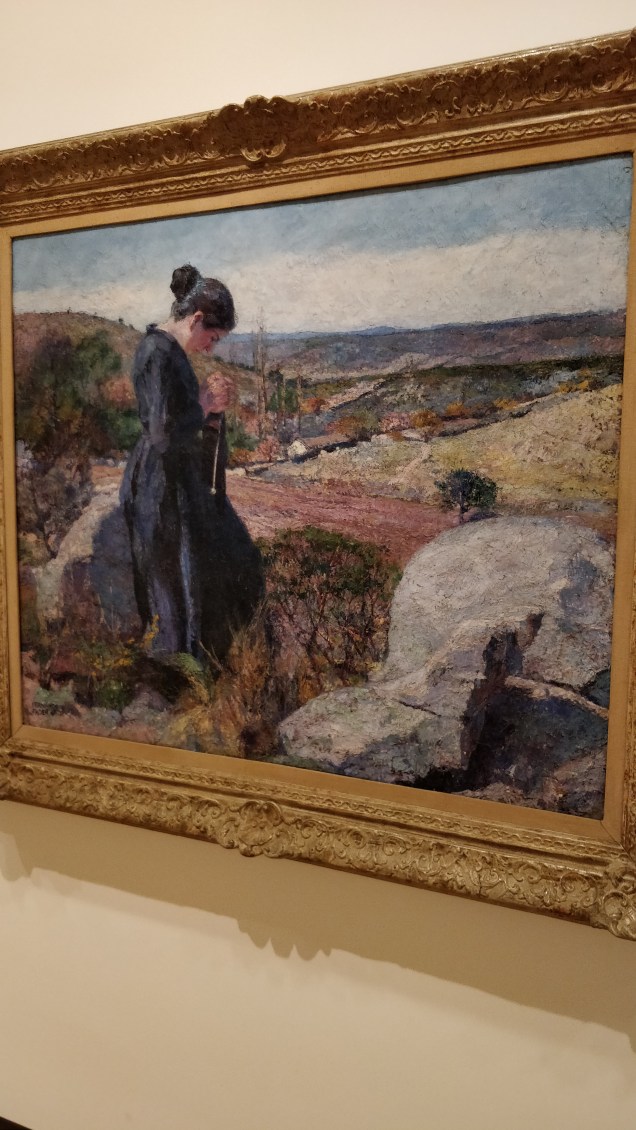
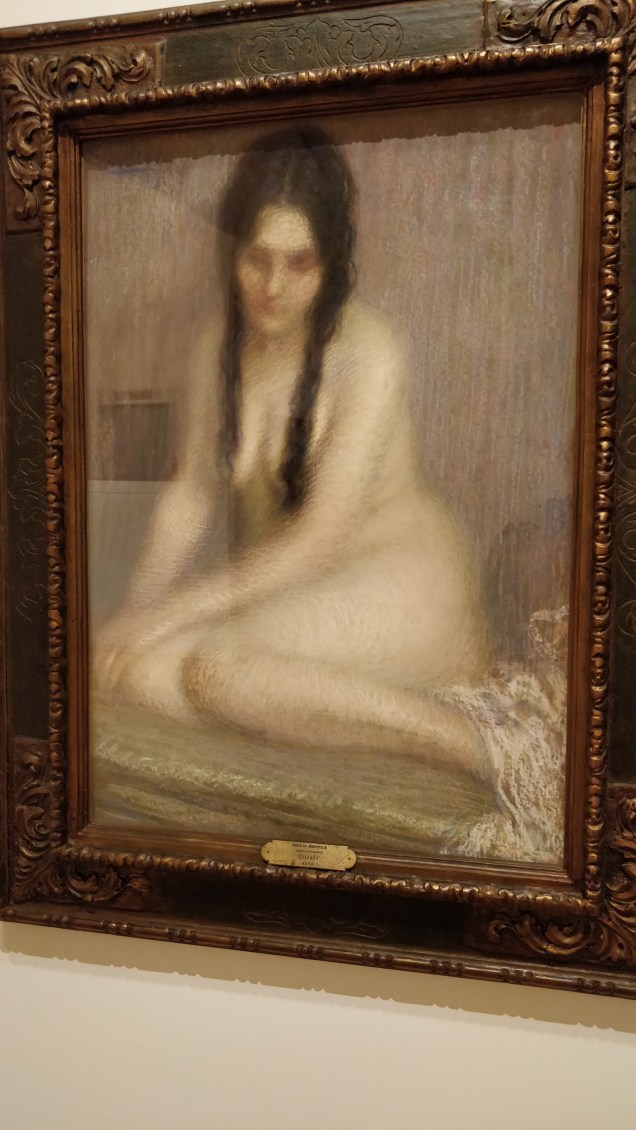
Cándido López’s “Wintering Eastern Army,” more beautiful in person than any photo I’ve seen.“To the Sunshine” by Fernando Fader, 1922, included here because she’s knitting.“Nude” by Emilia Bertolé, 1919
And into more modern styles:
“The Improviser,” Emilio Pettoruti, 1937
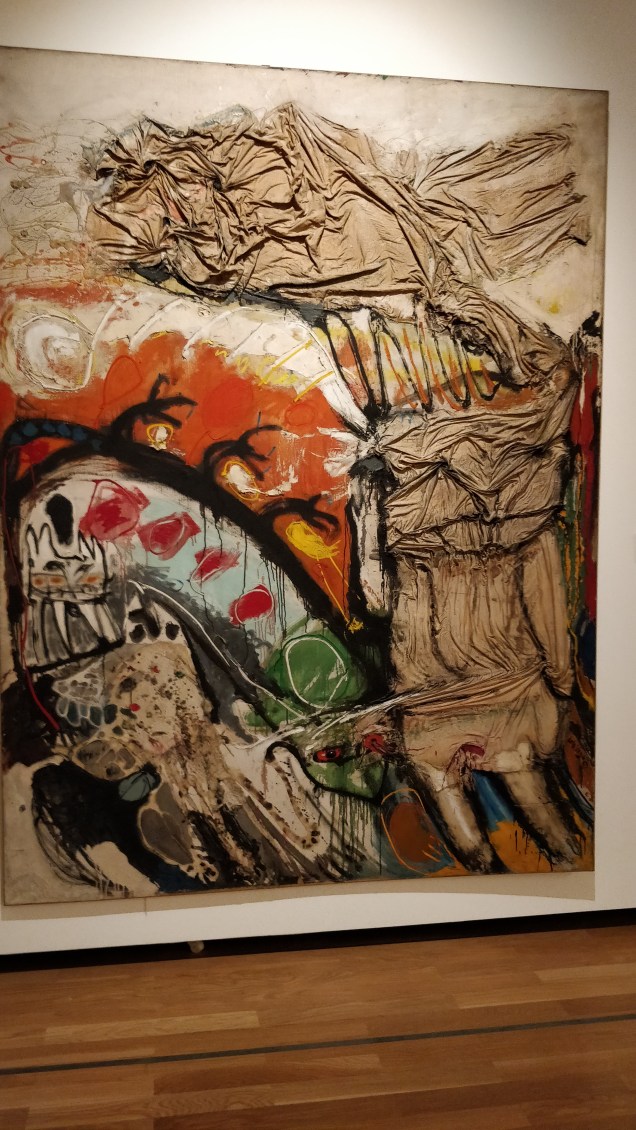
And mixed media works, such as Jorge de la Vega’s “A Timid Person’s Intimacy” (1963):
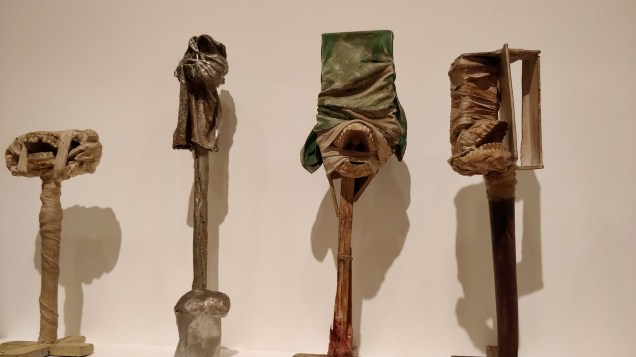
There are also, of course, Argentine sculptors represented, such as Alberto Heredia, who worked with discarded items to create his censorship allegory “The Gagged” in the early 1970s.
JEEEEEZUS WHAT THE HELL MAN
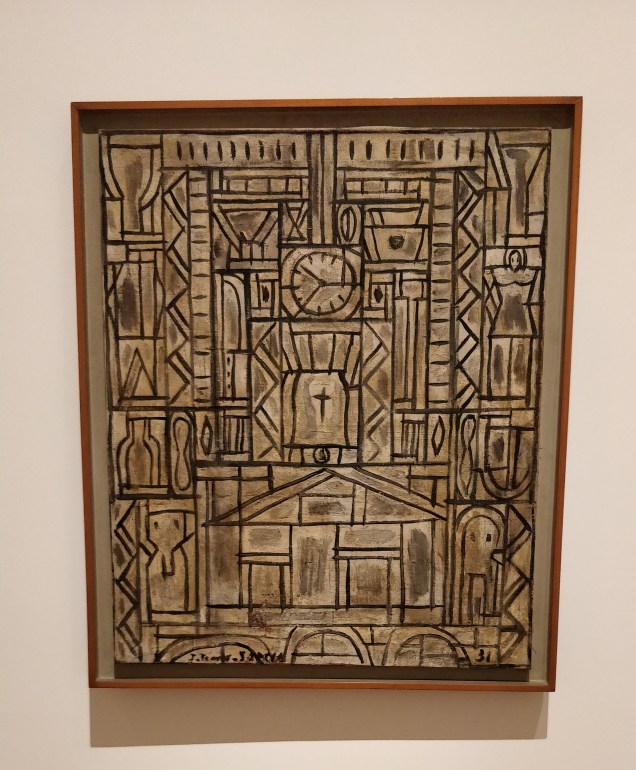
I’m also tacking on Joaquín Torres Garcia, who wasn’t Argentine but Uruguayan, because I really love his stuff so much.
“Contrast,” 1931
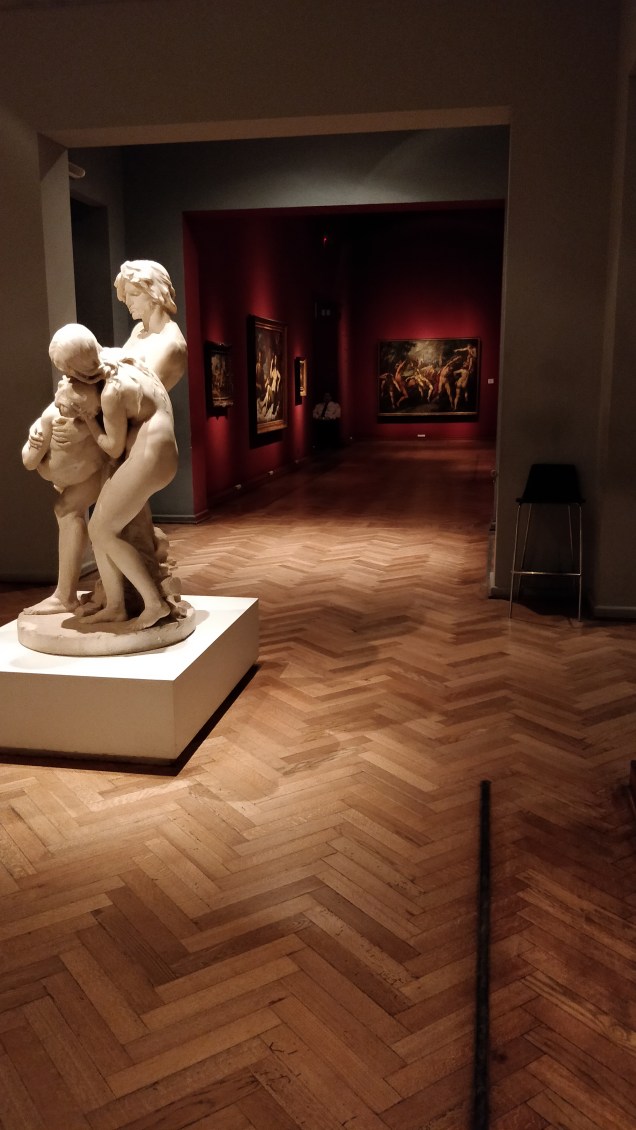
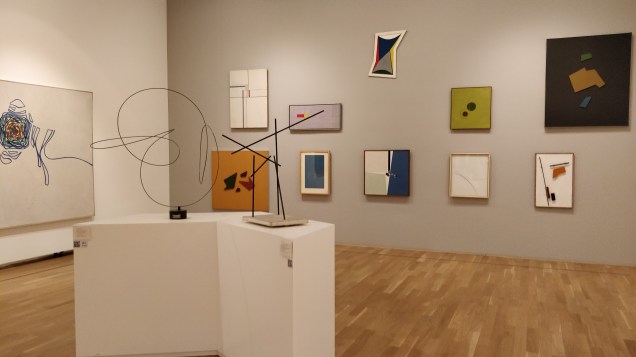
Finally, here’s views of a couple of galleries, to give you a feel for the place, and the difference between the classical art galleries and the modern ones.
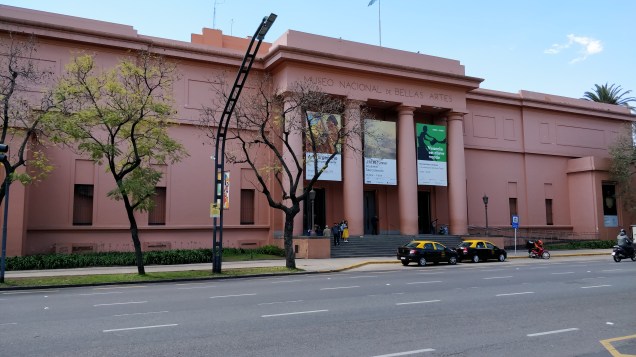
The Museo Nacional de Bellas Artes is big and pink and hard to miss at Av. de Libertador 1473 in Recoleta. You can get there on a lot of bus lines and the H line of the subway. It’s open 11am to 8pm Tuesdays through Fridays and 10am to 8pm Saturdays and Sundays. It’s free for Argentina residents and 100 pesos (currenetly about 3 bucks US) for non-residents, although it is free on Tuesdays and 645pm-8pm Wednesdays through Sundays. There’s a free English tour at 230pm on Wednesdays and Fridays. Most of the signage is also in English.
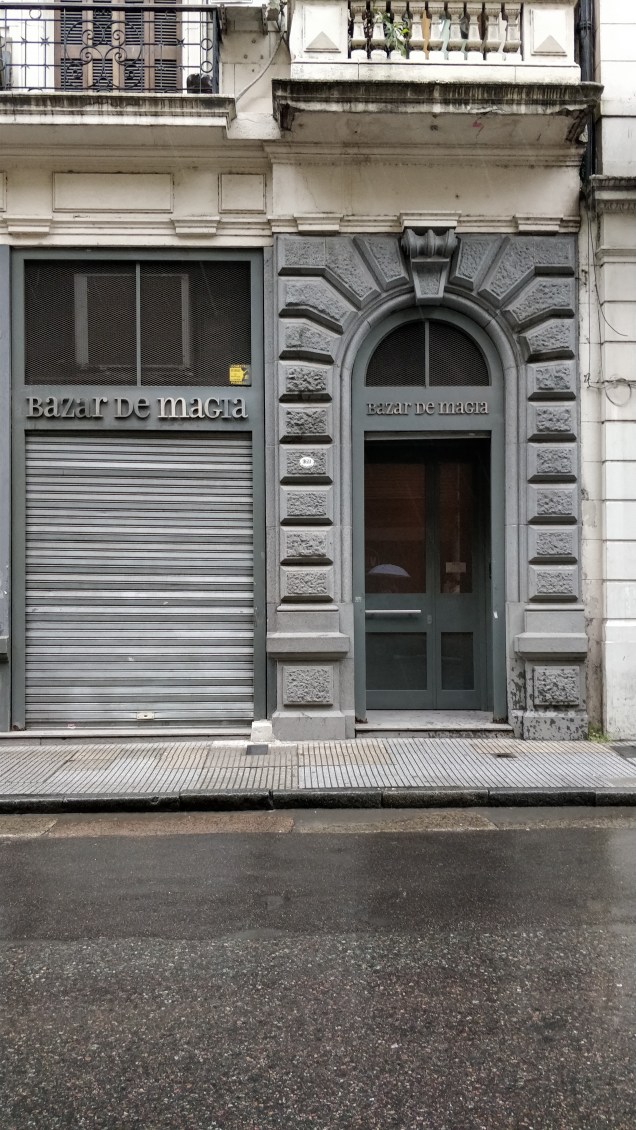
The Bazar de Magia, a shop that houses the Argentine Museum of Magic, is not particularly ostentatious.
It’s more classy and confident.
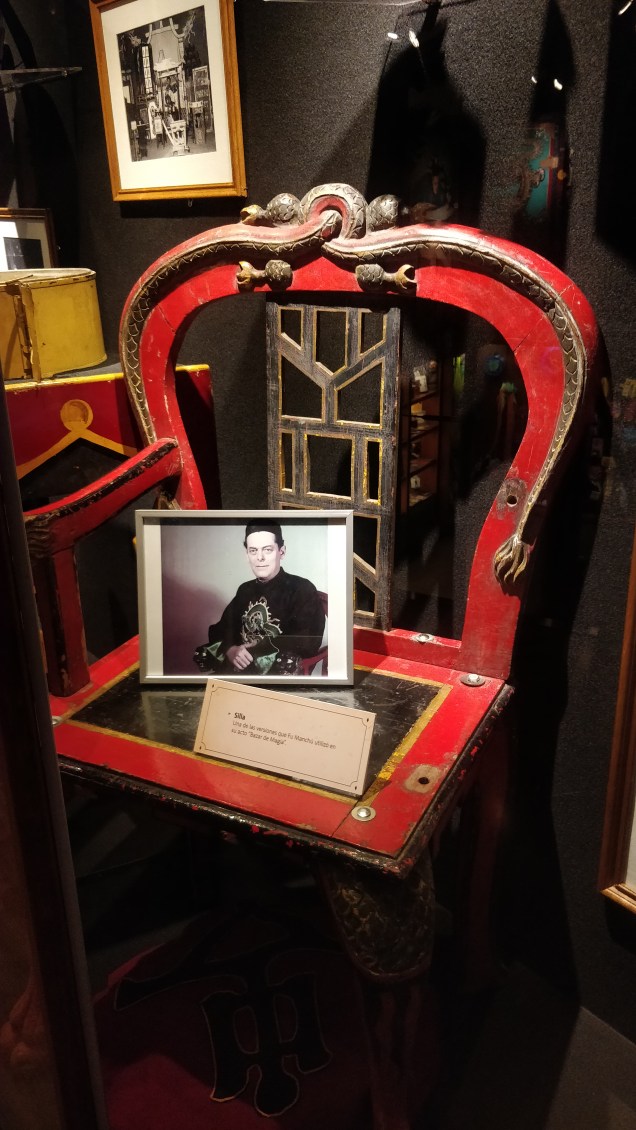
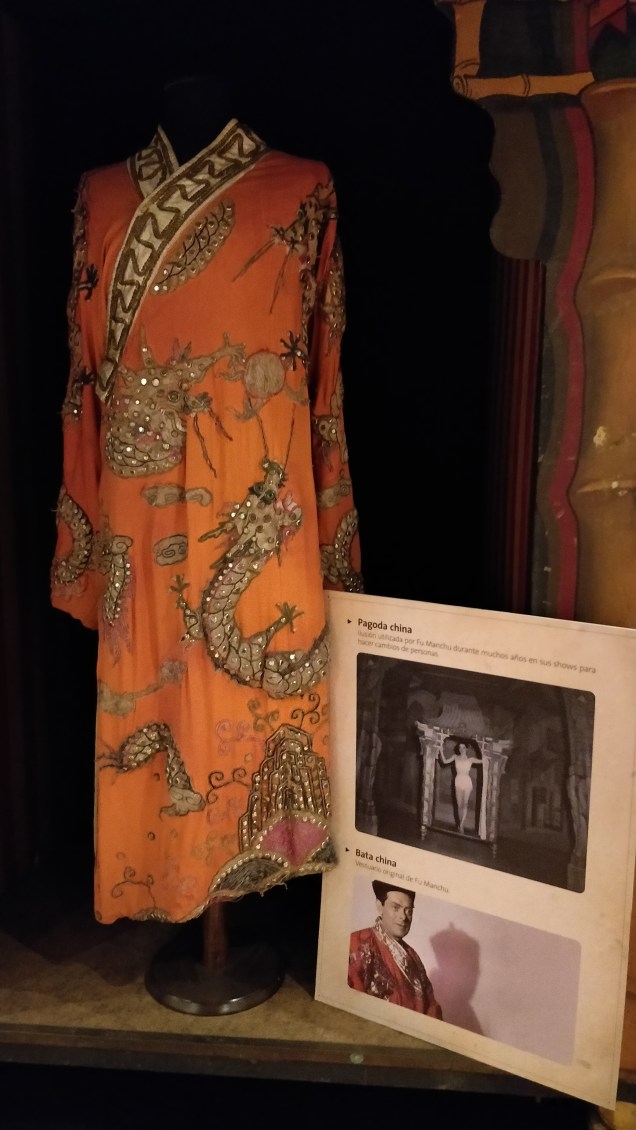
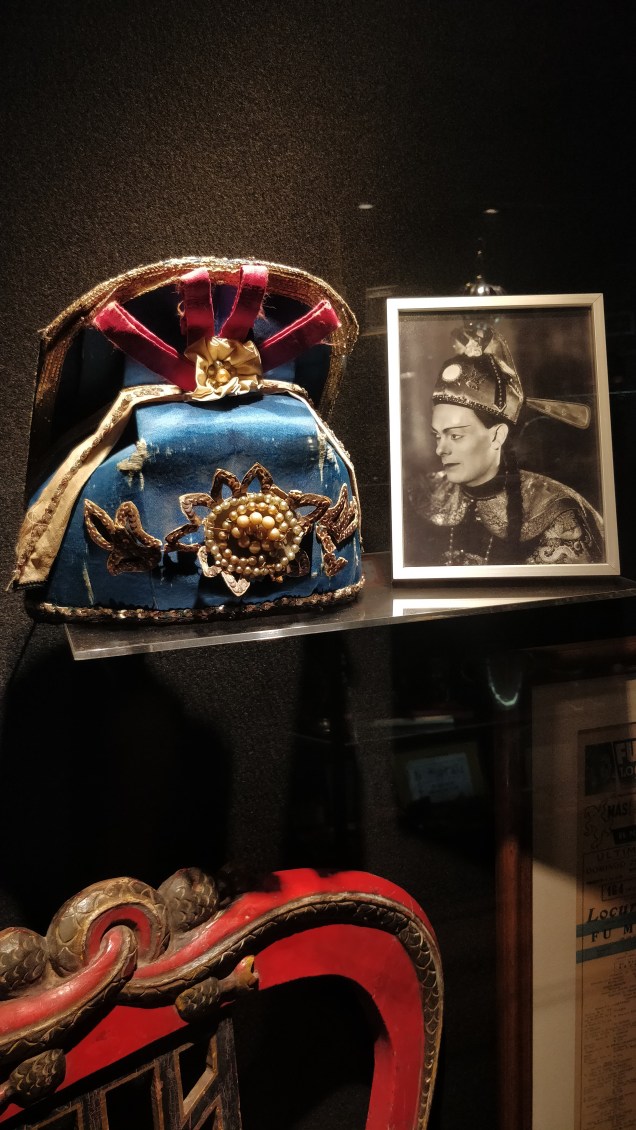
Stepping inside, however, reveals a slick space of vibrant color, from the enormous performance posters to the magic, clown, and practical joke props for sale. Visiting during normal shop hours will also grant you a look at a (small for museum but large for personal, which it is) collection of magic artifacts, including original posters from the 19th and 20th centuries, props, photos, and books. Most of it centers on one stage magician in particular.
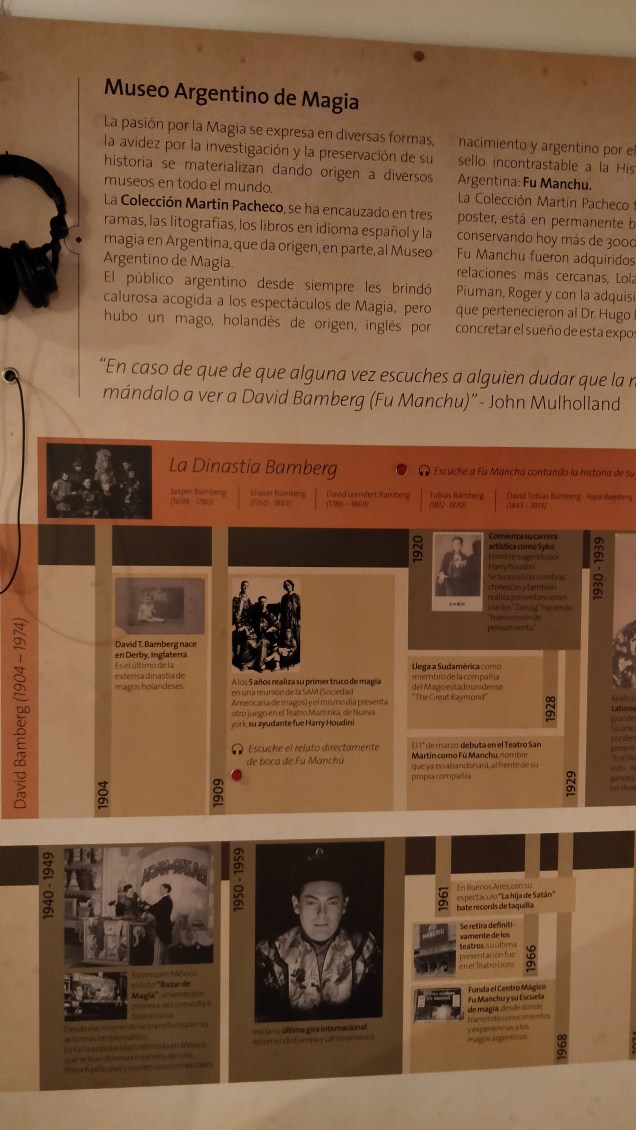
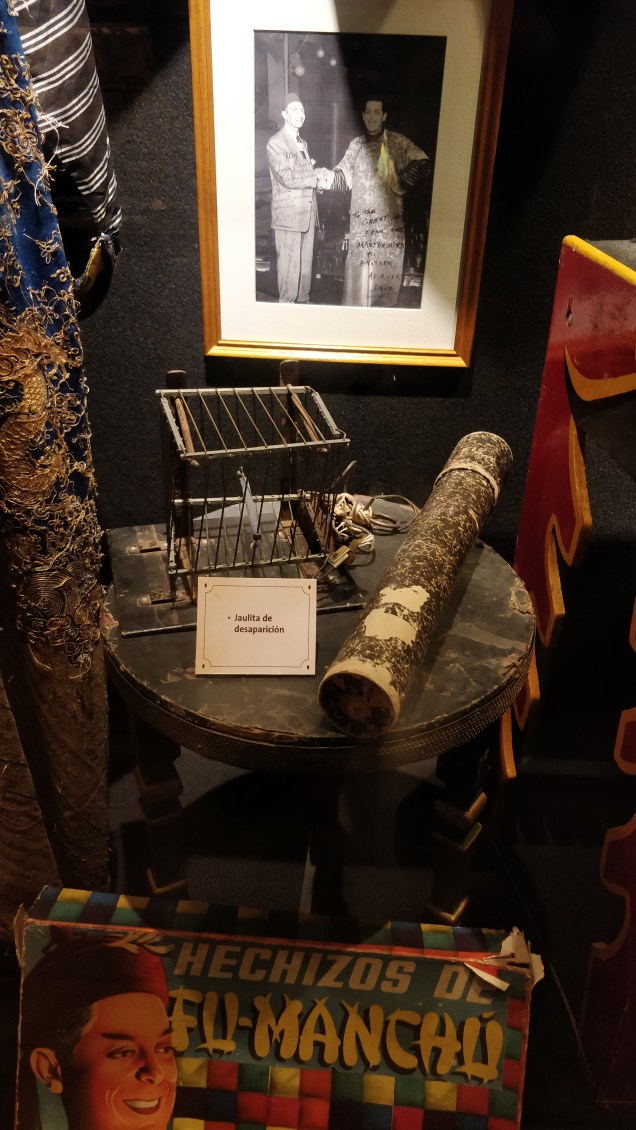
There was once a famous magician named David Bamberg, who was the seventh, and final, member of the Bamberg dynasty of Dutch magicians. During the first half of the 20th century, he performed in Chinese-style clothing under the fakey Chinese and remarkably racist name Fu Manchu.
A thing started by his dad.
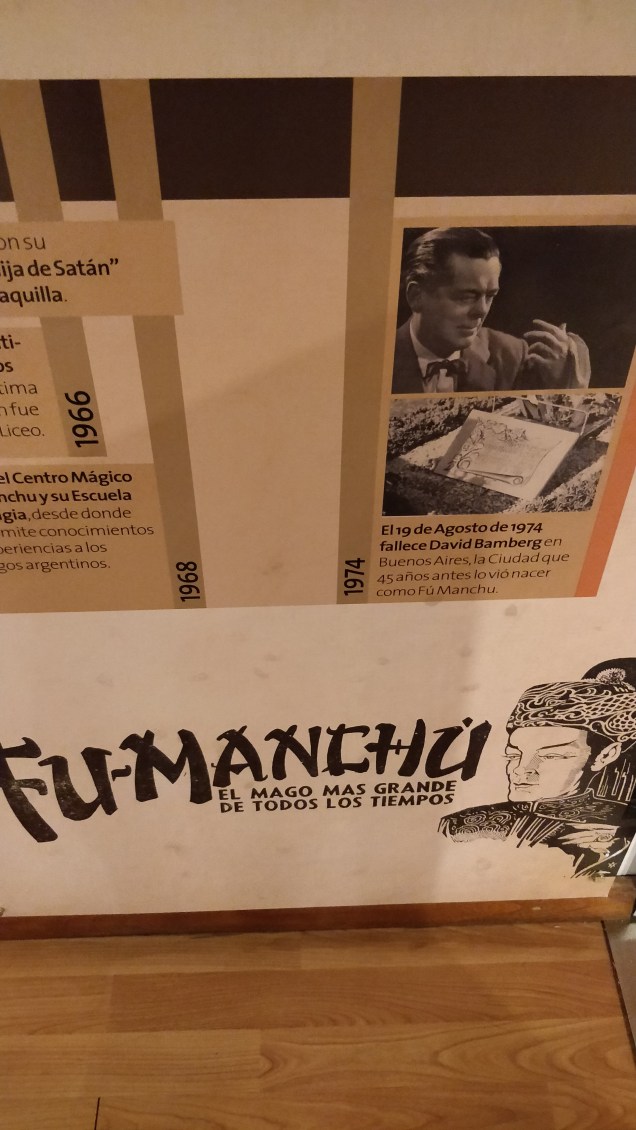
Odd place for a lot of the stuff belonging to a UK-born itinerant magician of Dutch extraction to end up, right? Well, David Bamberg started using the stage name “Fu Manchu” in Buenos Aires, and eventually retired here and opened a magic school. He died in the city in 1974.
The Spock ears, the finger nails…just…wow.
The museum is a small room, so it only takes a few minutes to look around, but if you’re interested in vintage magic stuff in general or David Bamberg in particular, you’re going to like it.
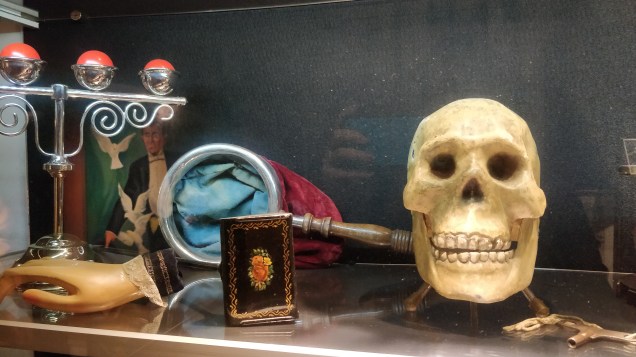
There is also a cabinet of mid-century Argentine magic props. The sign says the staff will not tell you how they work.
Although disembodied hands are pretty self-explanatory.
Visit the Argentine Museum of Magic in the Bazar de Magia during store hours every day but Sunday, but they break for lunch–check the website for hours. The store not only has magic props and gags, there’s also books on magic (even some in English). You can walk there from the Plaza de Mayo, and it’s around the corner from the Avienda de Mayo stop on the C line.
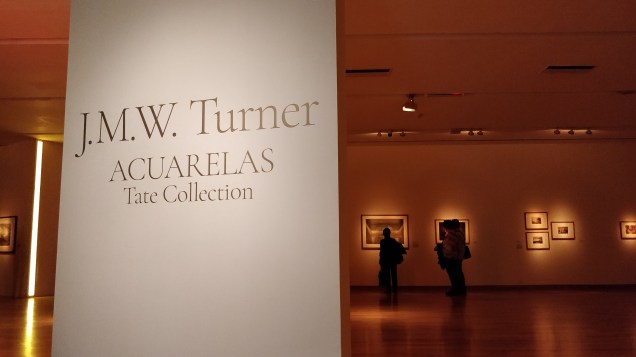
As you’d expect, it hosts some pretty impressive temporary shows. Currently, there’s one I was not going to miss.
From my scant education in art history, I picked up a couple of things about J. M. W. Turner: I love him, and he used very, very long titles. Also that he was very prolific. Ok, so three things.
Curators need something snappy, however
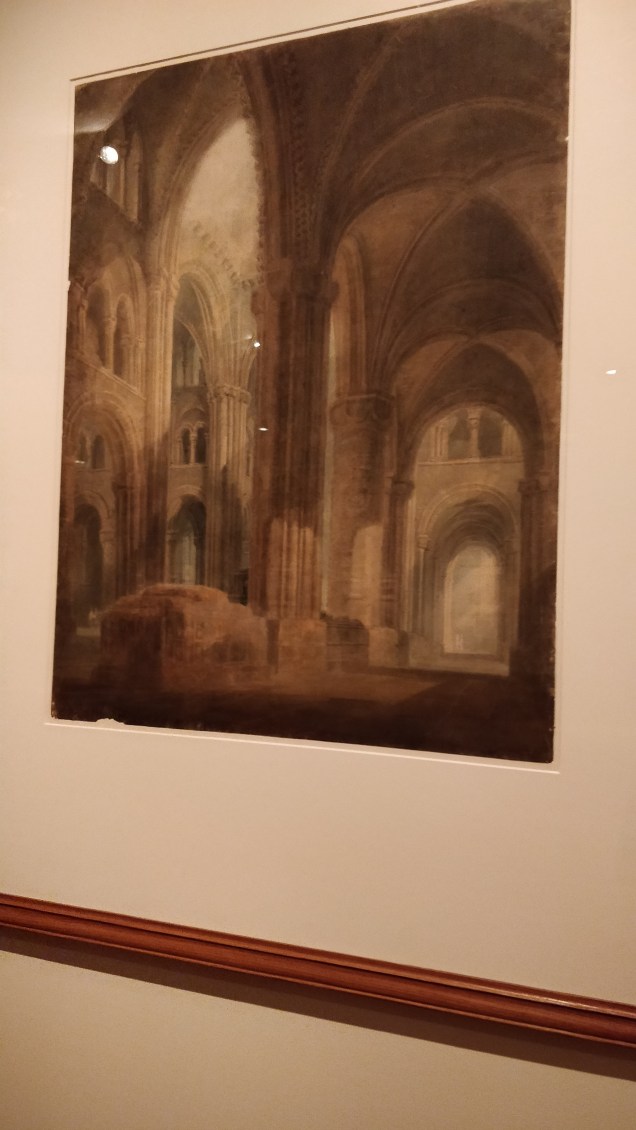
Eighty-five watercolors from the span of Turner’s career make up the show. They do not disappoint.
These two are from earlier on in his life, and you can read details about the paintings written by people more knowledgeable than I at the links, which go to the Tate’s website.
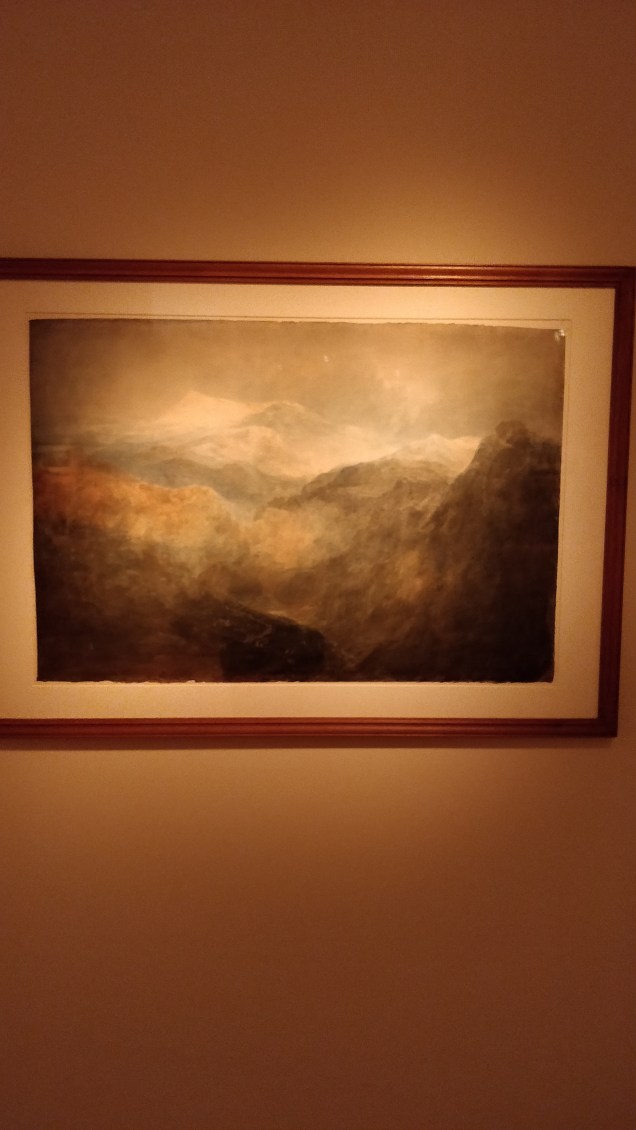
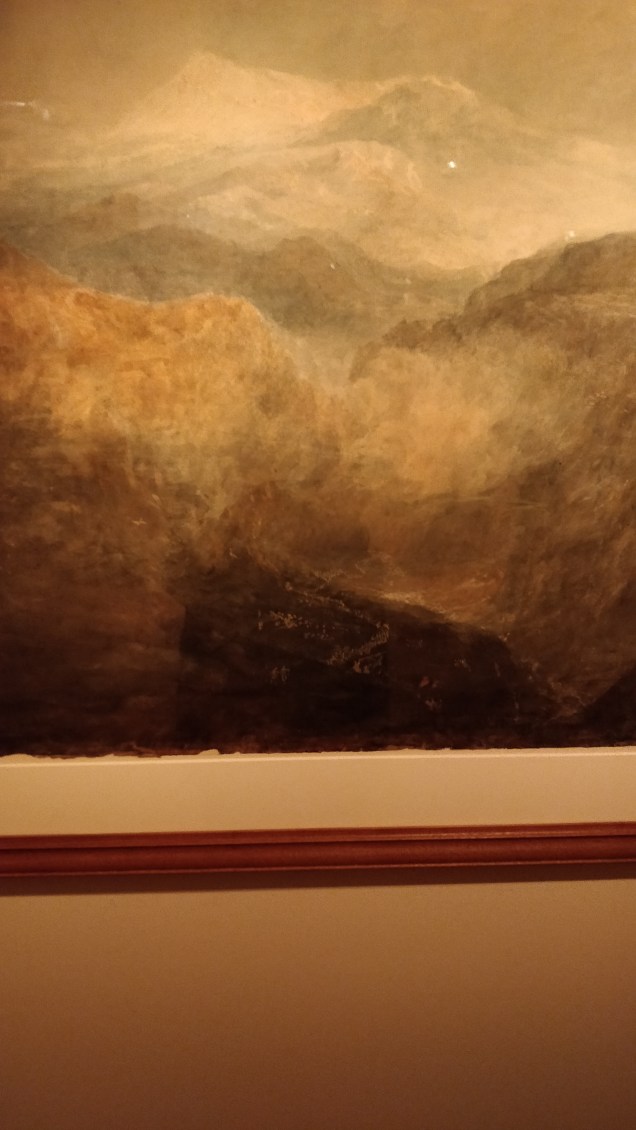
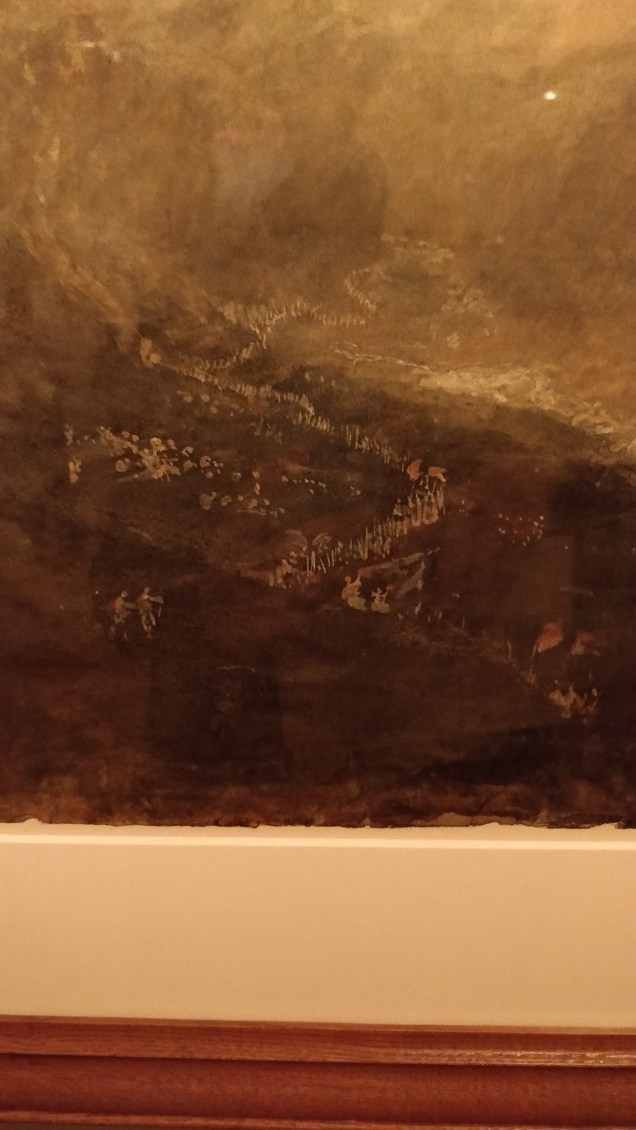
For my part, I enjoy looking at Turners from different distances. Here is The Destruction of the Bards by Edward I (c. 1799-1800). It’s a wild, beautiful landscape. Maybe you’re wondering where the slaughter of the bards is going on though.
SquintWait, is that a wall or sheep or whatOh there’s the mass execution.
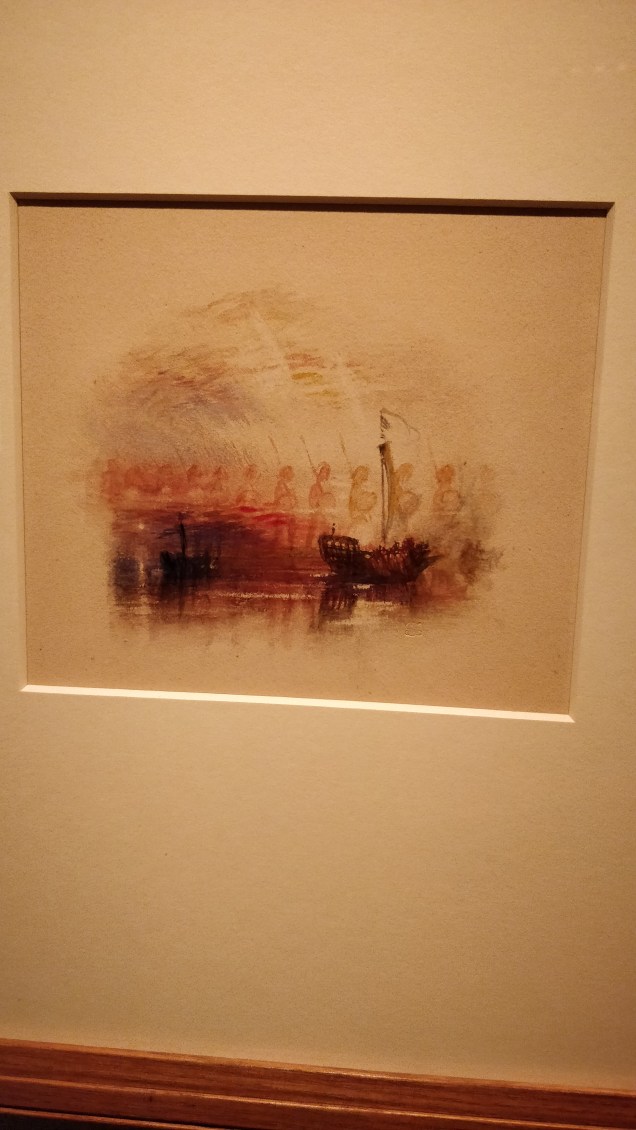
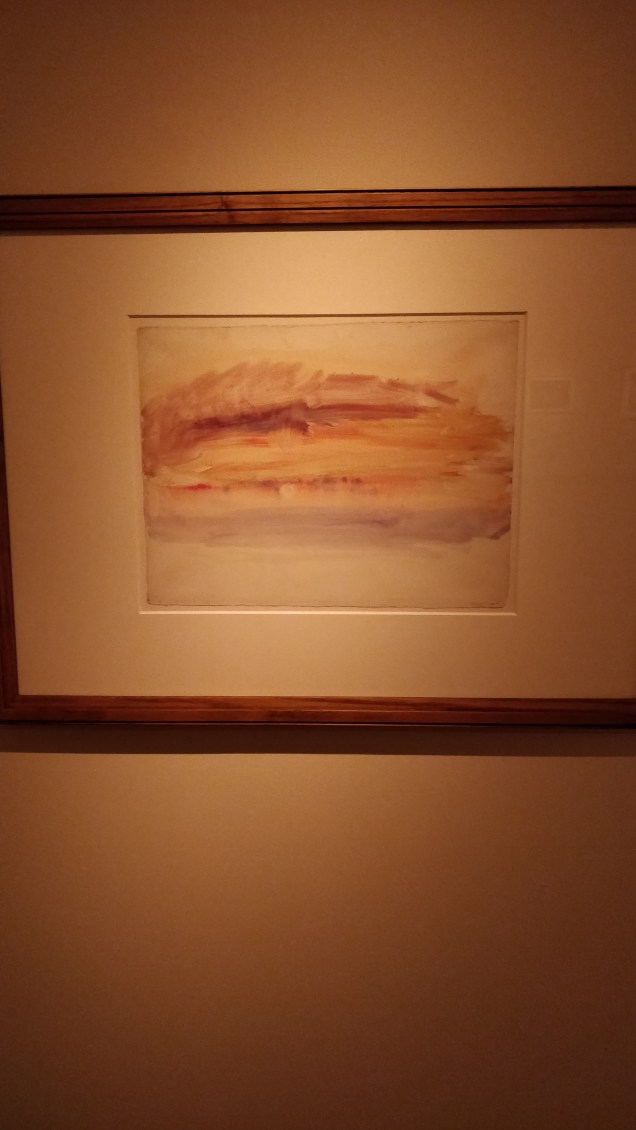
The landscapes (and seascapes) are my favorites, with the expressive colors and elusive atmosphere. I feel like I’m clearly looking at a scene, without being able to pinpoint what I’m looking at. Does that make sense? I feel like it doesn’t, but it’s the best I can do.
“The Vision of Columbus, for Rogers’s ‘Poems’“, c. 1830-2“Sea and Sky” c. 1845, one of many many many many “Sea and Sky”s from his late period, when his style took on a light touch, fluidity of color, and lack of detail, and he couldn’t be fussed with titles anymore.
Moving through his career and life in the form of his watercolors is a fine way to spend an afternoon. The explanatory signage is in both Spanish and English. The ticket into the show is AR$100, but it is free on Tuesdays and the rest of the week after 645pm (the museum is closed Mondays). The temporary exhibition pavilion is rather tucked away, so hold on to your ticket and follow your map, as the path isn’t obvious. As a major museum, swag is of course available, although Turner-specific swag has just two images to choose from. The exhibition closes February 17, 2019.
The Museo Nacional de Bellas Artes is easy to reach via the Facultad de Derecho station of the D line of the subway and sits between three major avenues in Recoleta. Can’t miss it.
I need to get this posted, because I was told that this museum will be closing next month, which sucks, because it’s pretty cool. It has a strong online presence, a good physical space, and a great staff. It will be a loss.
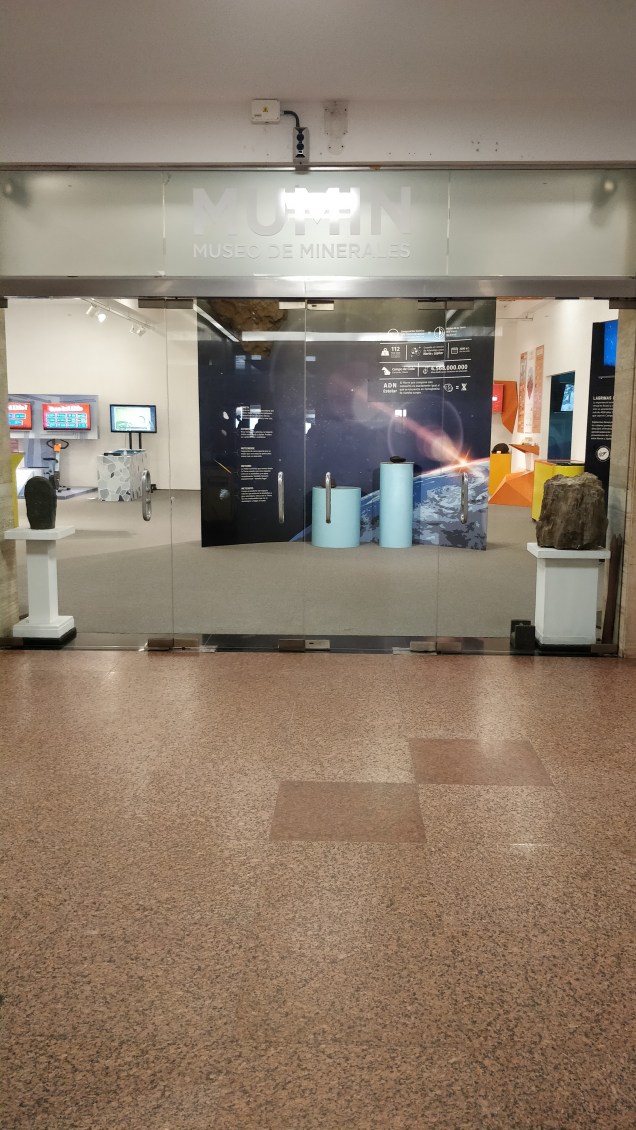
The MUMIN (MUseo de MINerales, get it?) is the educational endeavor of the SEGEMAR, the Servicio Geológico Minero (Argentine Mining Geological Service). It caters mainly to school groups, tasked with making rocks interesting to children. Geology, being perhaps not the sexiest of sciences, could make that a bit difficult to achieve, but they have done an admirable job. Things to touch, demonstrations to look at–there’s a lot of activity for minerals.
If a rock museum could have jazz hands
The museum is located within a government ministry building, the name of which escapes me at the moment–but you do need an ID to get in.
I poked around on my own until a staff member came out, discovered my terrible Spanish, and immediately went back to send out a very patient English-speaking geologist. He showed me around the museum, told me about all the displays, and answered all my questions. Let’s see a little of the collection! Argentina has a lot of mineral-related loot.
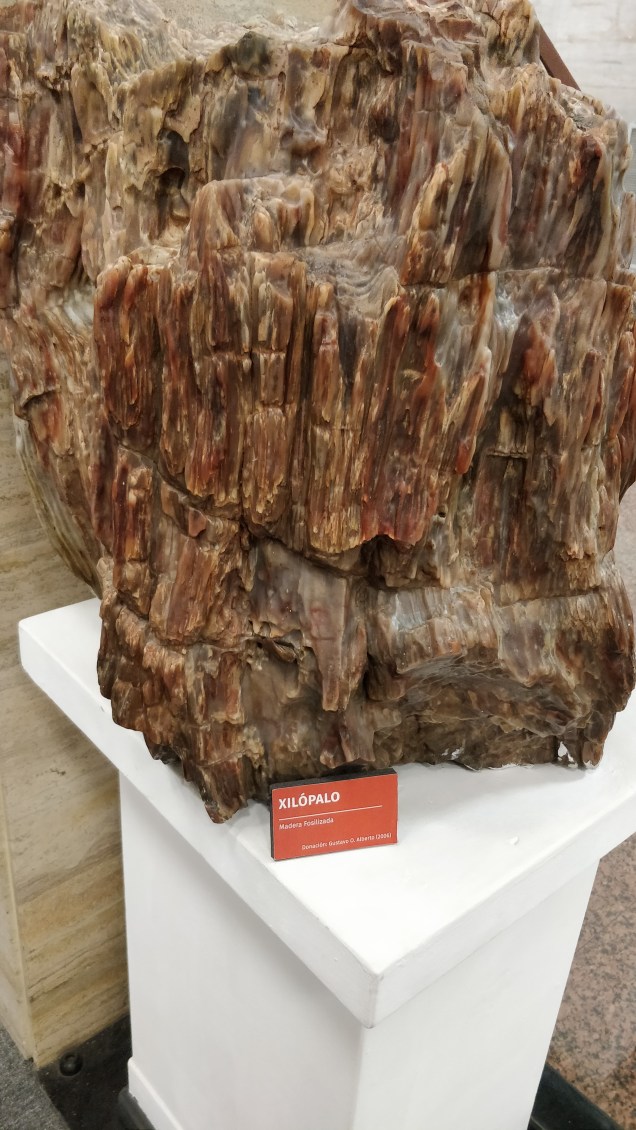
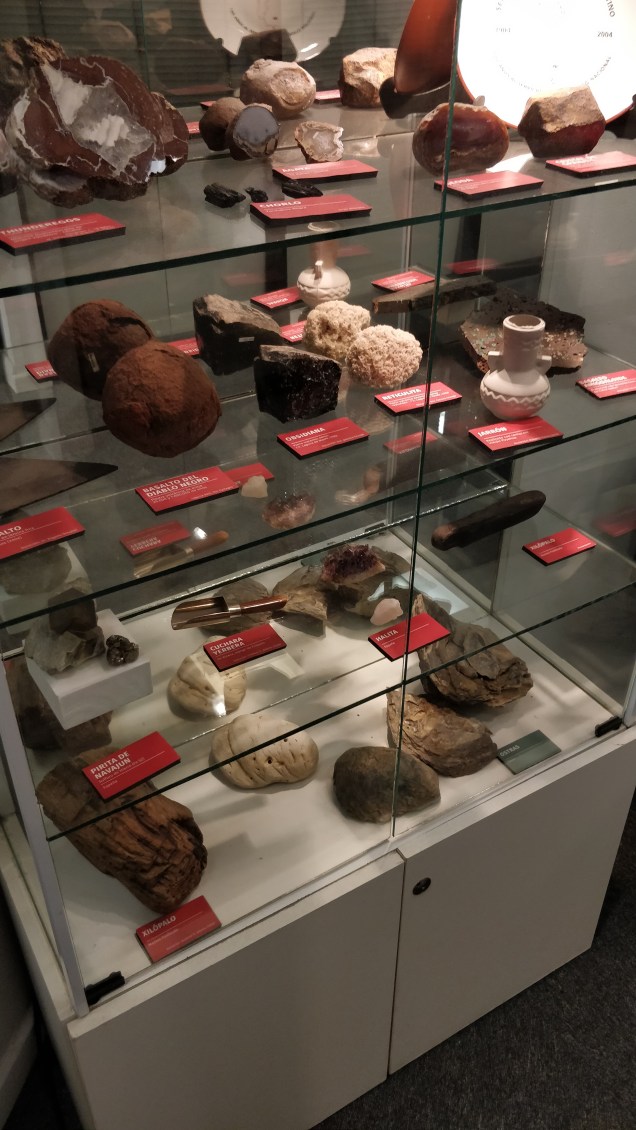
So, do you have a favorite kind of fossilized thing? ‘Cause I do.
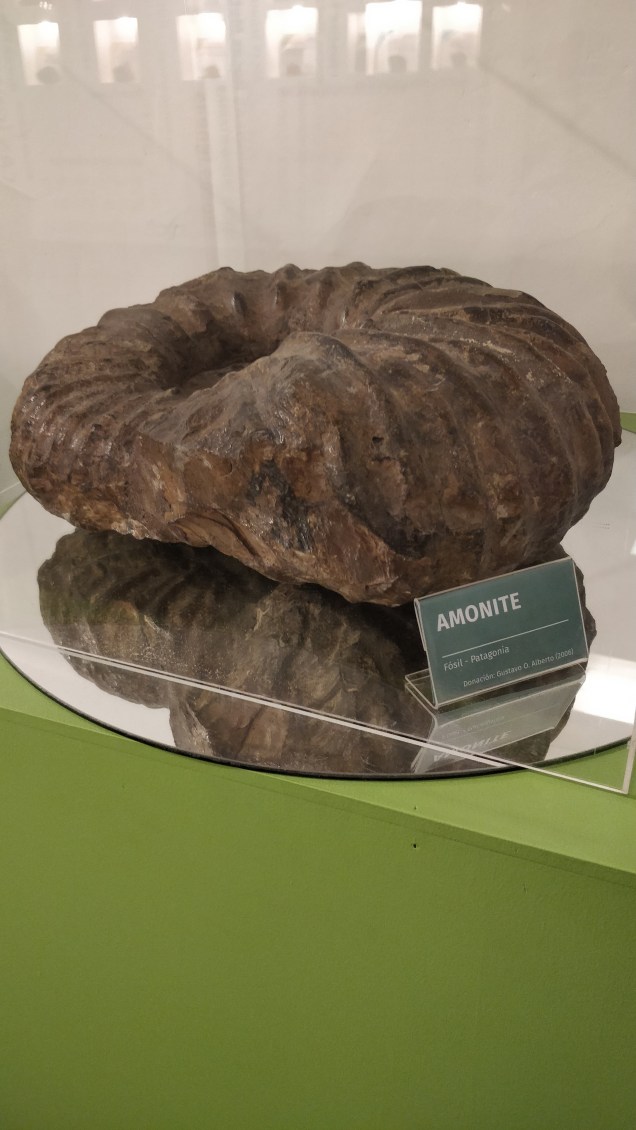
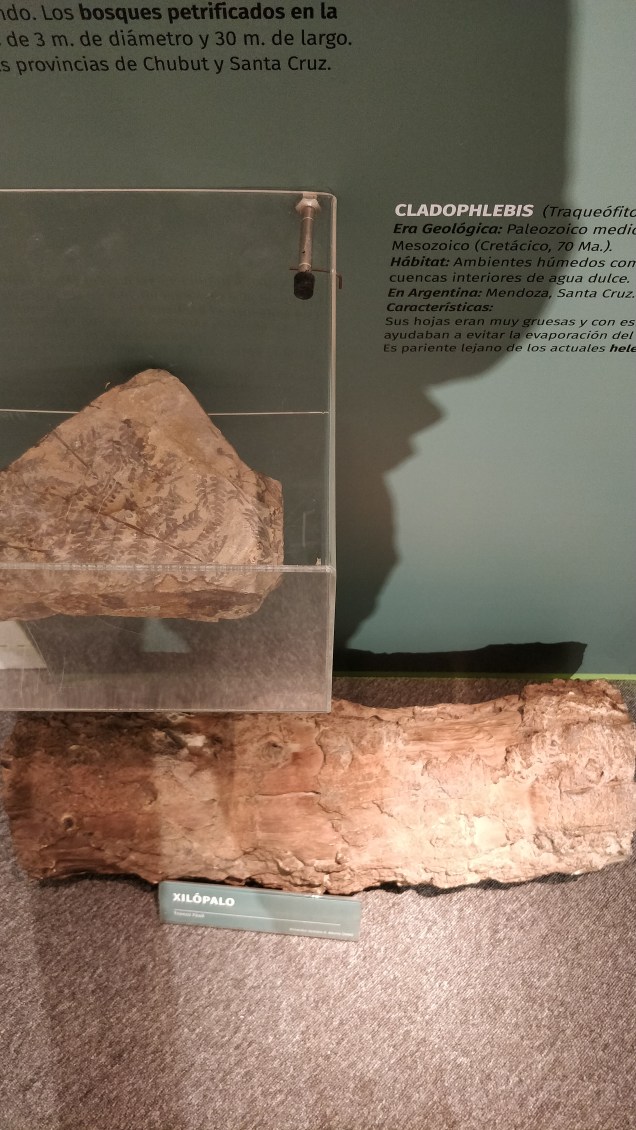
That thing is petrified wood, and the MUMIN has a huge chunk of it. Yaaass.Patagonia’s got some crazy fossil deposits.Up top you can see the impressions of a plant; at the bottom is a sauropod bone fossil.
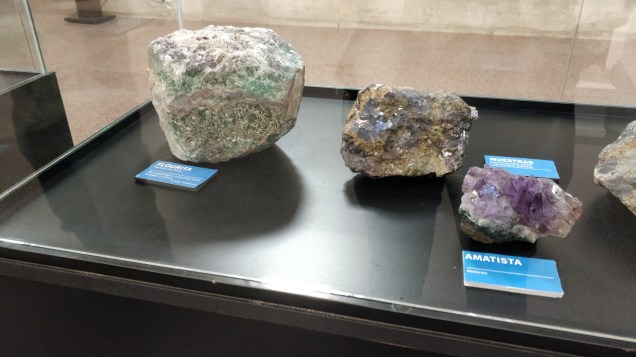
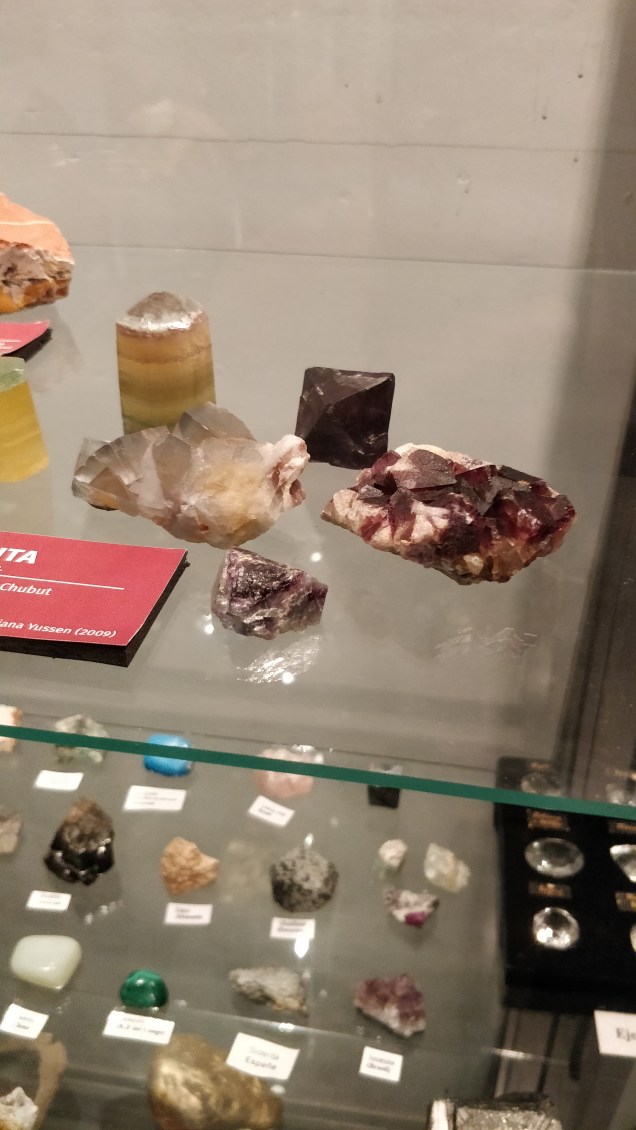
“That’s cool,” you’re thinking. “BUT ARE THERE PRETTY ROCKS”
Of course!
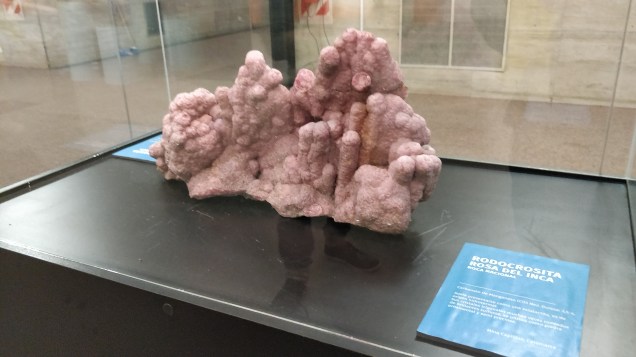
Fluorite! One of my favorite minerals.Big ol’ piece of rhodochrosite, the national stone of Argentina.
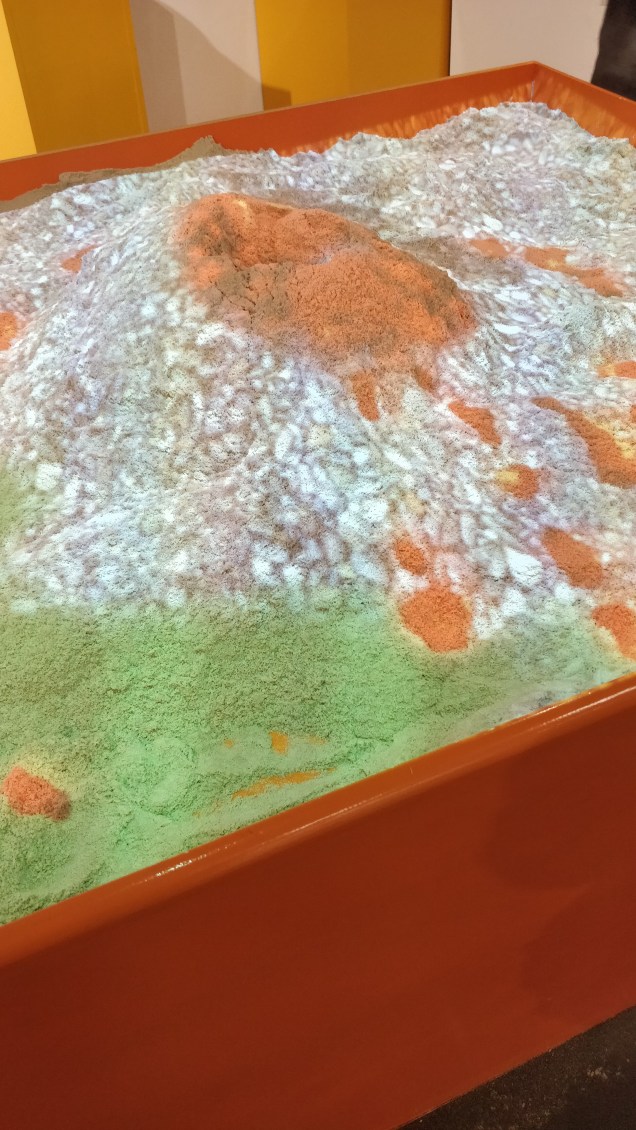
The museum does have an app available on the website that will do AR stuff with a few signs as well as a VR headset with a short meteorite thing to watch; nothing extravagant but fun and memorable. There are a few more hands-on elements to see/do, including some SUPER FUN SAND TABLES:
whaaaaaaaaaaaaat
If you move the sand around, the volcano changes:
There’s another one!
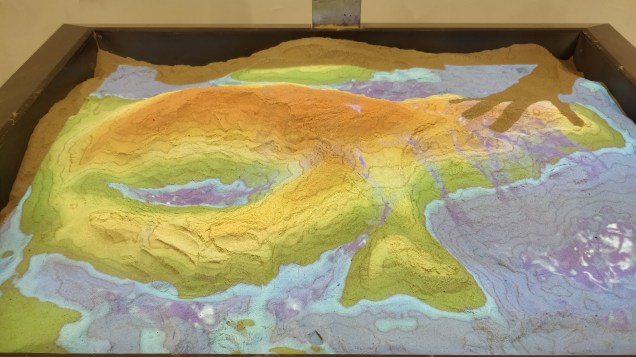
Islands in the stream, that is what we are
In this table, you move the sand around to form the topography of the land. Then you can make it rain by spreading your hand. The idea is to demonstrate how water moves over the topography.
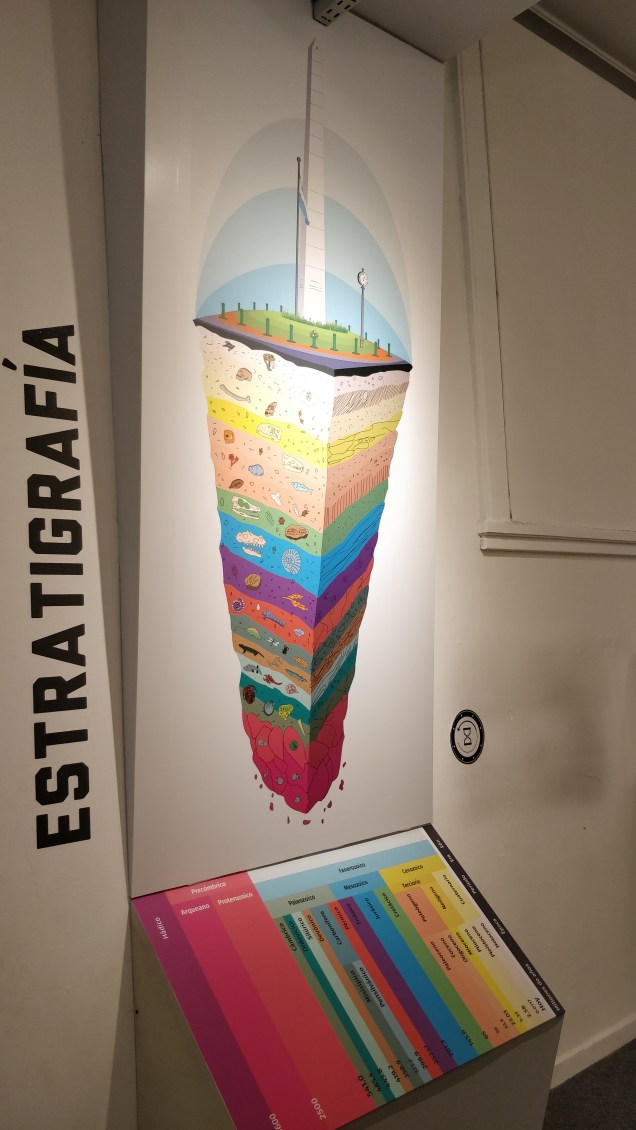
Know what else I liked? This Argentina-specific graphic of geologic time:
Although the geologist explained that it is just illustrative–if you dug beneath the Obelisco, you wouldn’t find a whole lot of the middle layers. You would, however, cause no end of excited reactions on the part of the local government.
Wanna see more minerals?
Good news.
I will never not find it fascinating that some minerals naturally grow in distinctive shapes.
NEVER.
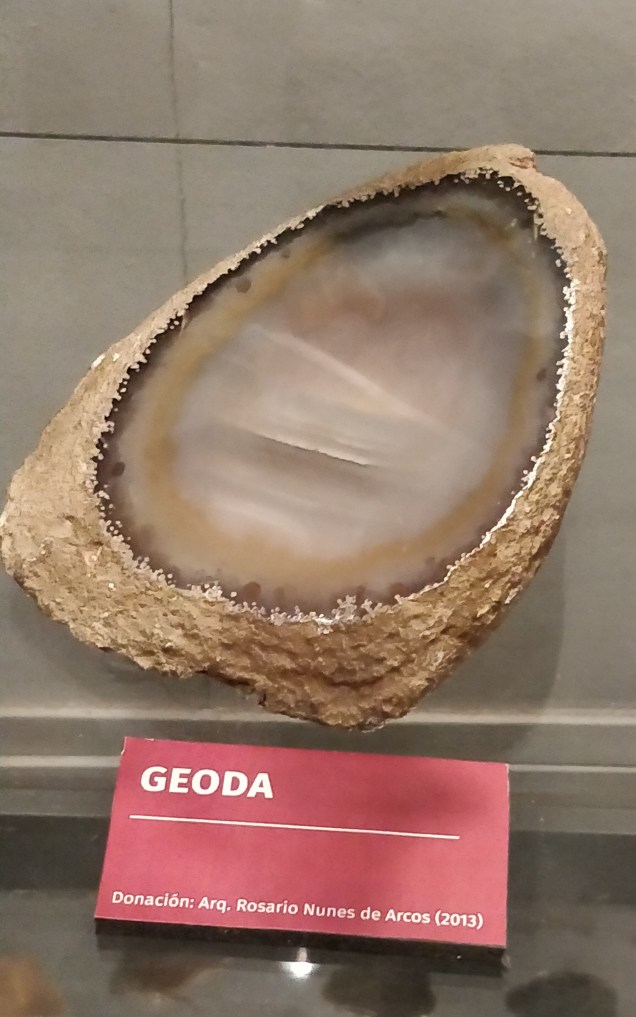
Finally, I will close this out with a geode.
The label doesn’t tell you this but the very nice geologist will, this geode is an enhydro agate–a geode with water inside of it. Did you know that was a thing? I had no idea that was even a thing!
The MUMIN is free and open to the public Monday through Friday from 9am-5pm (closed on holidays). Take your ID though because you need that to get in. It’s very close to the Plaza de Mayo and easily accessible by all the subway lines that go there. Go while you can.
The Ethnographic Museum is under the auspices of the Facultad de Filosofía y Letras of the University of Buenos Aires. It was founded in 1904, and it while it houses collections from other places in the world, it’s focused chiefly on this part of South America. There is a lot of information available on the English-language website.
I dig museums in old, stately houses.
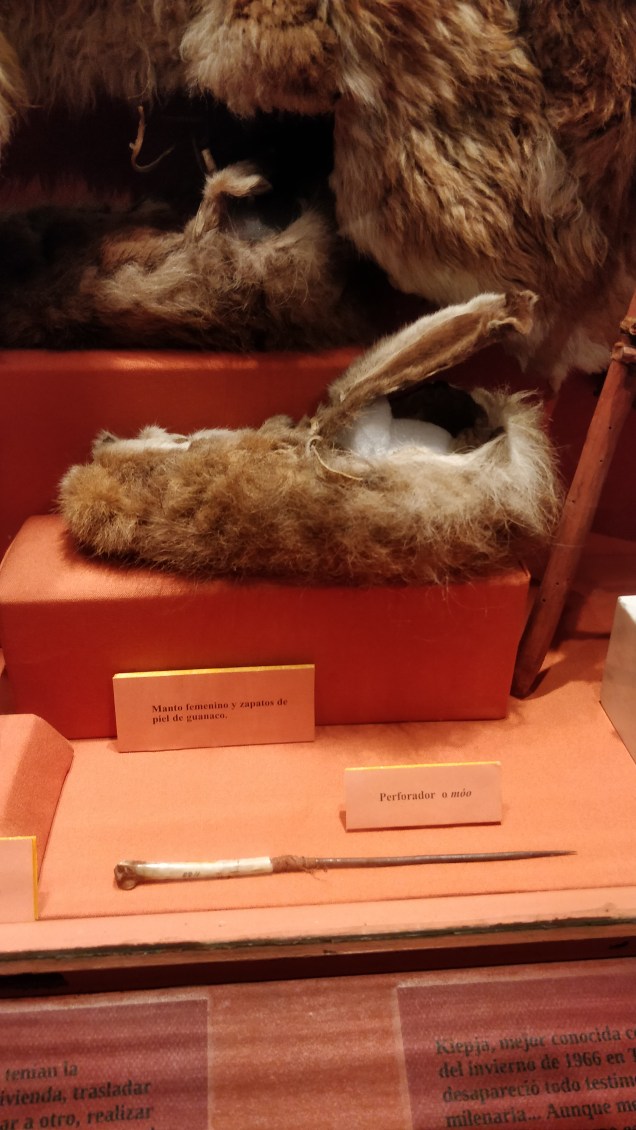
There are several exhibitions, and I’m not going to talk about all of them, because that would be a lot. The first one, The Uttermost Part of the Earth, addresses the native populations of Tierra del Fuego, and what happened to them. It’s not a happy story.
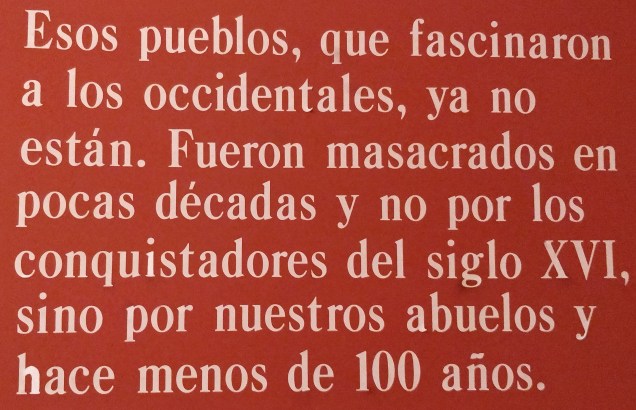
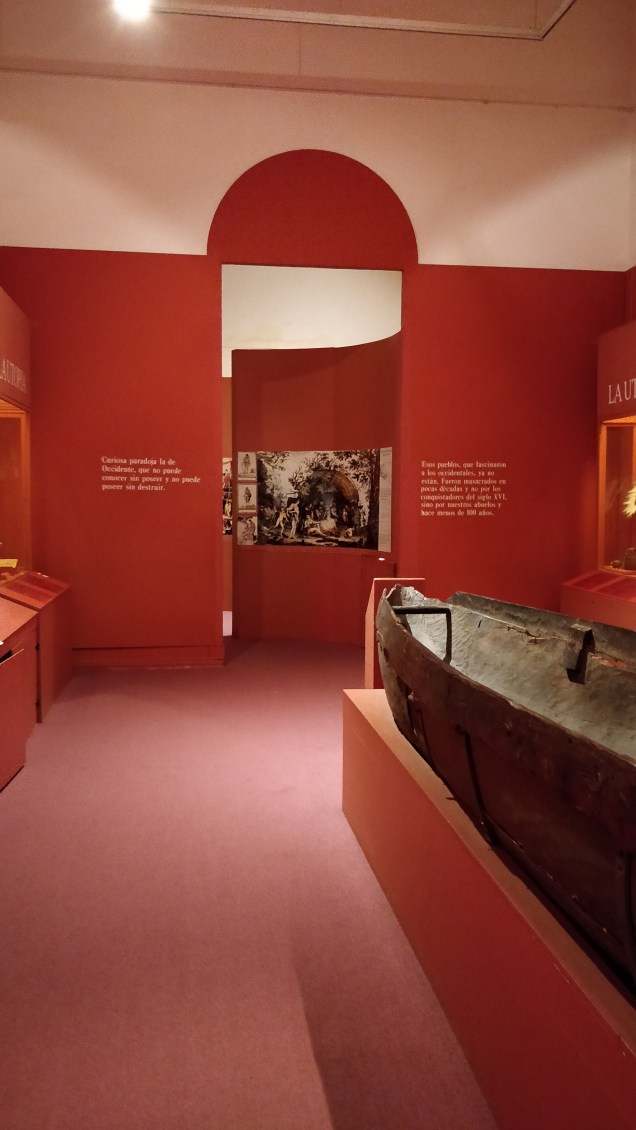
“These people, who fascinated the Western world, are here no more. They were massacred in a few decades and not by the 16th century conquistadors, but by our grandparents less than 100 years ago.”
There were two groups that had lived in the area for thousands of years: sea hunters (Kaweshkar and Yamana) and land hunters (Selk’nam). That went fine for awhile.
*sigh*
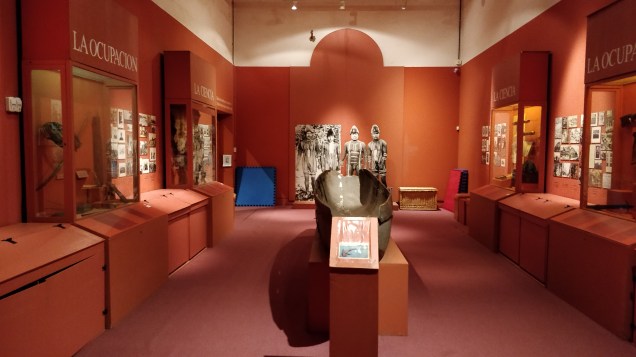
The hall is set up with the items of the Native peoples on the left, and items that would be used by explorers and colonizers on the right. A model of a Yamada-style canoe is in the center. There is a guide at the beginning of the hall that translates all the text into English.
Each side is labeled “utopia,” “occupation,” and “science.”
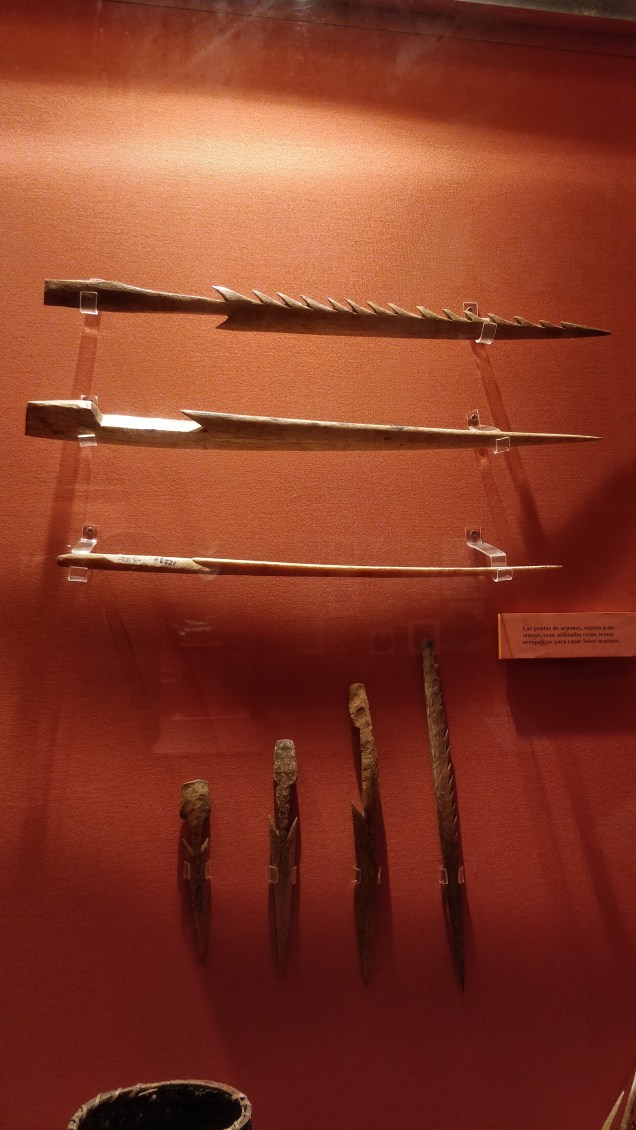
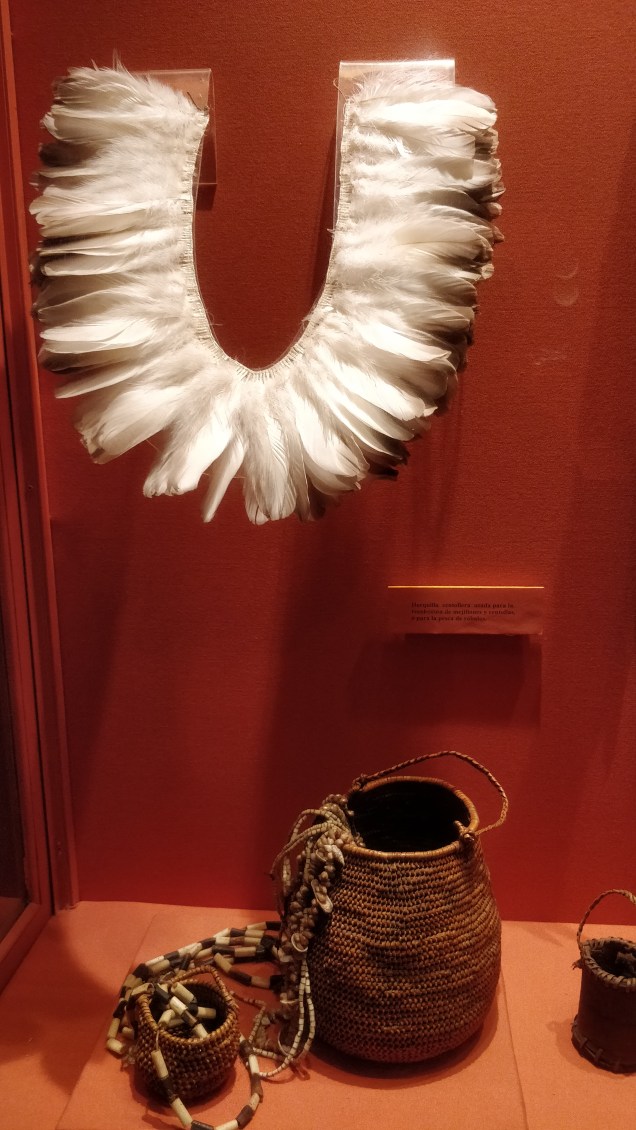
Let’s take a look at the Native artifacts first.
Meet Robert Fitzroy, captain of HMS Beagle, the ship that Charles Darwin sailed around South America on:
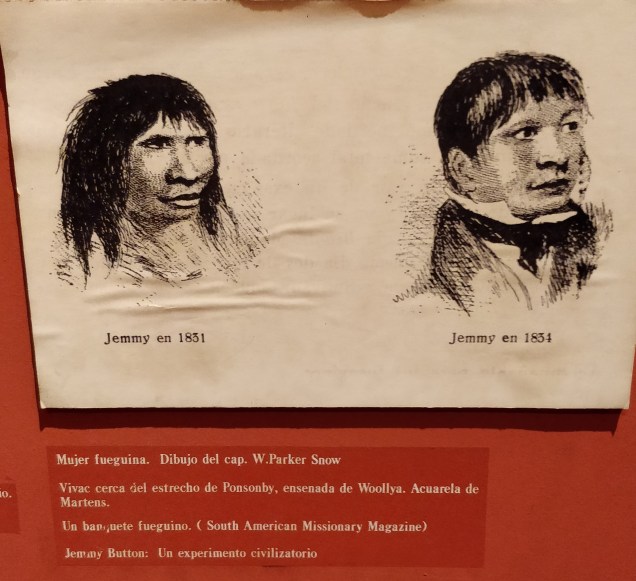
Now meet O’run-del’lico, a Native boy kidnapped by Fitzroy in retaliation for a stolen boat, who was renamed “Jemmy Button” because his family was given a button for him while he was taken back to England for a long time.
No part of this story is okay.
He and three other kidnapping victims, renamed York Minster, Fuegia Basket and Boat Memory, because no indignity was too small to inflict on them apparently, were supposed to be “civilized,” Christianized, and returned to Tierra del Fuego to serve as missionaries and intermediaries. Boat Memory died in England. The other three dropped Europeanism like a hot brick and reintegrated into their tribe immediately on their return.
“Hey,” I can hear you asking, “what other insanely racist things resulted in contact with Natives?” Hahaha.
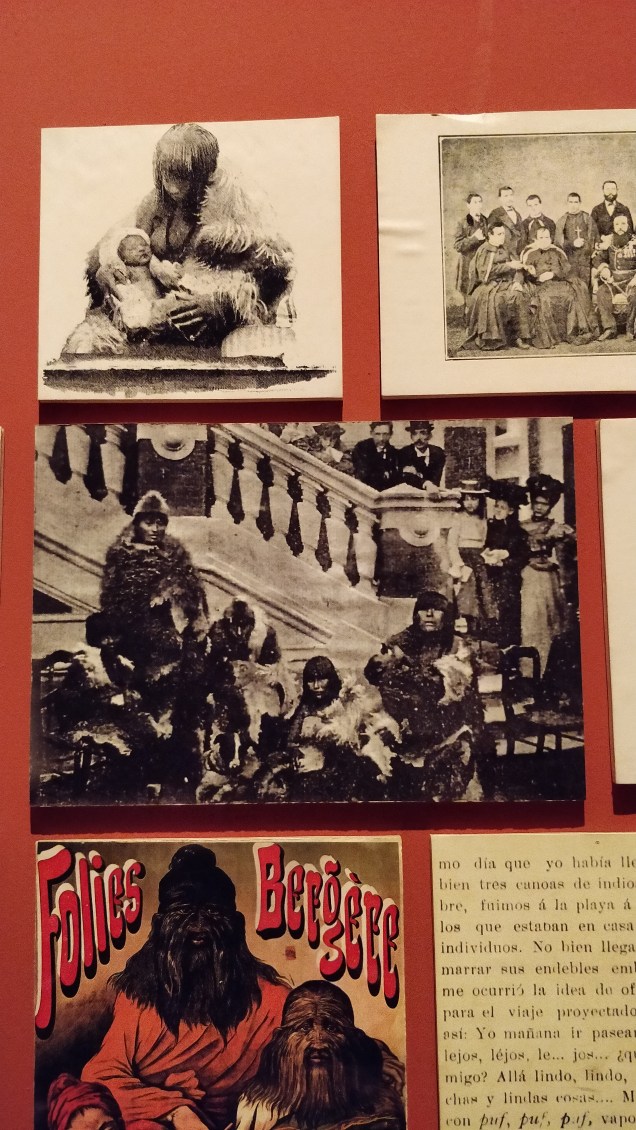
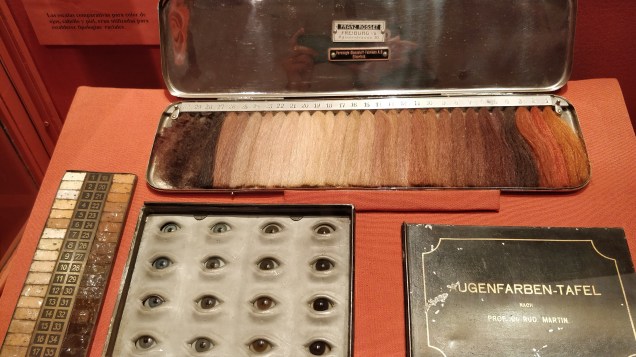
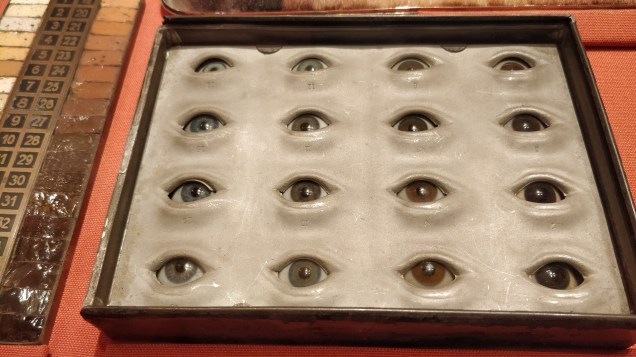
Incidentally, the quote on the right side of the wall says, “A curious paradox of the West, that it cannot know without possessing, and it cannot possess without destroying.”So human zoos were a thing that happened.And there was stuff to help color-code people.YEEAAAAAAGH WHY DO THEY ALL HAVE EYELIDS
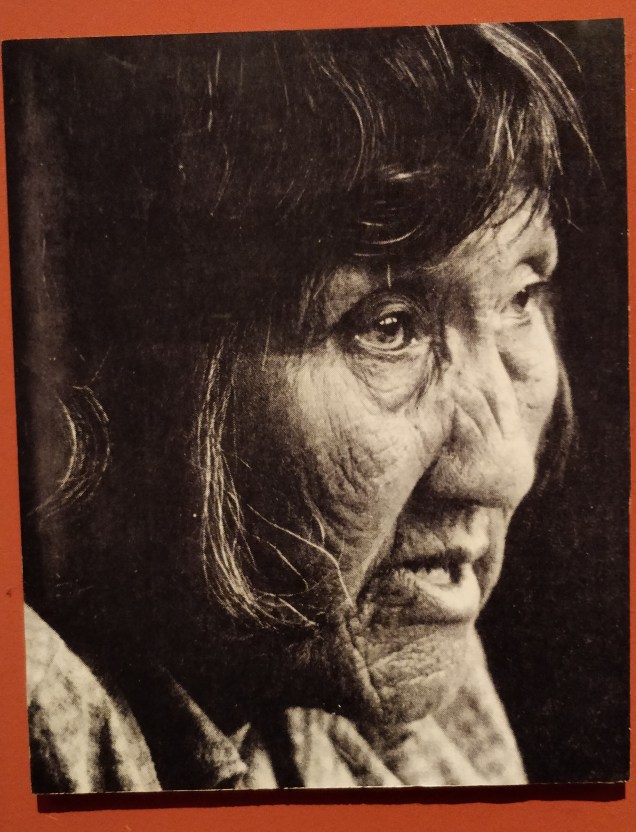
The Selk’nam didn’t long survive sustained contact with non-Natives, which would come to include actual contract murder. The very last died in the 1970s. I’ll end this part with a song, included in the museum’s English guide and I believe from Anne Chapman’s book The End of a World, of the last shaman, Lola Kiepja (recordings available at that link):
“Here I am singing, the wind carries me; I am following the steps of those who are gone. I have been allowed to come to the mountain of power, reaching the great mountain range of heaven, the way to the house in heaven. The power of those who are gone comes back to me. I step into the house in the great mountain range of heaven. Those from infinity have spoken to me.”
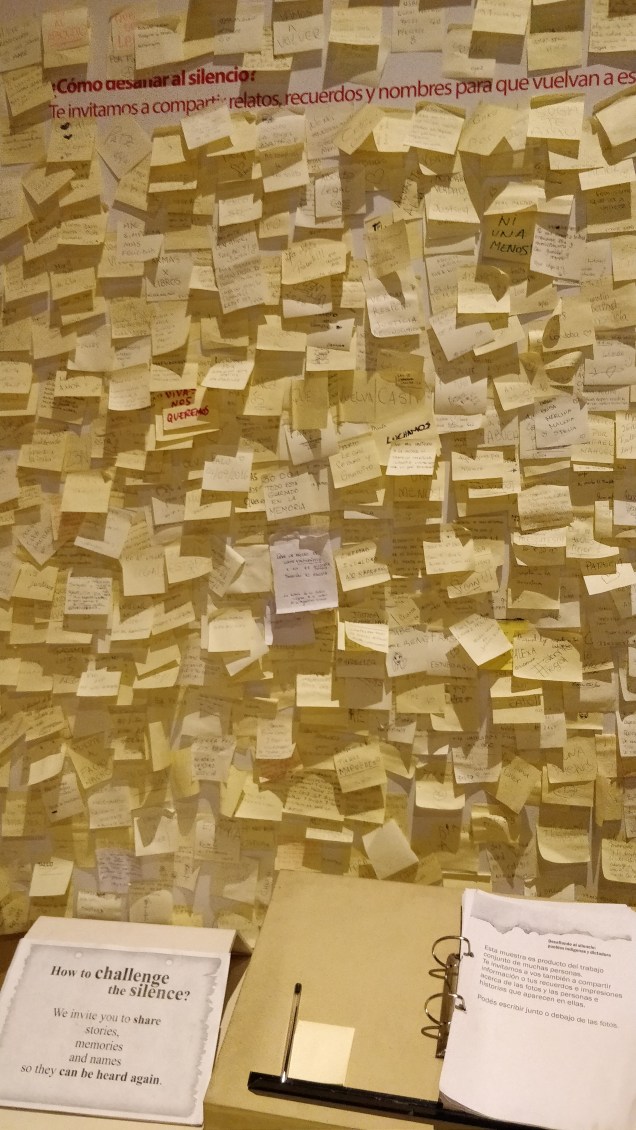
The next exhibition is “Challenging the Silence: Indigenous People and the Dictatorship,” so the reading isn’t going to get any lighter here.
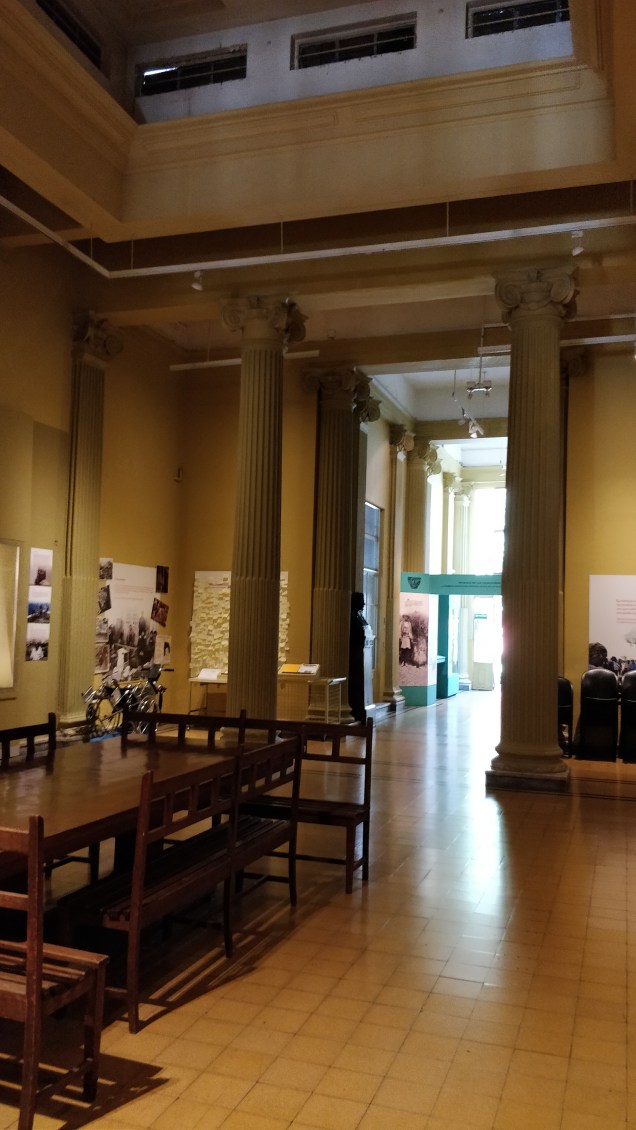
Main hall/exhibit space.
The last military dictatorship (supported by the US, I might add), as I’m sure you’re aware, is still very much in living memory here. Visitors are encouraged to leave a Post-It on the wall, which says, “How to challenge the silence?”
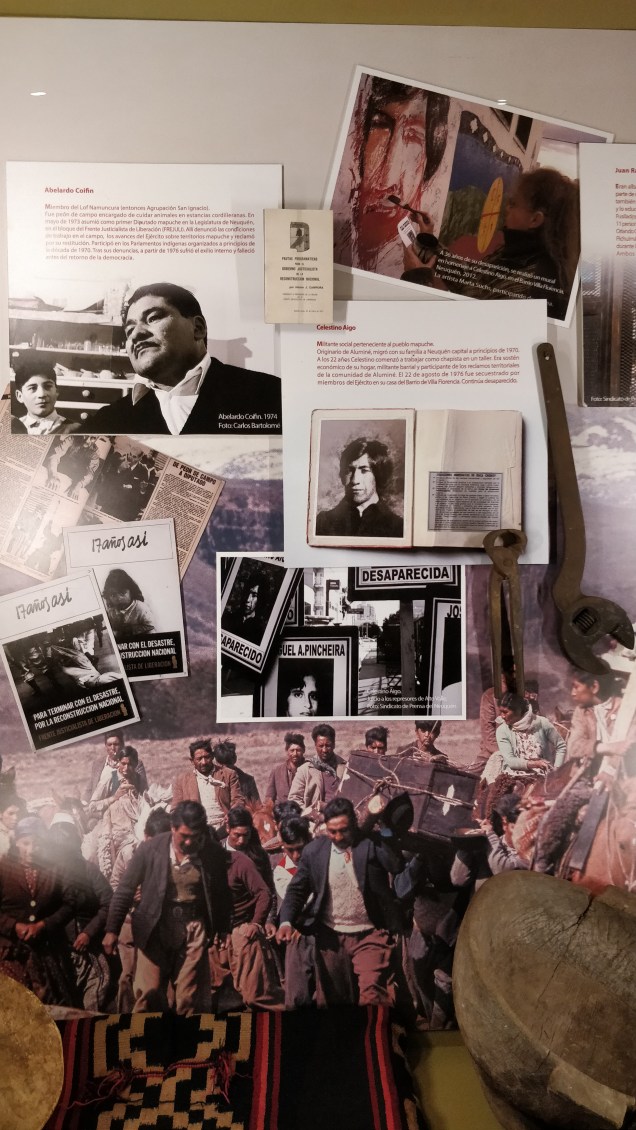
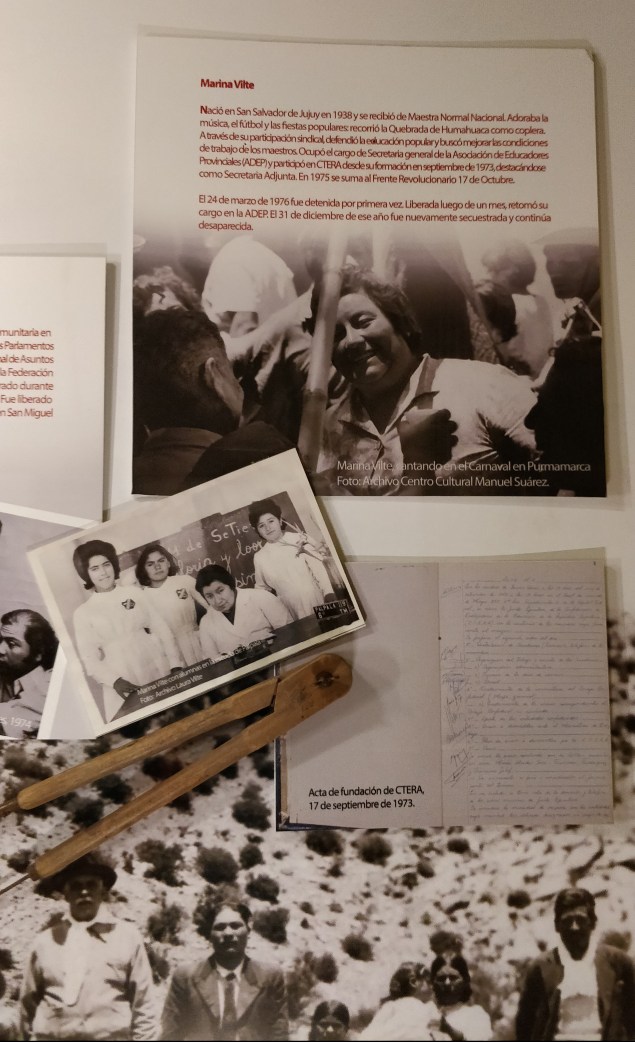
It will come as no surprise that Native rights and labor organizers ran afoul of the dictatorship.
On the left, Mapuche politician and activist Abelardo Coifin, died in internal exile. On the right, Mapuche activist Celestino Aigo, disappeared by the military in 1976.Marina Vilte, teacher and labor leader, disappeared by the military in 1976.
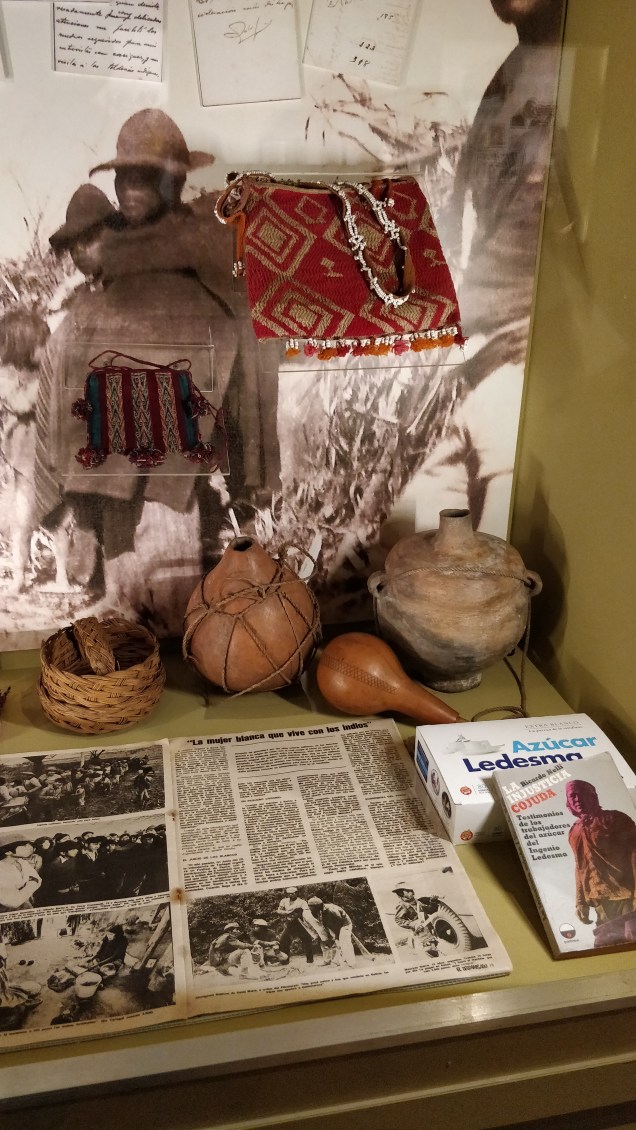
The exhibition includes information on how the sugar mills (having been the beneficiaries of military muscle keeping workers in check and working for decades) would act as agents of the dictatorship, informing on workers and allow their land to be used for clandestine detention centers. One company’s own vehicles detained over 400 activists, 30 of which were never seen again.
The company was Ledesma, which is still a major producer today.
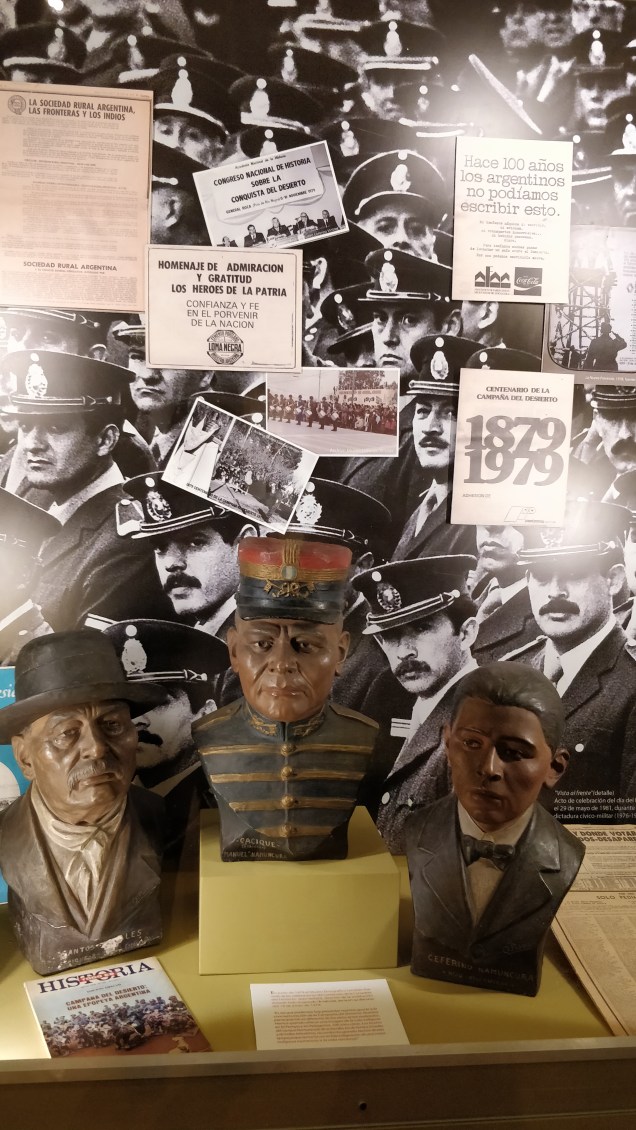
The exhibit also examines the museum’s own contribution to the erasure of Native cultures during the dictatorship, which celebrated the “Centenary of the Conquest of the Desert” in 1979, which could more accurately be characterized as the centenary of the genocide of the Native peoples. So, sure, parade time.
The busts of Native chiefs were displayed, meant to “remind us of the great facts of this epic that concluded with the happy integration of a numerous mass of indigenous peoples into the national life” are actual words that fell out of the museum director’s mouth in 1979.
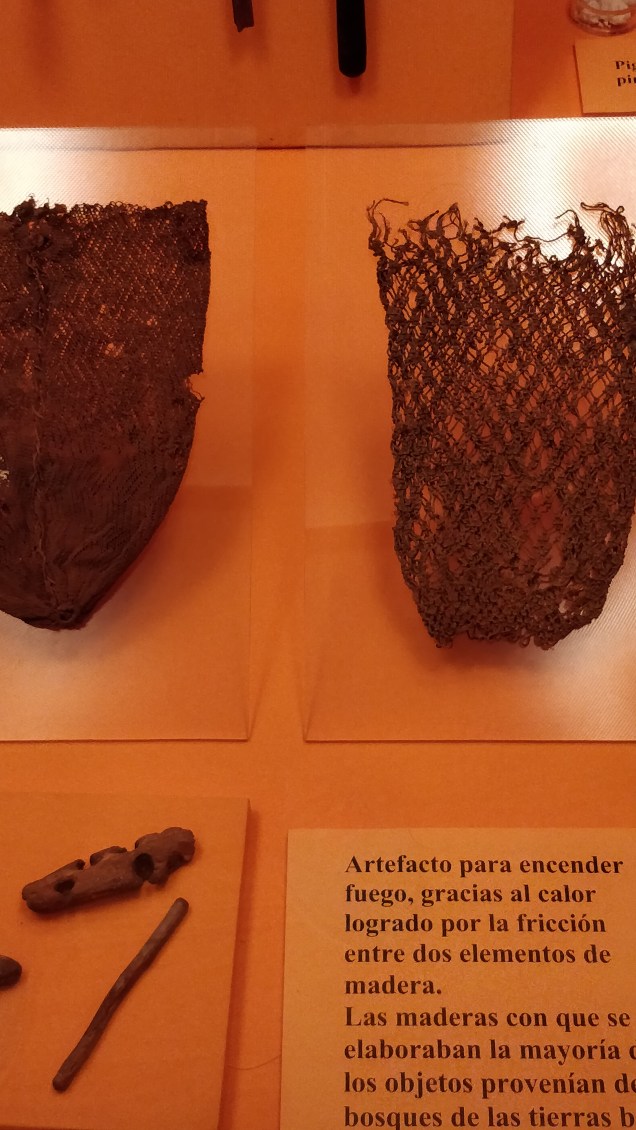
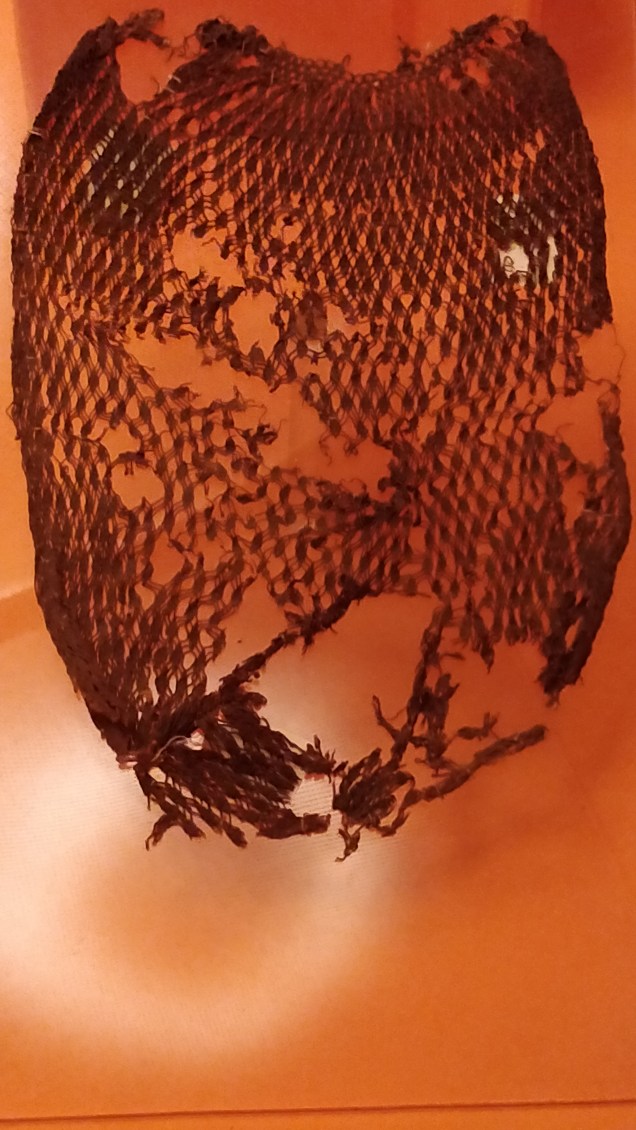
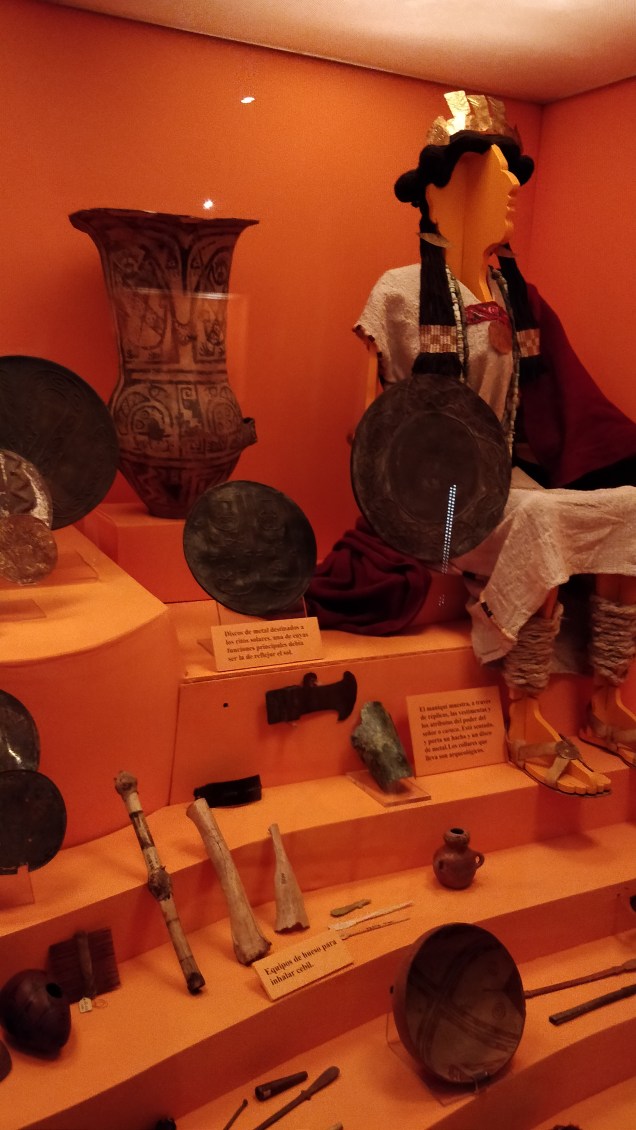
Let’s take a gander at the artifacts that live upstairs, and channel our inner (or outer) textile nerds.
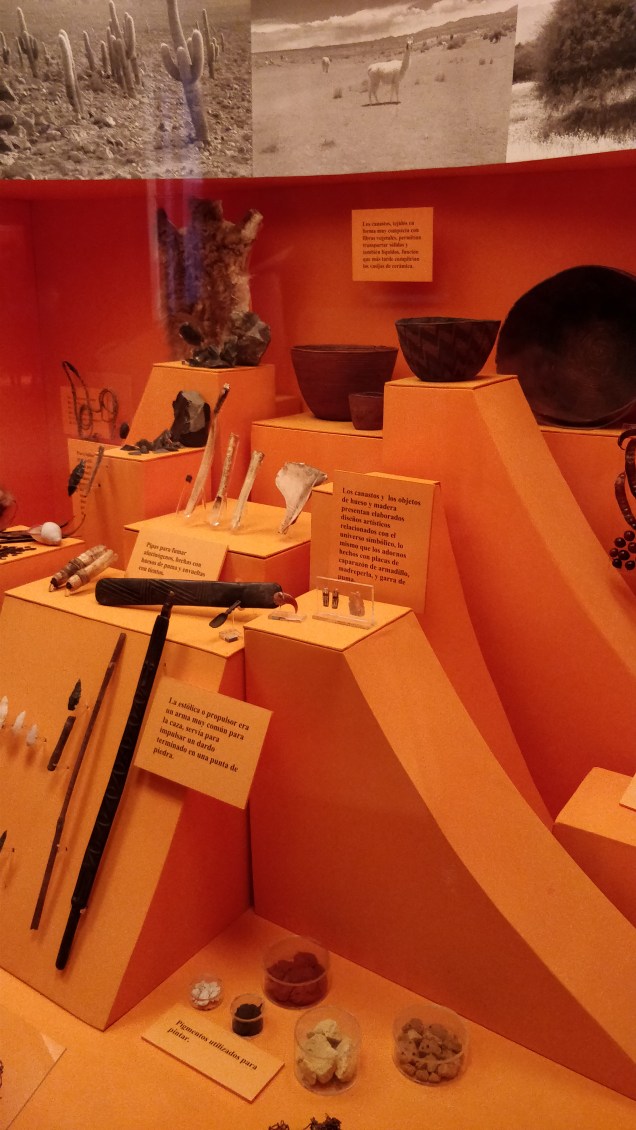
This exhibit covers a lot of ground and A LOT of time, there was an entire class of children occupying a large part of the room (and I never, ever begrudge children their space in learning institutions–I just didn’t get to the more recent artifacts because their activity was taking up a lot of floor space, but they were really engaged and two thumbs way up to the museum for having a hands-on activity for them), and my dinky little minor in anthropology did not equip me for being a great source on pre-Colombian history, so let’s hit this in broad strokes.
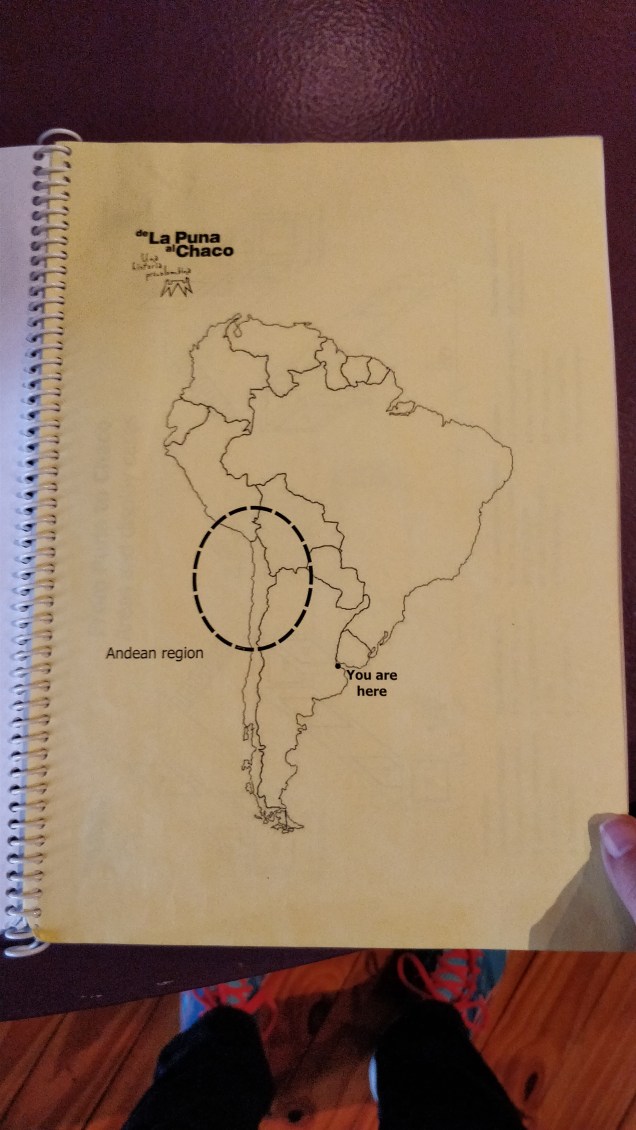
Here’s the region we’re looking at:
The English guidebook has got my back.
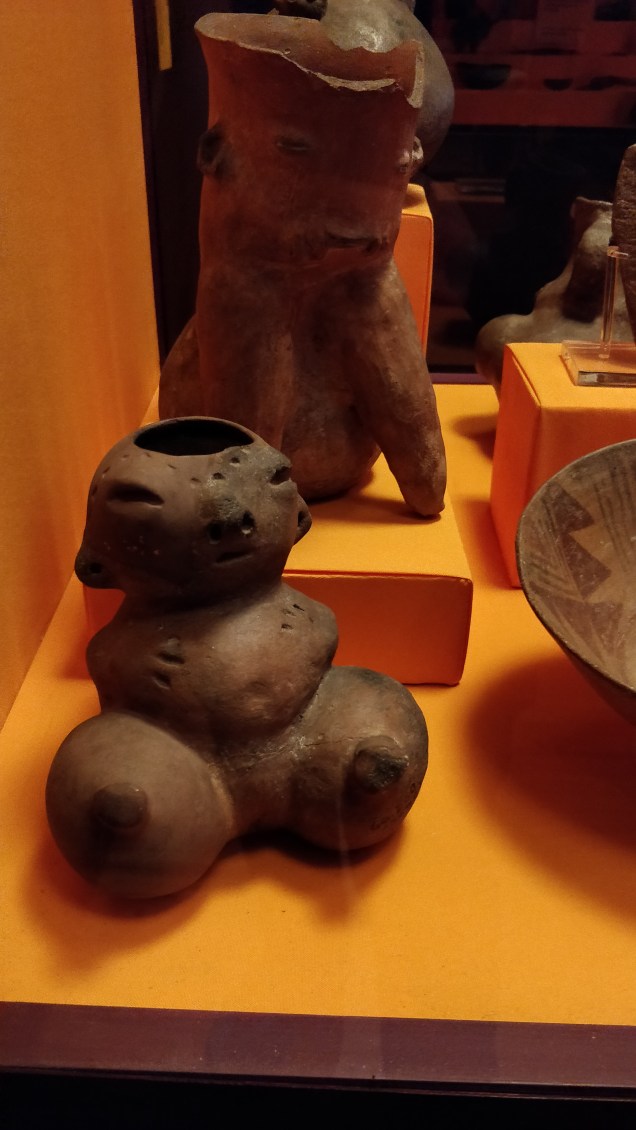
The exhibit covers about 4000 years of cultural development in the region (following roughly 6000 years of hunter-gatherer societies), beginning with the earliest domestication of crops and animals.
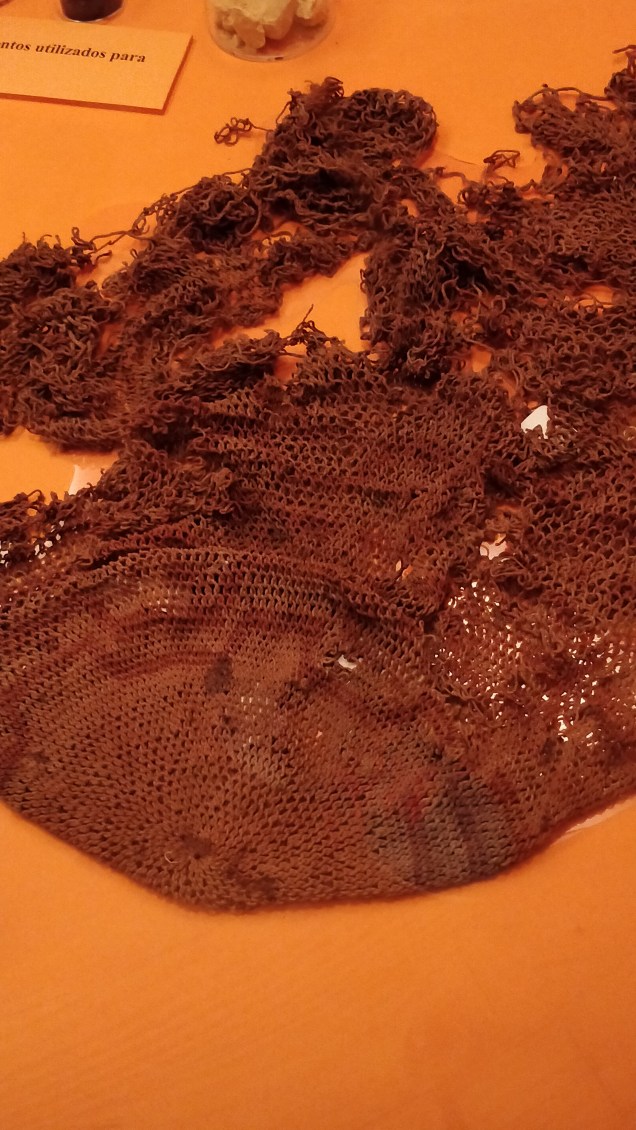
You can still see the colorwork!How gorgeous are those stitch patterns?!
It would have been very nice to have more information about each object, such as their ages and sources.
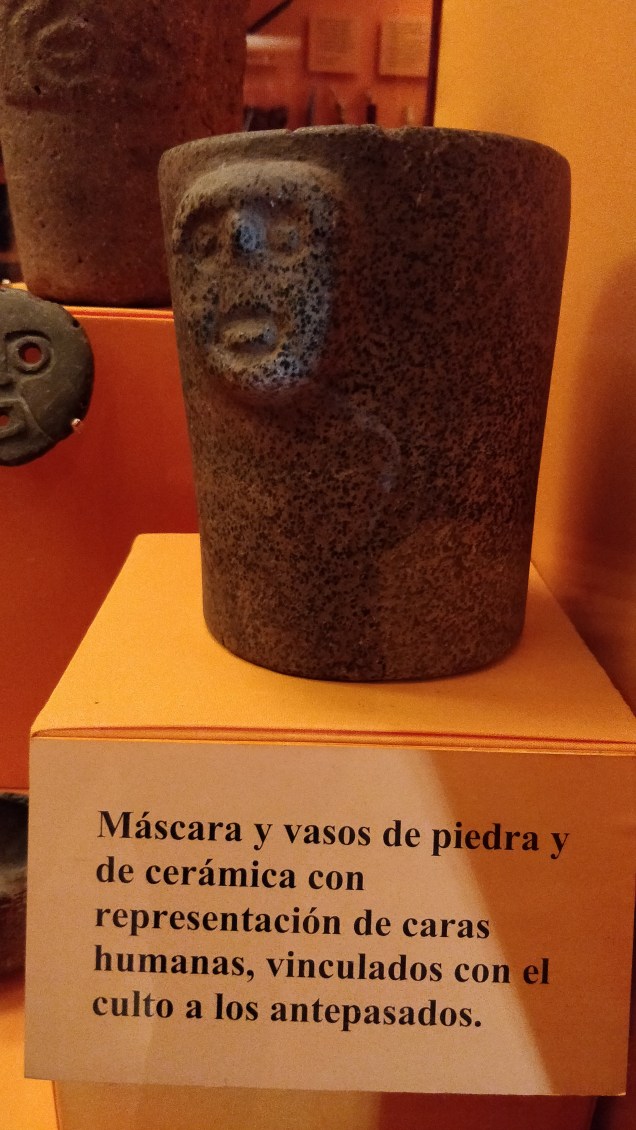
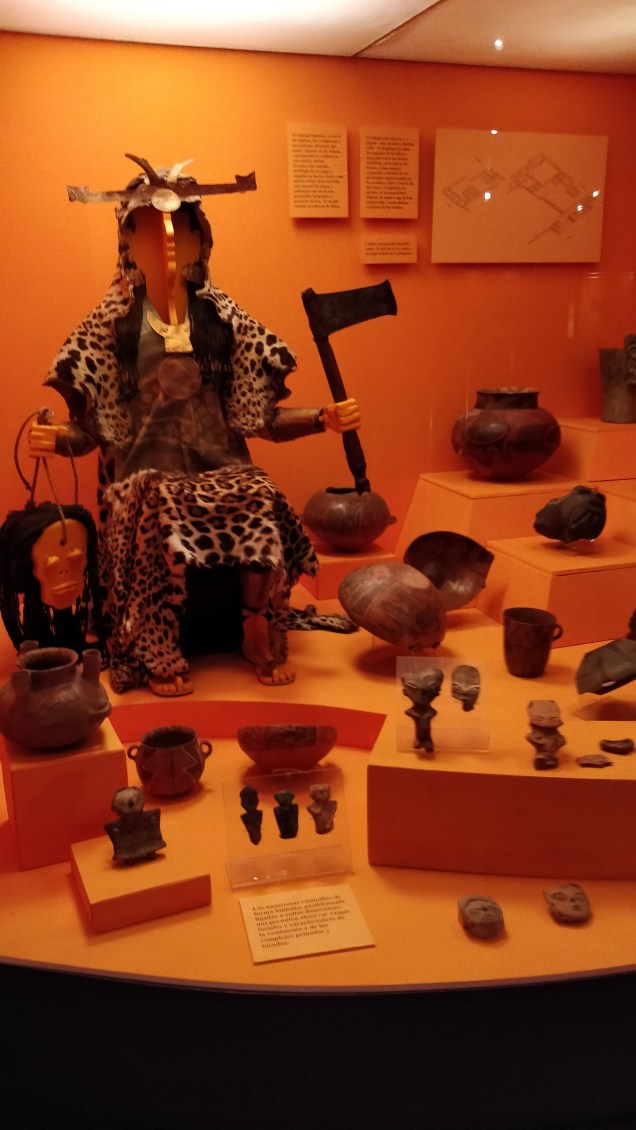
As things settled into the first millennium CE, society got less egalitarian and chiefdoms formed. Power became hereditary and ancestor worship was socially important.
Along with the integration of groups into a large political entity came more defined social stratification and a centralization of power and activity.
Also human sacrifice happened.
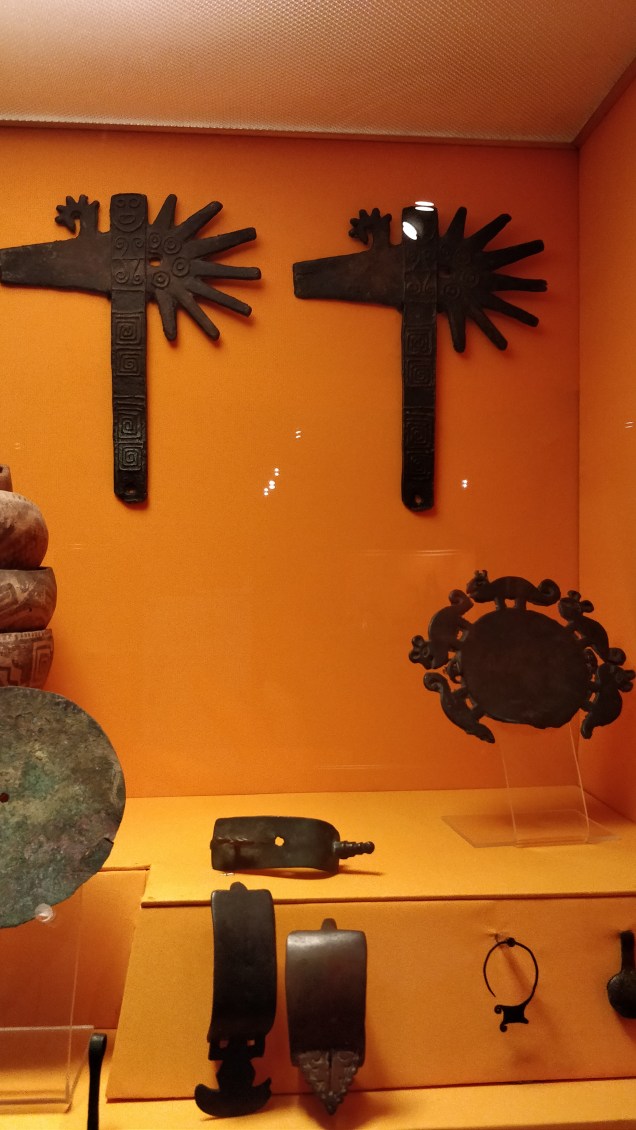
But nevermind the increasing sophistication of craftsmanship, particularly metalworking, and restricted luxury goods that signified social status, let’s get back to the textiles.
Aw, yeah.
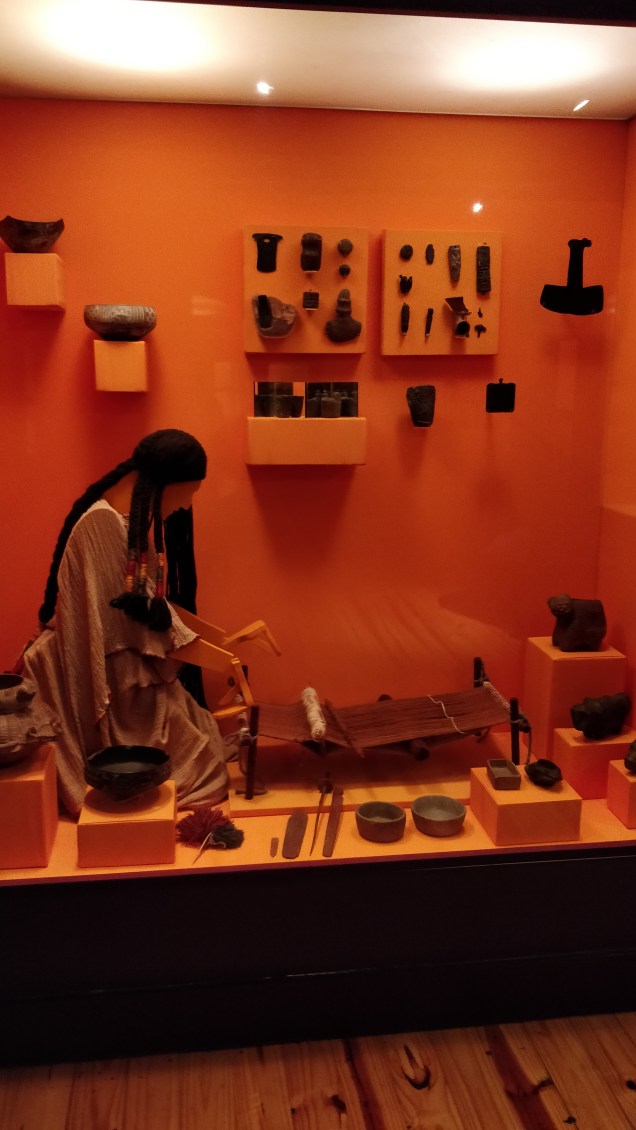
The loom comes into use, and surviving textiles show that weavers developed into specialized master craftspeople, just as the metalworkers and ceramics makers did.
Of course, everything goes to hell when the Europeans arrive, as it does. That was the area that the school children were working in, so I didn’t get photos over there.
The exhibition room is large, and there are a lot of stairs, but they’ve used the space well. Old houses present a lot of challenges when they’re used as public institutions, and they’ve done a nice job with this one. If steps are an issue for you, be aware that there are lots.
There’s more to see at the Ethnographic Museum, which is open Tuesday through Friday from 1pm to 7pm and 3pm to 7pm on weekends (closed Monday). There’s a small shop if you’d like to support the museum by upping your swag game. Admission is 40 pesos (about a US dollar currently), and it’s super easy to get to on subway lines D, A, and E and tons of buses.


























 The Exhibitist